Al-Hawilli: Hosting and integrating recovered addicts into society
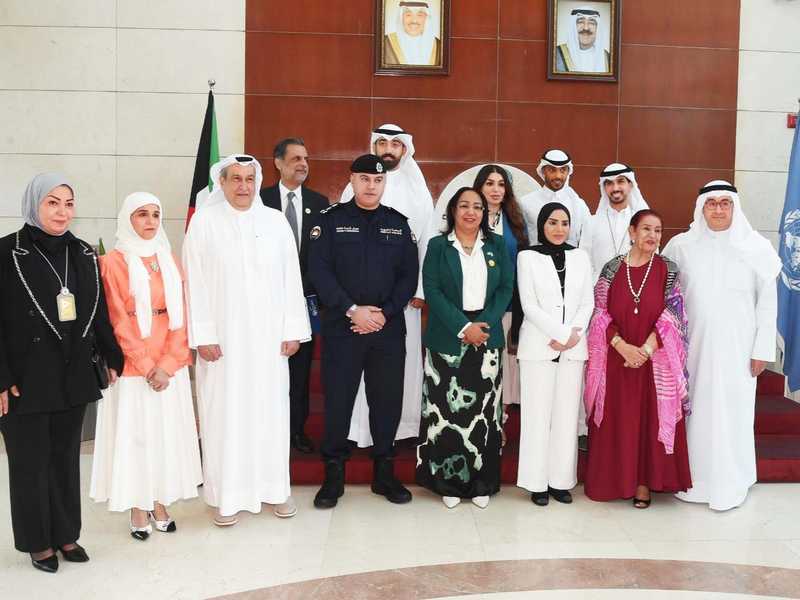
Maysa Al-Suqair: Dr. Amthal Al-Huwail, Minister of Social Affairs, Family, and Children’s Issues, emphasized the importance of integrating the roles of government entities, international organizations, the private sector, and civil society institutions, affirming that cooperation is the cornerstone for achieving sustainable development. This statement was made during a press conference marking the launch of the “Taaafi” initiative at the United Nations House in Mishref. The initiative is implemented by the Human Building Association for Social Development under the umbrella of the Ministry of Social Affairs, in partnership with the United Nations and with support from the Kuwait Fund for Arab Economic Development, and involves participation from various government and international entities, as part of national efforts aimed at empowering and reintegrating individuals recovering from addiction.
Dr. Al-Huwail affirmed that the Ministry of Social Affairs believes every person deserves a new opportunity, and that empowering, supporting, and reintegrating individuals recovering from addiction constitutes a national and humanitarian responsibility that contributes to building a more stable and cohesive society, offering hope to all seeking a fresh start. She stressed that the “Taaafi” initiative is one of the national efforts aimed at supporting and empowering individuals in recovery to regain their active role in society by providing an integrated system of care, rehabilitation, and empowerment, thereby enhancing opportunities for integration, stability, and productivity. She added that the initiative embodies Kuwait’s conviction that true investment begins with human capital, and that recovery is only complete through comprehensive services encompassing health, psychological, and social care, alongside rehabilitation, training, and economic empowerment programs, enabling individuals in recovery to return to society as productive and active members.
Dr. Al-Huwail also expressed her sincere appreciation to the Kuwait Fund for Arab Economic Development, the United Nations and its specialized agencies, the Human Building Association for Social Development, and all government and private entities that contributed to the preparation and implementation of the initiative, commending their efforts in supporting collaborative work to serve humanity.
On public health, Dr. Asad Hafeez, Representative of the World Health Organization (WHO) in Kuwait, affirmed that substance use disorders are a public health issue requiring a comprehensive response that extends beyond prevention and treatment to include rehabilitation, recovery, and social reintegration. He noted that true recovery involves empowering individuals to rebuild their lives, regain their independence, and actively participate in their families and communities. Dr. Hafeez stated, “The initiative represents an important model for supporting individuals in recovery by helping them acquire new skills and creating employment opportunities, thereby providing a suitable environment for achieving sustainable recovery and genuine social integration.”
For her part, Ghada Al-Tajer, Representative of the UN Secretary-General and UN Resident Coordinator in Kuwait, affirmed that the “Taaafi” initiative exemplifies strategic partnership between the Ministry of Social Affairs, Family, and Children’s Issues and the United Nations, supported by the Kuwait Fund for Arab Economic Development and implemented by the Human Building Association for Social Development. This reflects the integration of national and international efforts to serve humanity and promote sustainable development. Al-Tajer stated, “Kuwait continues to consolidate its position as a model in supporting humanitarian and social work. Cooperation among government entities, international organizations, civil society institutions, and the private sector constitutes a fundamental pillar for achieving social justice and sustainable development.”
