Head of the International Organization for Migration Mission to Al-Qabas: Kuwait supported millions affected by conflicts and disasters
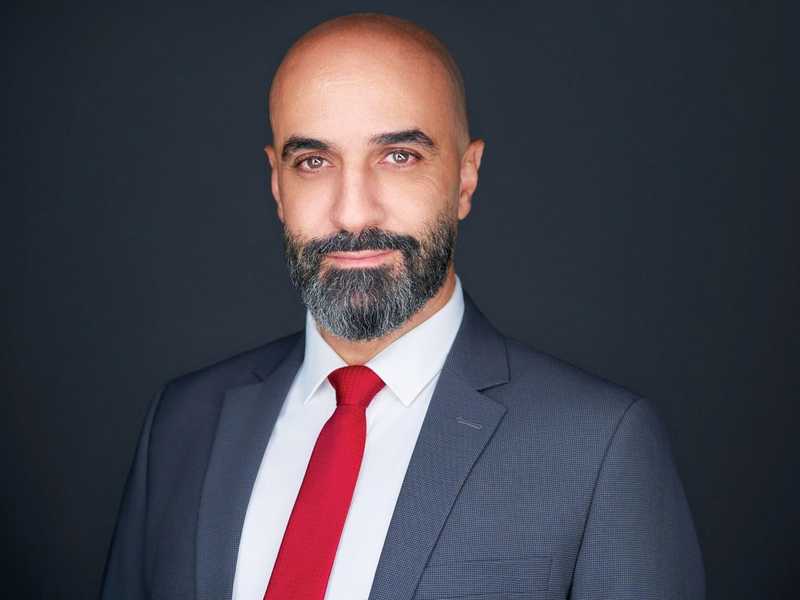
May Al-Sukari: Mazen Abu Al-Hassan, Head of the International Organization for Migration (IOM) mission in Kuwait, affirmed that Kuwait is a strategic partner for the organization at both the regional and international levels. He noted that the partnership between the two sides has evolved over many years of close cooperation and mutual trust, contributing to the implementation of humanitarian and developmental initiatives within Kuwait and abroad, as well as supporting efforts to develop immigration management and protect migrant workers, and aiding millions affected by conflicts and disasters worldwide.
In a special interview with Al-Qabas, marking the end of his six-year tenure in the country, Abu Al-Hassan revealed that Kuwait has provided approximately $75 million over the past 15 years to support IOM programs in Syria, Turkey, Afghanistan, Ukraine, Yemen, and other countries. He emphasized that this support reflects a consistent Kuwaiti approach to humanitarian action, rather than mere financial contributions. He added that the organization looks forward to launching new initiatives that support Kuwait’s priorities and the “Kuwait 2035” vision, enhancing its leading role in humanitarian work, development, and international cooperation.
He noted that the IOM has worked with the Ministries of Foreign Affairs and Interior, the Public Authority for Manpower, the Kuwait Fund for Arab Economic Development, and several other national entities to implement programs with tangible impact, whether in supporting humanitarian responses to crisis-affected countries or in building institutional capacity and enhancing the management of migrant labor issues within Kuwait.
He highlighted that the most significant achievement during his tenure as head of the mission was expanding the partnership between the IOM and Kuwait in the humanitarian and developmental fields through joint projects with the Ministry of Foreign Affairs and the Kuwait Fund for Arab Economic Development to support those affected in several countries facing humanitarian crises. He also pointed to cooperation with national partners to combat human trafficking through capacity-building programs and institutional collaboration. He considered it equally important that the IOM office in Kuwait has solidified its position as a trusted partner for the government, national institutions, the private sector, universities, and diplomatic missions, despite the office’s limited size compared to the wide range of files it handles.
Abu Al-Hassan stressed that Kuwait possesses extensive experience in immigration management, given its labor market’s reliance on migrant workers in many sectors. He identified key strengths as the presence of specialized national institutions and a continuous will to develop legislation and policies in line with economic and social changes. He added that recent years have seen positive steps to enhance labor market management, protect migrant workers, and combat human trafficking, reflecting a clear commitment to continuing reforms and development.
He viewed future priorities as focusing on enhancing the use of data to predict labor market needs and developing mechanisms to prevent exploitation. He noted that any regional escalation could alter migration patterns and the return of migrant workers. He emphasized that labor markets in the region and globally are undergoing rapid transformations due to digitalization, changing skill requirements, and demographic challenges, making labor recruitment systems in need of continuous updating.
He clarified that reform does not mean replacing existing systems, but rather developing them and linking them more closely to actual labor market needs, promoting ethical recruitment practices, expanding digital transformation, and developing dispute resolution mechanisms, alongside strengthening bilateral agreements with countries of origin, including pre-departure training, skills recognition, and post-arrival follow-up.
Abu Al-Hassan believed that balancing the needs of large developmental projects with the rights of migrant workers begins with planning based on labor market data, pre-identifying required skills, adopting fair and transparent recruitment channels, and strengthening partnerships with countries of origin. He stressed the importance of providing a decent working environment, including occupational safety, adequate housing, and effective mechanisms for handling complaints and resolving disputes, emphasizing that the private sector and employers play a pivotal role in ensuring respect for workers’ rights. He stated that protecting workers’ rights is not a burden on the economy, but an investment that boosts productivity, reduces conflicts, and enhances project quality and the reputation of the labor market.
Regarding his assessment of the level of migrant rights protection in Kuwait, Abu Al-Hassan affirmed that the country has made notable progress in enhancing the protection of migrant workers through the development of legislation and procedures regulating the labor market, strengthening dispute resolution mechanisms, and expanding multilingual awareness campaigns in partnership with the Public Authority for Manpower, embassies, communities, and the labor union. He indicated that areas for further development still include preventing wage delays, prohibiting the retention of passports, and enhancing workers’ access to accurate information, services, and secure complaint channels.
He explained that most cases reported to the IOM are not linked to a specific nationality, but rather revolve around understanding rights and legal procedures, changing employers, official documents, and labor entitlements.
When asked whether the organization has identified networks or recruitment offices exploiting migrant workers and how it coordinates with Kuwaiti authorities to counter them, Abu Al-Hassan affirmed that the IOM is not a supervisory or law enforcement body; its role is limited to supporting prevention, capacity building, providing technical advice, and promoting ethical recruitment. He added that any indicators of exploitative practices are handled by the relevant national authorities, primarily the Public Authority for Manpower, within the framework of applicable laws.
He confirmed that Kuwait has made significant progress in combating human trafficking by strengthening the legal framework, implementing the Anti-Trafficking in Persons and Smuggling of Migrants Law, issuing the new Law on the Residency of Foreigners, and adopting the National Strategy to Combat Human Trafficking and Smuggling of Migrants for the period 2025–2028.
A New Station in Riyadh: Abu Al-Hassan revealed that after completing his mission in Kuwait, he will move to the Saudi capital, Riyadh, to take on new responsibilities within the IOM. He expressed his happiness at continuing his work in the region and utilizing the expertise he gained during his years in Kuwait. He affirmed that Kuwait will remain present in his professional and personal journey, given the successes and human and professional relationships he cherishes.
New Mission Head: Abu Al-Hassan announced that a new head has been selected for the IOM mission in Kuwait and is expected to assume duties in early August. He expressed confidence in the continuation of the strong partnership between the organization and Kuwait, and in continuing joint work in the fields of migration, development, and humanitarian action.
Appreciation for Kuwait: Reflecting on the end of his mission, Abu Al-Hassan said he is leaving Kuwait with deep appreciation for an exceptional professional and humanitarian experience. He added that he will miss the spirit of cooperation he witnessed from various partners, the warmth characteristic of Kuwaiti society, and the human relationships that transcended formal work frameworks. He noted that diwaniyas, especially during Ramadan, were among the experiences that brought him closest to Kuwaiti society and culture, affirming that Kuwait was not just a work station, but a rich experience of partnership, trust, learning, and professional and human growth.
