"It's You"… When Authentic Art Prevails
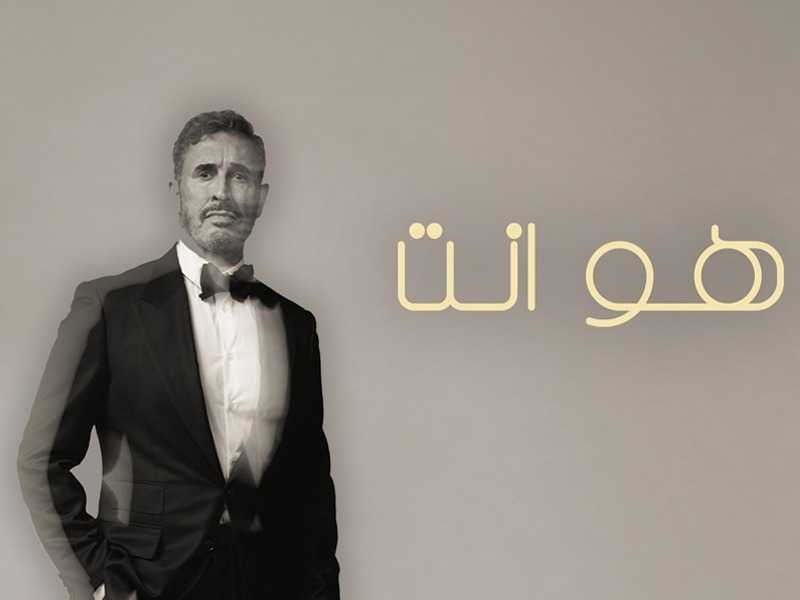
Amjad Jamal’s “Huwa Inta” (It’s You) is Kaziem Al-Saher’s third release, continuing to shake up the artistic scene ahead of his anticipated album, which will be entirely dedicated to the Iraqi dialect. In this project, the “Caesar” renews his collaboration with poet Aziz Al-Rasam after a hiatus of more than two decades. This move is not driven by nostalgia alone but is part of a grand artistic project that reintroduces the Iraqi roots that shaped his original identity, presenting them in a simpler, more fluid style suited to the tastes of new generations, without compromising their poetic depth or authenticity. It is a return to the school that produced timeless works such as “I Crossed the River on Your Modak” and “No, My Friend,” and played a key role in solidifying Al-Saher’s status across the Arab world since the late 1980s and early 1990s. This return confirms that simplification in Kaziem Al-Saher’s work is not synonymous with concession or dilution, but rather a capacity to reframe lyrical heritage in a smoother language while preserving its spirit and identity. Thus, the new collaboration with Aziz Al-Rasam appears as a natural extension of a career that began decades ago, drawing on Al-Saher’s artistic roots to present them through a contemporary vision that makes this heritage more accessible to new generations without losing its value or authentic features.
**Dissecting Betrayal and the Shock of Return**
The poetic text by Aziz Al-Rasam is based on a confrontation scene between the singer and a lover who returns too late. Al-Rasam employs rhetorical repetition in the opening lines: “It’s you who started my story with him… It’s you who made my eyes shed tears.” This repetition of the phrase “It’s you” reveals the contradiction in the position of the rival, who was once a source of security but has now become a source of pain. Iraqi folk metaphors reach their peak in the line: “Where is your love when I fell and my state collapsed?” representing the highest degree of emotional and physical exhaustion. Al-Rasam follows this with another comparison between generosity and ingratitude: “This is the state of the flame toward its friends, a candle… This is the state of one who does not know his quarter in hardship.” This frames the relationship between a lover who melts to illuminate others and a treacherous party that violates the principles of loyalty and “al-Rub’ah” (a traditional support system) during times of hardship.
Because the text carries the pride of the Iraqi spirit, it does not wallow in sadness. Instead, in its middle section, it shifts to hinting at revenge through poetic justice or “karma”: “Whoever oppresses will be oppressed… Whoever deprives will be deprived… Whoever does not show mercy for tears, his concern will be shown mercy.” In this section, the rhythm flows with sharp rhyming and passive verbs, indirectly threatening the inevitability of restoring honor and ending injustice.
**Genius in Melody and Music**
The genius of this work lies in the melody and music, which appeal to both the new and old generations. Al-Saher composed a melody that breathes with the text, transforming with it at every dramatic turn, so that the music becomes a partner in the narrative rather than merely a backdrop. The work begins with a gentle introduction in the Kurd maqam on the note of Sol, blending Al-Saher’s hums with the ney’s playing in a highly poetic musical scene. This serves as the narrator, opening the doors of the story as if whispering to the listener, “Once upon a time,” before the lyrical narrative begins. From that moment, the melody cleverly oscillates between anticipation, challenge, and heartbreak, precisely embodying the psychological and dramatic shifts in the confrontation between the lover and his rival. The coherent melodic structure proves Al-Saher’s rare ability to transform words into scenes and scenes into vibrant music.
The Kurd maqam continues in the chorus (“It’s you…”), maintaining a balanced state of melancholy, with a brief reference to the Ajam maqam in the line “You came suddenly in Musayyib.” The melodic phrases move toward a more mournful and expressive performance space in the couplet endings, especially at “O my early days” and “My state,” where the melody leaves Al-Saher’s voice ample room for emotion, confirming that the Caesar’s voice has not lost its brilliance.
With the start of the second couplet, the most prominent dramatic transformation occurs. The melody shifts to the Hijaz maqam on the note of Sol at the phrase “Whoever oppresses will be oppressed.” This is a calculated transition, as the Hijaz maqam naturally carries a spiritual and religious character, giving the words a feeling closer to preaching and awe while hinting at karma. The performance reaches its peak in this section, where Al-Saher envelops it in that warm sensation that has been one of his most prominent vocal signatures for decades.
The musical discourse then softens, moving into a zone of melancholy with a brief transition to the Bayat maqam in the phrase “You said I was harsh,” where the melody replaces the tone of preaching with one closer to reproach. The Caesar does not stop at these melodic shifts; he also moves to the Nikriz maqam on the note of Fa in the line “And now you changed and came,” then concludes the section with an exciting, uplifting crescendo that confirms time has not diminished his voice but has added maturity to it. He then closes the circle by returning to the Kurd maqam in “It’s you…,” as if the music has returned to the starting point, confirming the stability of the song’s protagonist in his stance and his refusal to retreat before the pleas of the rival who returned after betrayal. These maqam transitions are part of the song’s dramatic structure; each maqam appears in its psychological place, and each transition accompanies a feeling within the protagonist, confirming that Kaziem Al-Saher still belongs to a generation that believes musical maqamat are a narrative element, not mere decoration.
**Rescue from “Plastic Music”**
Musically, “It’s You” arrives at a time when the musical scene suffers from the dominance of music created via artificial intelligence tools. Here, Al-Saher specifically reaffirms his steadfastness to the living classical school that upholds the values of the human musician and authenticity. In the work, which was musically arranged by “Mahboub Al-Rawi” under Al-Saher’s vision, one does not find dry programmed strings or copied plastic rhythms. Instead, one hears and experiences the vitality of live music: the strings of the oud and qanun, mournful Eastern strings, ney sighs, and the harmony of classical guitars with Eastern rhythms and Iraqi rumbas, all played by human musicians who pulse with every lyrical line—a rarity today.
**The Bet on Authenticity**
“It’s You” comes to confirm for the third time that Kaziem Al-Saher’s return to his native dialect is a return to the source of true spirit; a return to early companions like Aziz Al-Rasam, and a steadfast commitment to live instruments and the honest human musician in an era of manipulation and ease.
