"The Fifth Survived": A Narrative Documenting Human Suffering Amid Rubble and Memory
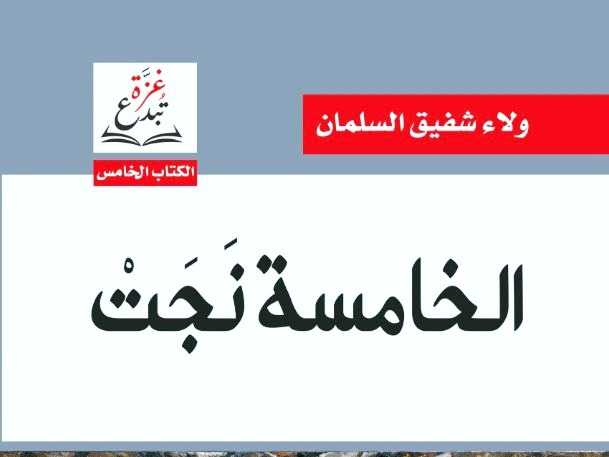
Palestinian writer Walaa Shafiq Al-Salman, residing in Gaza, presents in her novel *The Fifth Survived* a literary testimony pulsating with the pain of the Palestinian people. In the work, the details of daily life during wartime become narrative material that reveals the depth of the tragedy; from the fear of taking shelter under a roof, to hunger and the pursuit of humanitarian aid, culminating in a redefinition of survival, which is no longer the end of danger, but the beginning of another form of suffering. Published by Al-An Publishers and Distributors as part of the “Gaza Creates” initiative, the novel employs a dense narrative language that combines precise description with psychological depth, successfully rendering visual and human scenes that place the reader at the heart of the experience.
In his introduction to the work, Moroccan critic Seddik Nour Eddine notes that Al-Salman chose a clear and direct language, yet one saturated with literary imagery and psychological connotations. He further points out her use of the “novel within a novel” technique, where two narrative levels intersect, united by a single axis: the war on Gaza. The novel’s events unfold in the Gaza Strip during the years of war, opening with a world dominated by rubble, fear, and the memory of loss. Through this atmosphere, the author seeks to transform the harsh human experience into a literary text that touches upon pain and grants the testimony a creative dimension that transcends direct documentation.
Nour Eddine describes the novel as revealing a clear artistic ability in constructing and shaping the text, highlighting the author’s success in moving beyond traditional narrative structures by blending diaries, messages, and live testimonies. This approach allowed her to innovate a narrative form that aligns with the harshness of the experience she conveys. In his view, the novel does not offer artificial heroism; rather, it approaches the anatomy of a memory weighed down by war, recalling its profound effects on the human psyche. From the outset, the novel relies less on plot than on the impact of war on the soul, drawing closer to a space of confessions and personal testimonies. It invites the reader to move from a world of safety to a reality where life is shattered, emphasizing that what lies between its pages is merely a muted image of a harsher reality endured by civilians in Gaza.
Spanning approximately 250 pages, the novel abounds with moving human scenes that embody the transformations imposed by war on the details of daily life. In one passage, the author paints a picture of a child no older than five, walking barefoot, clutching a stale loaf of bread stained with old blood, while his eyes remain tearless, as if war had even stripped him of the ability to cry. Through this scene, the novel observes how Gaza’s childhood—once filled with dreams of school and play—has been replaced by the daily struggle for sustenance and aid, turning the schoolbag into a symbol of childhood stolen before it could be completed.
In another narrative strand, the novel takes a deeper psychological turn through the character of Laili, who turns to writing not merely as a novelist, but as a means of escaping her internal collapse. She says, “I emerged from the rubble with a body half alive and half a grave,” a phrase that encapsulates the philosophy of the entire work. Here, survival appears as the beginning of a new struggle with memory, nightmares, and successive losses, rather than as a final salvation.
The novel also addresses the strained relationship between survivors and their place. When Laili enters a tent housing a family, she is overcome by fear of the roof, as it reminds her of the first structure that collapsed on her during the shelling. She prefers to sleep outdoors under the open sky, as roofs in her consciousness have become symbols of death rather than protection. These details reveal the deep psychological transformations imposed by war, even on the simplest aspects of daily life.
Scenes of bombing and destruction do not disappear from the novel’s pages; they are presented in a painful poetic language, particularly in passages describing air raids targeting displaced persons’ tents, burying their victims deep underground without trace, farewell, or graves to visit. In other places, the author imbues the setting with symbolic weight, as if the earth itself is exhausted by death and can no longer contain more victims.
At the same time, the novel retains its documentary dimension. The author emphasizes in the dedication and introduction that she wrote this work for those who experienced the war with their bodies, not through news broadcasts; for mothers who waited for their children in front of homes that no longer stand; and for children who learned the sounds of missiles before they learned their first words. Thus, *The Fifth Survived* transcends the boundaries of traditional fiction, becoming a human testimony that preserves memory from oblivion and translates the war from the language of numbers and news headlines into the language of humans who experienced fear, loss, and waiting.
The novel concludes with a central idea: survival is not the end of the tragedy, but the beginning of another war waged by survivors against their memories and the images of loss that never leave them. This makes the work closer to literature of live testimony than to classical fiction, in an attempt to document one of the most painful chapters in contemporary Palestinian history.
The novel is part of the “Gaza Creates” initiative launched by Al-An Publishers and Distributors in the Jordanian capital, Amman. The initiative aims to publish literary works by writers from the Gaza Strip, conveying the Palestinian experience through the eyes of its protagonists and documenting it from within the suffering. In a press statement, the publisher affirmed that the initiative responds to the need to amplify the voices of creators in Gaza amid the exceptional circumstances they endure, driven by the belief that words may remain the last open window when all other doors are closed.
