"The Electricity Authority": Brilliant efforts in service of the nation
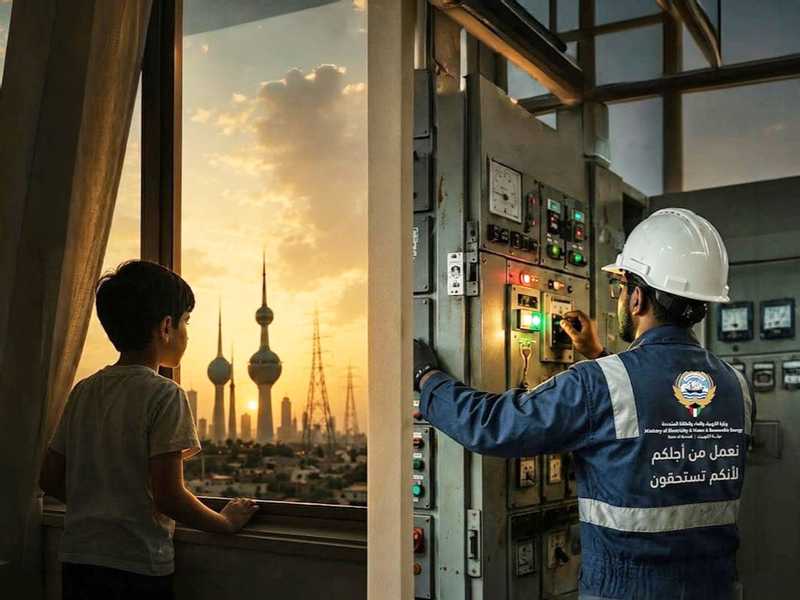
Faisal Matar – In response to the brutal Iranian aggression and the targeting of “rockets and drones of evil and destruction” against service and civilian facilities, the technical teams and emergency units affiliated with the Ministry of Electricity, Water, and Renewable Energy have doubled their efforts and readiness to deal with this repeated aggression against power stations and water desalination plants. They are working to repair damages and return affected units to service as quickly as possible, while maintaining the stability of the electrical grid.
The renewed attack on Sunday, July 19, added a new fire to the series of damages caused by Iranian attacks over the past few days. The Ministry of Electricity, Water, and Renewable Energy announced that a power and desalination station was targeted in the second attack within two days, resulting in a fire in some of its facilities and affecting a large number of electricity generation units.
Targeting these stations was not an isolated incident; attacks on electricity and desalination infrastructure repeated over a short period, revealing the nature of the targets chosen by Iranian rockets and drones. The targeted sites are not military camps or combat facilities, but civilian infrastructure that produces electricity and water, securing basic needs for the population. Some of these sites were attacked more than once in recent days.
The true objective of Iran’s aggression requires little explanation. When electricity generation units and water desalination facilities are bombed in the peak of summer, and production units are taken out of service due to the attacks, the impact directly affects the network’s ability to meet high demand, as well as efforts to secure water and energy for millions of citizens and residents. Thus, Tehran’s claims of targeting military sites collapse in the face of images of fires inside power and desalination stations, and of emergency and firefighting teams racing against time to protect facilities and return affected units to service. The aggression does not face military force; rather, it threatens the population’s right to lighting, cooling, and water, attempting to pressure the basic services system amid extreme summer heat.
Following the repeated attacks, the General Fire Force teams immediately intervened to control and extinguish the fires. Meanwhile, technical teams and emergency units from the Ministry of Electricity, in coordination with security authorities, implemented necessary technical and precautionary measures to secure the station, assess damages, and mitigate the incident’s impact on the stability of the electrical grid. Technical teams continued working around the clock to return affected units to service as soon as possible, monitoring network indicators and taking necessary measures to ensure service continuity.
This highlights the resilience of workers in the electricity and water sector, who operate amidst the aftermath of aggression and fires, in high temperatures, repairing damages and maintaining the stability of a network that cannot tolerate delays. Technical challenges are compounded by other network failures not directly linked to the attacks. Two feeders from the main Hittin “H” substation went out of service due to a technical fault, causing power outages in a limited part of Hittin areas 2 and 4.
Emergency teams from the Ministry arrived at the site to restore power as quickly as possible. At the same time, technical staff efforts were distributed between addressing routine operational faults and repairing damages to production units and stations caused by Iranian attacks.
Amid this pressure, the home front did not remain passive. Citizens, residents, and the private sector responded to the Ministry of Electricity’s calls to conserve energy, especially during the peak period from 11:00 a.m. to 5:00 p.m., when loads rise due to intensive use of air conditioning. This public response extended to numerous private shops and facilities that announced suspending operations during peak hours or reducing consumption, in solidarity with the Ministry’s efforts and to help alleviate pressure on the grid. Meanwhile, technical teams continued rehabilitating units damaged or taken out of service due to the attacks.
Conservation has thus transformed from a technical directive into a national stance, involving citizens, residents, and the private sector, supporting workers in power and water stations and bolstering state efforts to protect the stability of basic services and prevent the aggression from achieving its objectives. Between Iranian rockets targeting civilian infrastructure, national cadres entering damaged sites immediately, and a society responding to conservation calls, the image of Kuwait in the face of aggression takes shape: stations under attack, workers restoring them, and a people uniting to protect light and water.
The attack on a power and desalination station is not a military target, as Iran claims, but a war crime and an act of dehumanization. Attacking civilian infrastructure and attempting to strike the lifelines of life, exposing the population to the risk of darkness and water shortages in the peak of summer, constitutes a clear violation of international norms and humanitarian principles.
