Extremist Ben Gvir threatens Asiri with crocodile-enclosed prisons
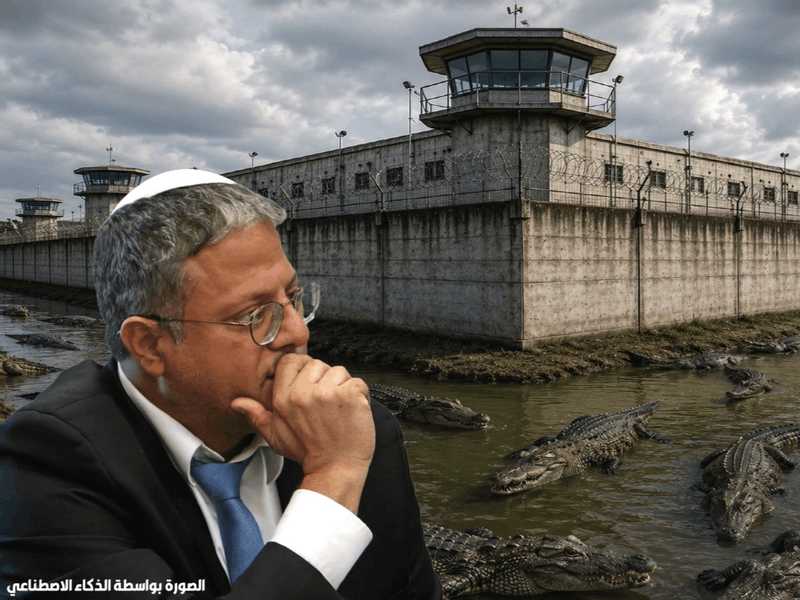
The idea of Israel’s far-right National Security Minister, Itamar Ben-Gvir, which sparked a wave of mockery when first proposed, has moved to the stage of actual implementation. This followed legal groundwork laid by Isr
Translated by Qiyas from القبس — Original source
The idea of Israel’s far-right National Security Minister, Itamar Ben-Gvir, which sparked a wave of mockery when first proposed, has moved to the stage of actual implementation. This followed legal groundwork laid by Israel’s Minister of Environmental Protection, Idit Silman, who cleared the way for the establishment of a high-security prison surrounded by crocodiles. The move has drawn widespread criticism and is seen as a manifestation of policies aimed at intimidation and harshness against Palestinian prisoners.
Channel 13 reported that Silman enacted a legal amendment reclassifying crocodiles from “wild animals” to “farmed wild animals,” thereby legally permitting their transfer to the perimeter of the Negev Prison (Ktzi’ot) in the Negev Desert. This change overcame previous opposition from the Nature and Parks Authority, which had objected to the project based on the earlier classification.
According to the channel, Ben-Gvir first proposed the idea during a meeting held last December with Prison Service Commissioner Kobi Yaakobi, calling for the creation of a high-security prison surrounded by crocodiles to prevent any escape attempts. The proposal did not remain merely theoretical; days later, representatives from the Prison Service conducted a field visit to the “Hamat Gader” resort, which houses the largest crocodile farm in the Zionist entity, to observe handling methods and assess the feasibility of purchasing the animals.
The report states that the cost of a young crocodile is approximately $8,000, while an adult crocodile can cost up to $20,000. Although several senior officials in the Prison Service initially treated the proposal as an unworkable idea, it later evolved into a project under study and advanced toward implementation following the recent legal amendment.
In a message carrying a threatening tone, Ben-Gvir posted a photo of himself alongside a crocodile on his Telegram account, describing the proposal as a “new nightmare” for prisoners.
This development coincides with ongoing criticism of the occupation’s policies within prisons. Latest data from Palestinian prisoner organizations indicate that approximately 9,400 Palestinian and Arab prisoners and detainees are held in Israeli prisons, including 99 women and more than 350 children, as well as 3,244 administrative detainees.
Palestinian organizations emphasize that prisoners are facing extremely difficult humanitarian conditions, including torture, starvation, medical neglect, and solitary confinement. They point out that dozens of prisoners have died in Israeli prisons since the outbreak of the war on the Gaza Strip.
