Dinosaur Skeleton Sold for $50.1 Million
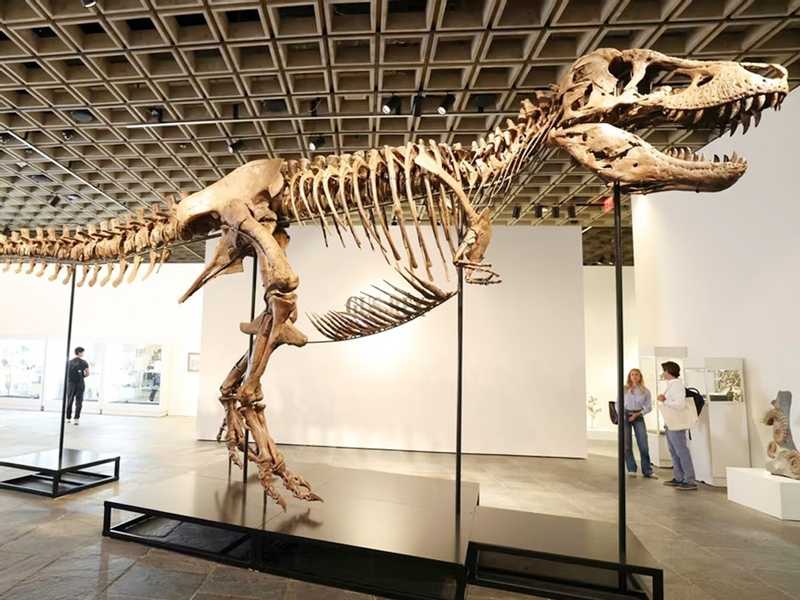
A rare Tyrannosaurus rex fossil skeleton, named “Guss,” set a new record after selling for $50.1 million at a Sotheby’s auction in New York, becoming the most expensive dinosaur skeleton ever sold at public auction. The buyer, who participated by phone, chose to remain anonymous, according to The Associated Press.
“Guss” is one of the largest and most complete known T. rex skeletons, dating back approximately 67 million years. Its sale price surpassed the previous record of around $45 million, set by a Stegosaurus skeleton sold by Sotheby’s in 2024, and exceeded the $32 million achieved by the “Stan” skeleton in 2020.
Cassandra Hatton, Vice President at Sotheby’s, stated that “Guss” represents not only an exceptional discovery but also a rare specimen that underwent excavation, documentation, restoration, and preservation according to the highest standards. She emphasized that the scientific value of such specimens increases when they are preserved with precise scientific rigor.
The bidding for the skeleton lasted approximately ten minutes, involving seven bidders, despite initial estimates placing its value between $20 million and $30 million. During the auction, auctioneer Felicia Cao joked with the audience, saying, “Raise your bids higher… after all, we’re talking about a T. rex!”
The skeleton stands about 3.8 meters tall and measures 11.5 meters in length, making it one of the largest known specimens of this apex predator. It is approximately 61 percent complete, featuring an exceptionally preserved skull, nearly full set of teeth, two well-preserved feet, and several rare bones, including fused clavicles known as the “wishbone.”
Scientists discovered “Guss” in 2021 on a ranch in South Dakota, USA. It was named in honor of landowner Gary Licken, who passed away before the excavation, restoration, and preparation for display were completed—a process that took nearly five years.
Despite the celebration surrounding the sale, the transfer of the fossil to a private owner has raised concerns within the scientific community. The Society of Vertebrate Paleontology has called for “Guss” to be displayed in a museum or research institution, ensuring continued access for researchers and the public, and preventing the scientific community from being denied the opportunity to study one of the most significant T. rex specimens ever found.
Christie K. Rowe, the newly elected president of the Society, expressed hope that the new owner would recognize the fossil’s exceptional scientific and educational value and donate it to a natural history museum, so it could continue to serve science and future generations rather than remain out of reach for researchers.
This is not the first time dinosaur skeletons have become prized possessions attracting collectors and the wealthy worldwide. The “Apex” skeleton, a Stegosaurus that previously held the record, is currently on long-term loan to the American Museum of Natural History in Manhattan. Meanwhile, Chicago’s Field Museum of Natural History displays “Sue,” the first dinosaur sold at a Sotheby’s public auction in 1997. The “Stan” skeleton, which remained the most expensive T. rex sold at auction for years, is now exhibited at the Natural History Museum in Abu Dhabi, where it depicts a dramatic confrontation with another dinosaur atop the remains of a Triceratops.
Tyrannosaurus rex, whose name means “tyrant lizard king,” is one of the most famous creatures that lived during the late Cretaceous period. It reigned at the top of the food chain due to its massive size and powerful jaws. Its presence extends beyond science books and museums, becoming an icon in popular culture—from children’s characters to the “Jurassic Park” film franchise—ensuring that, millions of years later, it remains one of the most captivating dinosaurs in human imagination.
