Proposal to open the central passage in Hormuz
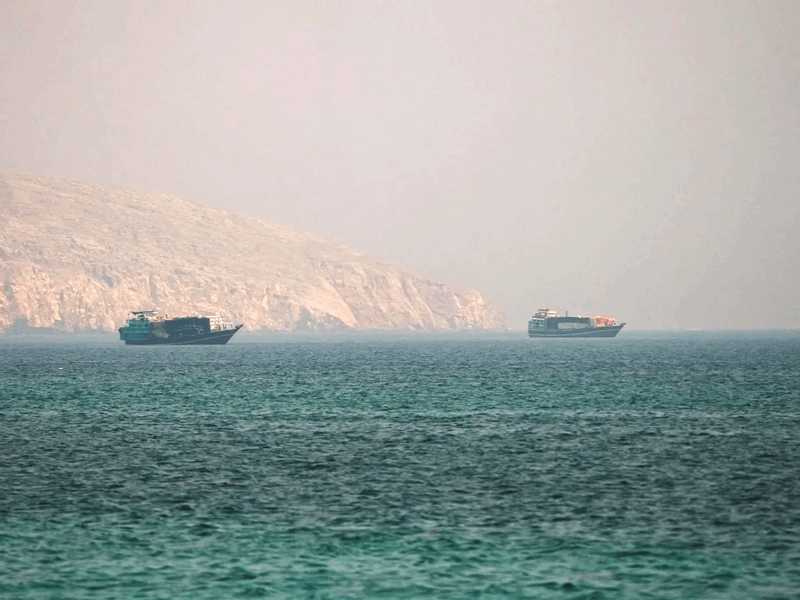
The United States and Iran exchanged threats on Saturday as a temporary ceasefire agreement aimed at ending the war teetered on the brink of collapse amid a renewed exchange of fire. US President Donald Trump issued thre
Translated by Qiyas from القبس — Original source
The United States and Iran exchanged threats on Saturday as a temporary ceasefire agreement aimed at ending the war teetered on the brink of collapse amid a renewed exchange of fire. US President Donald Trump issued threats via his Truth Social platform to launch further missile attacks on Iran, following explicit calls for the assassination of the US president during the funeral of former Supreme Leader Ali Khamenei. Trump wrote: “One thousand missiles are ready to fire and are aimed at the Islamic Republic of Iran, with thousands more to follow immediately if the Iranian government carries out its threat... The US military will destroy and annihilate all areas of Iran completely.” Trump announced the end of the ceasefire but affirmed that the United States would continue negotiations. Meanwhile, senior US officials demanded that Iran issue a public statement confirming that the Strait of Hormuz remains open without fees and that ships will not be attacked, calling on Tehran to provide written guarantees.
Later, Iran’s Supreme Leader, Mojtaba Khamenei, vowed that Iranians would continue seeking revenge for his father’s death. In a statement broadcast on state television, he said: “This revenge is the will of our nation, and it must be carried out.” Khamenei has remained out of public view since the war began on February 28. Amid warnings from the Trump administration that Tehran’s refusal to issue a public commitment to open the Strait of Hormuz could have severe consequences, US officials revealed on Saturday that President Trump had granted US negotiators a limited window to reach an agreement with Iran. Axios reported that Qatari officials are participating in talks between Iran and the Sultanate of Oman in Muscat regarding the Strait of Hormuz, noting that participants in the Muscat meetings are discussing issuing a statement on reopening the middle channel of the strait. The source indicated that the middle channel of the Strait of Hormuz lies in international waters, ensuring freedom of navigation and passage for ships. If Iran agrees to open the middle channel, it could be considered a suitable compromise for Washington.
US officials described the Oman meeting as a crucial test for the future of diplomacy with Iran, noting that the Strait of Hormuz crisis has raised doubts about Tehran’s ability to honor any commitments. Iranian Foreign Minister Abbas Araghchi arrived in Oman on Saturday, which informed the UN Shipping Agency that it does not support imposing transit fees in the strait, contradicting Tehran’s demands.
Details follow: President Donald Trump has given diplomacy a new chance to reach a deal with Iran that would end the war and its controversial nuclear program, while regional mediators work to de-escalate tensions and revive nuclear talks. Trump directed his team—led by Vice President J.D. Vance, son-in-law Jared Kushner, special envoy Steve Witkoff, and Secretary of State Marco Rubio—to continue negotiations in Oman. An Iranian delegation arrived in Oman on Saturday to continue mediated talks, despite the violent exchange of fire with the United States that shattered the ceasefire. Araghchi arrived in Muscat ahead of negotiations expected to proceed through mediators without direct US participation, according to Qatari negotiators involved. Araghchi is also expected to discuss the Strait of Hormuz with his Omani counterpart, Badr Al Busaidi, with a joint statement to be issued following the meeting.
US officials told CBS News that the United States would respond using military and economic leverage if Iran continues hostile actions in the Hormuz Strait and Gulf states. One official stated, “They came back to the table and said: We made a mistake, we erred, let’s continue talking.” Following Saturday’s meeting in Oman, the administration expects Iran’s position to be that the strait will remain open and managed as it was before the conflict began. The official added, “If that is not their position, it will not be a great day for them.” Another official said, “We are certainly in a waiting and watching phase,” adding that Trump is giving US negotiators space and time to reach a nuclear deal, but not much time.
Senior US officials said on Friday that Iranian officials had secretly informed Trump’s advisors that they had erred in attacking commercial ships in the Strait of Hormuz, and that the attacks stemmed from a rogue faction of hardliners attempting to undermine negotiations to regain influence, and that they wish to continue talks. However, the Trump administration maintains that the ships were targeted for another reason and wants the Iranian regime to publicly acknowledge its error and violation of the ceasefire. The United States had believed that the southern channel of the Strait of Hormuz, adjacent to the Omani coast, would open under a memorandum of understanding. However, Iran was surprised by the rapid pace of navigation and the volume of oil and gas traffic passing through the southern channel, leading it to back out of the agreement, according to one official.
The Trump administration has given Iran until the end of Saturday to publicly commit to ending attacks on commercial ships in the Strait of Hormuz, or face unspecified consequences, according to Axios, citing three US officials. The report stated that the administration wants Tehran to publicly acknowledge that the strategic waterway is open, commit to ceasing attacks on ships, and confirm that all shipping channels through the strait will remain open without fees. The US warned Iran through mediators that it would not remain silent on any attacks against freedom of navigation, demanding written and public guarantees from Tehran not to target tankers again. In this context, Axios cited a diplomatic source stating that Qatari officials involved in the talks proposed a compromise in the Strait of Hormuz, marking a dividing line between the northern Iranian channel and the southern Omani channel, and are discussing issuing a trilateral statement on reopening the middle channel of the strait, which lies in international waters, ensuring freedom of navigation and ship passage. The United States has demanded that Iran issue a statement declaring the strait open and free; if it does so, but with the middle channel specified, it could be considered a suitable compromise, as Iran’s Joint Military Committee had deemed this channel unsafe due to the presence of mines, according to Axios.
Nuclear File: In a separate development, a US official stated that the United States and Iran have made progress toward a nuclear deal during three weeks of direct and indirect negotiations, adding, “We are talking to people with authority there who say they want to reach an agreement.” However, officials also noted that the Hormuz crisis has raised serious questions about whether Iran will agree to a nuclear deal or remain committed to it. One official confirmed that Trump has given US negotiators sufficient space and time to move forward on a nuclear deal with Iran, “but not a large amount of space and time.” The official added that plans are being drawn up for alternative options in case no nuclear deal is reached.
Regarding what Trump refers to as “nuclear dust”—residues of highly enriched uranium—officials stated that the United States prefers to extract it, but if Iran refuses to act as a “normal state,” there are other options, including leaving it buried. Another official said that if Iran cannot fulfill what the United States considers the easiest part of the agreement—opening the strait for trade—negotiators will never be able to address the more complex issue of Iran’s nuclear program.
