Minister of Education: Kuwait is committed to building a flexible, advanced, and sustainable education system meeting global standards
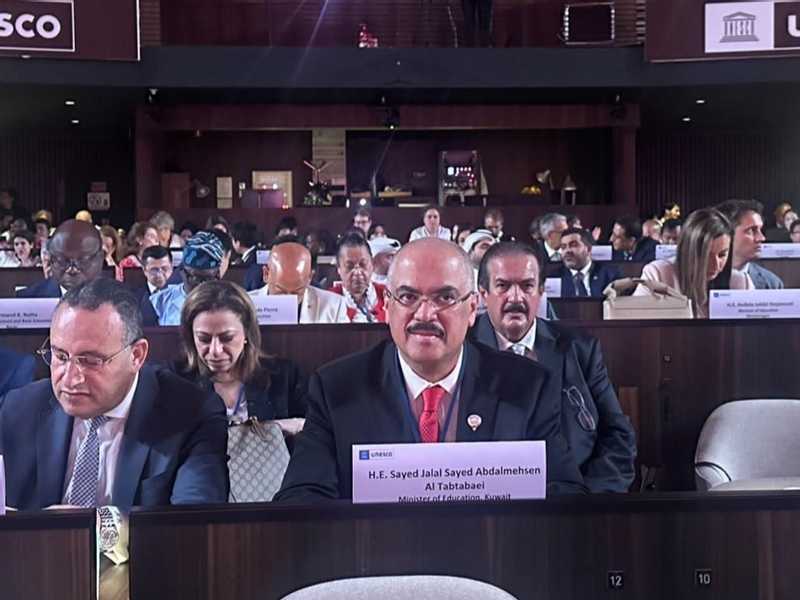
Education Minister Sayed Jalal Al-Tabatabaee reaffirmed on Friday Kuwait’s commitment to continuing the construction and development of a more flexible, advanced, and sustainable education system in line with international standards. This statement was made in a speech delivered during his participation in the “Government Leadership and Youth Innovation” session at the Transforming Education Summit, held at the headquarters of the United Nations Educational, Scientific and Cultural Organization (UNESCO) in Paris.
Minister Al-Tabatabaee stated that Kuwait’s educational experience in the previous academic year was exceptional, demonstrating the system’s capacity to maintain continuity of learning despite the emergency conditions faced by the country and the region. He noted that the year in question represented an extraordinary phase in the educational journey, as regional circumstances necessitated swift decisions to ensure student safety and sustain the learning process, transitioning the education system to remote learning across all school levels.
He clarified that during this period, more than half a million students continued their education remotely, with attendance rates exceeding 85 percent. The Ministry organized and developed mechanisms for teaching, monitoring, and assessment, while also ensuring the provision and delivery of textbooks to students to guarantee their safety, sustain the learning process, and ensure equal opportunities.
The Minister highlighted that the Ministry developed more than 27 electronic platforms and services, including the Electronic Transfer platform, utilized by over 106,000 teachers, and a smart chat service linked to the curriculum. Additionally, approximately 2,350 teachers and educational leaders were trained, a digital system for professional development was introduced, and a national project was implemented to qualify around 40,000 teachers in artificial intelligence applications.
He emphasized that Kuwait is striving to translate Sustainable Development Goal 4—which calls for inclusive and equitable quality education and lifelong learning opportunities, equipping individuals with the knowledge and skills needed to improve their lives and contribute to building prosperous and sustainable societies—into reality by 2030.
The Minister underscored the importance of practical initiatives and measures that elevate the quality of education, noting that Kuwait views this summit as a milestone for transitioning from commitments to implementation, reviewing achievements, exchanging experiences, and setting priorities for the coming phase up to 2030.
He pointed out that the world is facing rapid transformations and interconnected challenges that require re-evaluating the capacity of education systems to adapt and endure. Kuwait has translated its commitment to achieving Goal 4 into concrete actions focused on the quality of education, equity in access, and enhancing the resilience and responsiveness of the education system to changes.
Minister Al-Tabatabaee presented Kuwait’s national project to harness artificial intelligence in education, implemented in collaboration with Google, aimed at qualifying approximately 40,000 teachers over two academic years. He explained that the Ministry continues to develop curricula in accordance with contemporary international standards and skills, and is preparing a unified education charter. These efforts are supported by enhanced governance and institutional oversight, involving more than 193,000 participants from the educational field and parents in a national survey to develop the curriculum.
He stressed that investing in education is an investment in human capital and the future of generations, adding that Kuwait remains committed to strengthening its cooperation with UNESCO and international partners to achieve the Sustainable Development Goals.
During the “Short Presentations” session of the summit, Al-Tabatabaee outlined aspects of Kuwait’s experience in educational transformation, reform, and innovation, as well as efforts aimed at achieving tangible results in developing the education system. He highlighted key lessons from the Kuwaiti experience that could enrich educational practices and facilitate knowledge exchange among countries.
The summit discussed the major achievements and challenges faced by the education sector since the Transforming Education Summit in 2022, alongside exploring ways to enhance the resilience of education systems, ensure sustainable financing, support comprehensive digital transformation, and elevate the teaching profession, thereby accelerating progress toward Sustainable Development Goal 4, which ensures inclusive and equitable quality education for all.
