UN Secretary-General's Representative to Al-Qabas: Strategic Cooperation Framework to Support Kuwait's 2035 Vision to Be Signed Soon
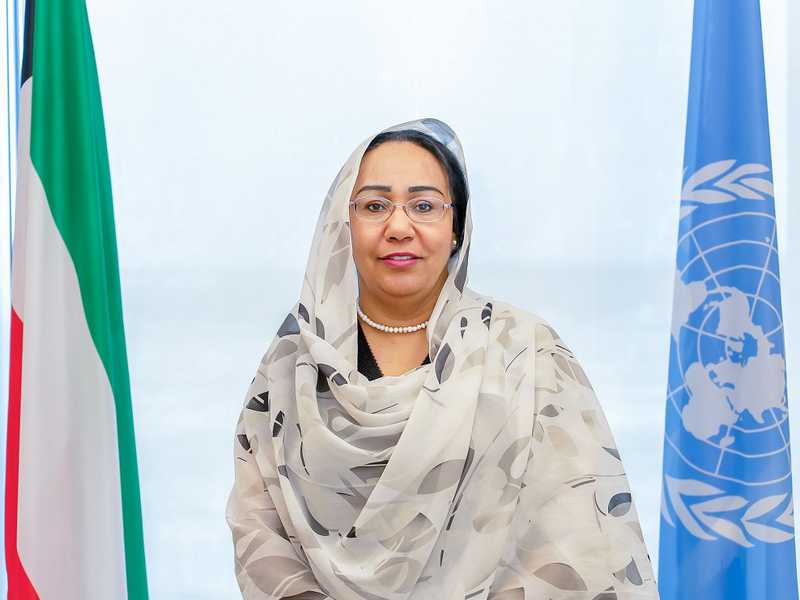
UN Secretary-General's Representative Ghada Fathi confirms Kuwait's leading role and anticipates signing a strategic partnership with the UN to support the 2035 Vision
Translated by Alqyas from Al-Qabas — Original source
Maysa Al-Sukari: Ghada Fawaz, the Representative of the UN Secretary-General and Resident Coordinator in Kuwait, affirmed that Kuwait is an active and reliable member within the United Nations system, noting that its international presence has significantly strengthened in recent years through its political, humanitarian, and developmental contributions, as well as its election and membership in various international bodies and forums.
In an interview with Al-Qabas, Fawaz stated that Kuwait’s role is particularly prominent in the humanitarian field, having hosted major international conferences to support responses to humanitarian crises and provided generous contributions to humanitarian and developmental efforts carried out by UN agencies worldwide. She added that Kuwait enjoys widespread appreciation for its continuous support of multilateralism and its commitment to the principles of the UN Charter.
Fawaz emphasized that Kuwait’s membership and election to several international bodies reflect the trust it commands globally and its constructive role in promoting dialogue and consensus on regional and international issues. She confirmed that Kuwait consistently contributes to supporting efforts aimed at achieving sustainable development goals and enhancing peace, security, and responses to humanitarian and human rights challenges both within and beyond the region.
She stressed that the United Nations views Kuwait as a key partner in strengthening international cooperation and consolidating the values of solidarity and shared responsibility in addressing global challenges.
On leadership initiatives and UN files that Kuwait could lead in the coming period, Fawaz affirmed that Kuwait possesses a diplomatic, humanitarian, and developmental track record that qualifies it to assume leadership roles in several UN files that are gaining importance at both the regional and international levels. She noted that Kuwait not only has a distinguished record in humanitarian work but also enjoys political credibility and the ability to build consensus—elements that are more needed than ever amid complex global challenges.
She added that as the international system faces a growing gap in financing humanitarian and developmental needs, the importance of countries capable of combining financial support with long-term developmental vision becomes increasingly evident. Fawaz also viewed Kuwait as well-positioned to play a larger role in preventive diplomacy, mediation, and regional dialogue, areas that align with its historical approach based on moderation, bridge-building, and promoting peaceful conflict resolution.
She pointed out that current global transformations also open numerous opportunities for Kuwait to lead regional initiatives in sustainable development, climate action, water security, digital transformation, and youth empowerment—issues that align with UN priorities and with Kuwait’s Vision 2035, which places economic diversification, building a knowledge-based economy, and investing in human capital at the core of its objectives.
Fawaz added that Kuwait is also capable of contributing more significantly to enhancing regional dialogue on artificial intelligence for development and the future of work, the green transition, and sustainable energy—issues that will form a central axis of international discussion in the coming years.
Regarding the UN’s assessment of Kuwait’s role as a mediator and dialogue builder in the region, Fawaz affirmed that Kuwait’s name has always been associated with balanced and effective diplomacy, a characteristic that Kuwait’s foreign policy has acquired over decades of steady and constructive work.
She praised Kuwait’s efforts aimed at bridging differences and promoting peaceful solutions to conflicts, noting that this role has become particularly evident at several regional junctures, foremost among them mediation efforts during regional crises, as well as its continuous contributions to supporting regional and international dialogue. Regarding the rights of migrant workers, Al-Taher clarified that Kuwait, like other Gulf Cooperation Council (GCC) countries, hosts a highly diverse workforce, with migrant workers comprising approximately two-thirds of the country’s population, totaling around 3.4 million people. This makes the protection of migrant workers’ rights and the improvement of the work environment issues of significant importance at both the national and international levels. Al-Taher stated that Kuwait has taken important steps in recent years to strengthen the legal framework governing migrant workers, pointing out that Labor Law No. 6 of 2010 and Domestic Workers Law No. 68 of 2015 form a fundamental pillar for protecting workers’ rights, given their provisions concerning wages, working hours, rest periods, and complaint mechanisms.
On UN cooperation to support Kuwait Vision 2035, Al-Taher said that Kuwait and the United Nations share a long-standing and robust partnership that has now entered a more advanced stage of cooperation to support the national priorities outlined in the Vision, which align closely with the Sustainable Development Goals. She explained that the anticipated Strategic Cooperation Framework between Kuwait and the United Nations, expected to be signed in the coming weeks, will serve as the primary platform for coordination between the government and the UN system across various economic, social, environmental, and institutional dimensions of development. She added that UN agencies are working in collaboration with relevant Kuwaiti authorities to support a wide range of initiatives, including economic diversification, enhancing public sector efficiency, financial sustainability, digital transformation, and human capital development, with a focus on supporting youth and women, environmental sustainability, climate change adaptation, and strengthening social protection systems.
Addressing criticisms directed at the United Nations regarding the war in Gaza, Al-Taher stated that the question is legitimate and reflects the scale of the humanitarian tragedy and the frustration felt by many around the world over the continued suffering of civilians. She emphasized the importance of distinguishing between the role undertaken by the United Nations and the powers granted to it under the UN Charter and international law, clarifying that the organization does not possess independent authority to impose solutions or unilaterally halt conflicts.
Regarding Kuwaiti diplomacy, the UN Secretary-General’s Representative and Resident Coordinator in Kuwait, Ghada Fathi Al-Taher, affirmed that Kuwaiti diplomacy retains all the qualities that qualify it to continue playing influential and constructive roles in addressing regional crises, drawing on the experience, credibility, and respect it has accumulated over decades.
On the recent visit of UN Secretary-General’s Representative Marianne Yamasita to Kuwait, Al-Taher explained that her meetings with His Highness the Crown Prince Sheikh Sabah Al-Khaled Al-Sabah, Foreign Minister Sheikh Jaber Al-Jaber Al-Sabah, and Assistant Undersecretary for Missing Persons and Family Affairs Ambassador Rabih Al-Adwani reflected the strength of the partnership between Kuwait and the United Nations and the shared commitment to supporting the implementation of UN Security Council Resolution 2792 (2025).
Future of the Middle East and the Gulf In response to Al-Qabas’s question about the region’s future, Ghada Al-Tahir affirmed that the Middle East is undergoing rapid transformations across political, economic, and security dimensions. She noted that the region’s future should not be measured solely by political or geopolitical changes, but by the ability of countries and peoples to achieve sustainable peace, comprehensive development, and long-term stability. She added that the region faces shared challenges that transcend national borders, such as food and water security, climate change, economic transformation, and employment opportunities for youth.
