S&P and Moody's confirm Kuwait's sovereign ratings at AA and 1A with stable outlook
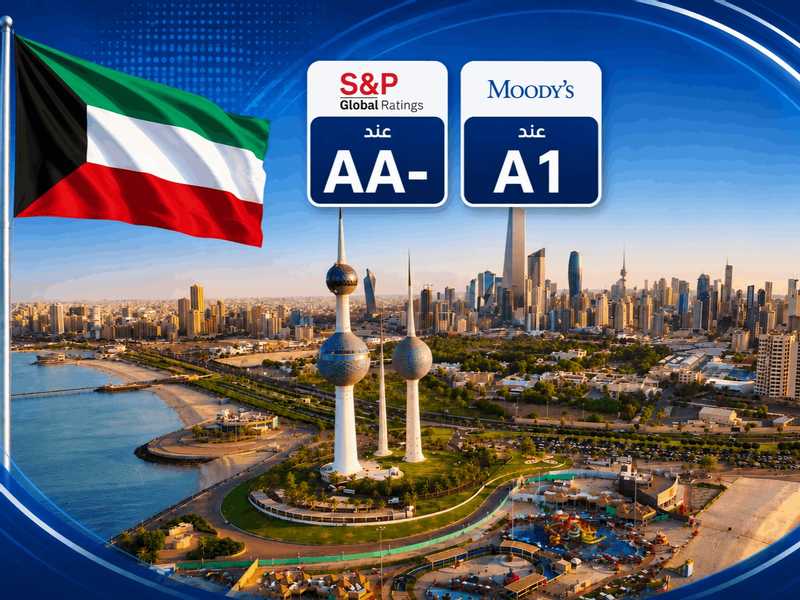
Two credit rating agencies confirmed Kuwait's stable rating with expectations of moderate economic growth.
Translated by Alqyas from Al-Qabas — Original source
Kuwait’s two leading credit rating agencies, Standard & Poor’s and Moody’s, affirmed Kuwait’s sovereign credit rating. S&P maintained its rating at AA and its short-term rating at A-1, while keeping the outlook “Stable.” Moody’s affirmed its rating at A1, also maintaining a “Stable” outlook.
According to a statement from the Central Bank of Kuwait, S&P’s report stated that Kuwait’s financial assets will help it withstand the repercussions of the war in the Middle East region and the resulting disruptions in supply flows through the Strait of Hormuz. The agency noted that the “Stable” outlook reflects its assessment that Kuwait’s financial and external assets provide sufficient resilience against risks threatening security and trade flows. S&P based its assessment on the assumption that these disruptions will not be prolonged, with expectations that exports through the Strait of Hormuz will resume.
On economic growth, the agency predicted that, given the closure of the Strait of Hormuz and its impact on oil production, real GDP would contract by approximately 2% in 2026. It further forecast that real GDP growth would recover to around 3% during the 2027–2029 period following the temporary contraction in 2026, supported by the recovery of oil production levels and broad investment programs in non-oil sectors.
The statement added that, regarding the general budget, the agency projected an average budget deficit of around 14% of GDP during the fiscal years 2025/2026 to 2028/2029, due to increased public spending. It noted that fiscal reforms would contribute to sustaining growth momentum and stabilizing public finances in the medium term. On monetary policy, the agency highlighted that the Kuwaiti dinar’s exchange rate regime has historically helped manage inflation.
Regarding inflation, S&P’s forecasts indicated that the average annual inflation rate would remain moderate at around 3% during 2026–2027. It also noted that the government issued a decision to support additional costs borne by suppliers to ensure the continued flow of essential goods without price increases.
The statement clarified that the agency also anticipated no significant contingent liabilities for the government arising from the Kuwaiti banking sector. It pointed out that recent reforms and the expansion of banks abroad have helped stimulate lending, while asset quality in the banking sector has maintained its relative strength since 2022.
Furthermore, the Central Bank announced that the global credit rating agency Moody’s affirmed Kuwait’s long-term sovereign credit rating at A1, maintaining a “Stable” outlook. The statement said the agency explained that the affirmed rating reflects the strength of the country’s financial position, providing robust buffers against shocks and granting flexibility in addressing long-term credit challenges. Moody’s report indicated that the affirmed rating is also supported by high GDP per capita, which enhances economic resilience, as well as substantial oil reserves that bolster the country’s competitive position in the global oil market.
Regarding the rationale for the “Stable” outlook on the sovereign credit rating, the agency viewed that the size of government financial assets would limit the impact of the regional conflict on Kuwait’s sovereign credit rating.
Based on the size of these assets and the assured ability to access them when needed, the report stated that “the state budget has the capacity to absorb a prolonged decline in financial revenues without weakening Kuwait’s financial strength or undermining its creditworthiness.” Accelerating recovery
Moody’s assessed that “higher global energy prices and the resumption of production will help accelerate the recovery and improve financial performance as soon as trade flows through the Strait of Hormuz fully resume.” It added that government financial assets enhance sovereign creditworthiness through multiple channels: they directly contribute to the sustainability of public finances, reduce government liquidity risks, and help mitigate geopolitical risks by enabling the government to absorb the financial and economic impact of lost oil export revenues without resorting to sharp cuts in public spending.
Regarding Kuwait’s general budget, Moody’s estimated, according to the statement, that the fiscal deficit would rise to approximately 21 percent of GDP in the 2026/2027 fiscal year, and then shrink to less than 7 percent in the 2027/2028 fiscal year, assuming oil production and export flows return to pre-conflict levels.
Local banks remain in good shape
Standard & Poor’s noted in its report that local banks remain well-positioned to cope with risks of capital outflows in the event of escalating geopolitical tensions. At the same time, it emphasized that recent mitigation measures taken by the Central Bank of Kuwait focused on enhancing banks’ access to liquidity and providing temporary regulatory flexibility, which will help banks navigate the current disruptions.
Non-oil sectors to grow by 1.5%
Moody’s projected that non-oil sectors would record positive growth of around 1.5 percent in 2026, reflecting the continuation of government-led infrastructure projects and limited exposure to sectors with “high sensitivity,” such as tourism and aviation.
