Wall Street: Gulf States Turn Against Iran, Edging Closer to War
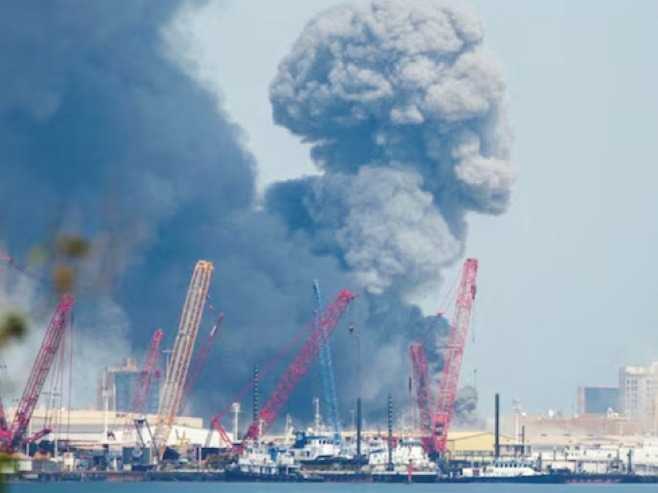
The UAE and Saudi Arabia show a shift in their policies toward Iran following the attacks.
Translated by Alqyas from Al-Qabas — Original source
The Wall Street Journal has revealed a growing inclination among Gulf states, particularly the United Arab Emirates and the Kingdom of Saudi Arabia, to enter the ongoing conflict with Iran, following the shelling of Gulf cities, especially Dubai and Abu Dhabi, which witnessed the highest number of missile and drone attacks in the past 48 hours. In response, the Iranian regime, which suffered a crushing defeat in the initial hours of the US-Israeli campaign that began on Saturday, launched air strikes on at least nine countries in the Middle East, thereby igniting a genuine regional war. The apparent calculation was that Tehran, by targeting the wealthy Gulf states that hold influence with the Trump administration, would force Washington and the Zionist entity to quickly de-escalate. Iran anticipated that tightening the noose on oil tanker movements through the Strait of Hormuz and disrupting air traffic would inflict severe damage on Gulf states that rely heavily on expatriate labor, tourism, and foreign trade.
However, this calculation appears to have backfired on Iran so far. The Gulf states, shaken by the barrage of Iranian drones and missiles that targeted their hotels, ports, and airports, have recognized the necessity of confronting the Iranian threat. A prevailing sentiment in the Gulf states—at least for now—is that the Iranian regime must not be allowed to escape unpunished for this unprecedented attack on its neighbors. Anwar Gargash, the diplomatic advisor to the President of the UAE, stated in an interview: “Iran is addressing the Gulf states and peoples, saying: I am, in fact, your primary threat. This has long-term repercussions, regardless of who holds power in Iran. Targeting Gulf states is utterly irrational and extremely short-sighted.”
Iran has launched attacks on all six oil-rich Gulf Arab states, including the Sultanate of Oman, which mediated the nuclear negotiations between Tehran and the Trump administration, as well as Jordan, Iraq, and Israel. Initially, all Gulf states publicly opposed the US-Israeli attack on the Iranian regime, which already resulted in the death of Supreme Leader Ali Khamenei and the killing of numerous Iranian military and intelligence leaders. The situation changed rapidly when Iranian strikes hit cities such as Dubai and Abu Dhabi in the UAE, Doha in Qatar, and Manama in Bahrain, causing severe damage to infrastructure and resulting in civilian casualties. In the UAE alone, Iran killed three people and injured 58 others after firing 165 ballistic missiles and 541 drones, most of which were intercepted, according to the Ministry of Defense.
William Winkler, director of Middle East programs at the Atlantic Council in Washington and former deputy assistant secretary of defense for the Middle East, said: “Many in the Gulf woke up on Saturday angry at the United States and Israel, and went to bed angry at Iran.” Iranian Foreign Minister Abbas Araghchi stated on Sunday that the escalation of the conflict was not Iran’s fault, and if the Gulf states and their neighbors in the Middle East are angry, “their anger should be directed at the United States and Israel.” Araghchi added: “They should not pressure us to stop this war; rather, they should pressure the other side.” This approach proved successful in last year’s twelve-day war, when limited Iranian strikes on Qatar led to the cessation of hostilities.
Nikolai Kozanov, an expert on Iranian affairs at Qatar University, said: “Iran’s strategy has long been that if you cannot reach your main adversary, you must strike its allies to pressure it.” He added, “Iran was confident in the success of this psychological pressure and believed it could achieve its goals by intimidating Arab leaders, but it seems the situation this time may be different.” In fact, the opposite is happening, at least for now. The major Gulf states have quickly shifted their foreign policy from rapprochement with Iran to something akin to welcoming the idea that regime change in Tehran might be acceptable.
Ahmed bin Abdullah Al Owais, a senior official from the United Arab Emirates, stated: “The fate of this regime, whether it remains or falls, belongs to the Iranian people. They must decide and accept the outcome. I do not believe it is our right to decide.”
In Europe as well, despite strained relations with the United States following President Trump’s re-election, initial concerns about an attack on Iran have given way to tacit approval, particularly after some Iranian missiles were intercepted on Sunday en route to Cyprus, a member of the European Union. Kaja Kallas, the EU’s High Representative for Foreign Affairs and Security Policy, described the assassination of Khamenei as “a watershed moment in Iran’s history.” She added, “What happens next is unclear, but the path is now open for a different Iran, one whose people may enjoy greater freedom in shaping their future.”
European leaders show little enthusiasm for confronting Trump over Iran, despite tensions across the Atlantic due to demands regarding Greenland. For them, Europe’s priority lies in ensuring Ukraine’s survival and deterring Russia, in cooperation with the United States. Natalie Tocci, director of the Institute for International Affairs in Rome, said: “In Europe, we view the world through the lens of the war in Ukraine, and for good reason; it is the most important issue for Europeans.”
Germany, France, and the United Kingdom, which did not participate in the initial strikes on Iran, announced on Sunday that they “will take steps to defend their interests and those of their allies in the region, possibly by enabling them to take necessary and proportionate defensive actions to destroy Iran’s capacity to launch missiles and drones from their source.”
With the US-Israeli campaign against Iran focused almost entirely on air power, it remains unclear how the Iranian regime, which brutally suppressed recent protests, could be removed in the absence of a popular uprising. Saudi political analyst Ali Al-Shahabi said: “The best outcome we can hope for is a Venezuela scenario,” referring to the cooperation established between the remnants of the Venezuelan regime and the United States after the ouster of President Nicolás Maduro in December. Al-Shahabi added: “Frankly, it is a good scenario because it means the country remains united, avoids chaos and civil war, and results in a neutral and reformed system.”
He noted that Iranian attacks on Gulf states had removed any hesitation these monarchies might have had about cooperating with the US military campaign. Regional officials said it is unlikely that Saudi Arabia, the UAE, and other Gulf states will continue to endure Iranian strikes for long. Among the available options is beginning to target missile and drone launch sites inside Iran. Al Owais, the UAE’s diplomatic advisor, said: “Instead of passive defense, we can be more effective in our defense. We must study the nature of the conflict that looms on the horizon. We also have our own capabilities. The idea is that our response should be proportionate.”
The United Arab Emirates closed its embassy in Tehran on Sunday and withdrew its diplomats from Iran. With sectors such as tourism, air travel, real estate, and finance beginning to bolster oil revenues, Gulf economies cannot afford the prospect of the war ending while the Iranian regime remains in power and retains its ability to threaten them again with drone and missile attacks, according to numerous officials. Air Marshal (Retired) Martin Sampson, director of the International Institute for Strategic Studies’ Middle East office in Bahrain, said: “Iran has crossed red lines. The situation is now existential for the economic and social future of the Gulf states.”
