Time: Iran Protest Death Toll May Exceed 30,000
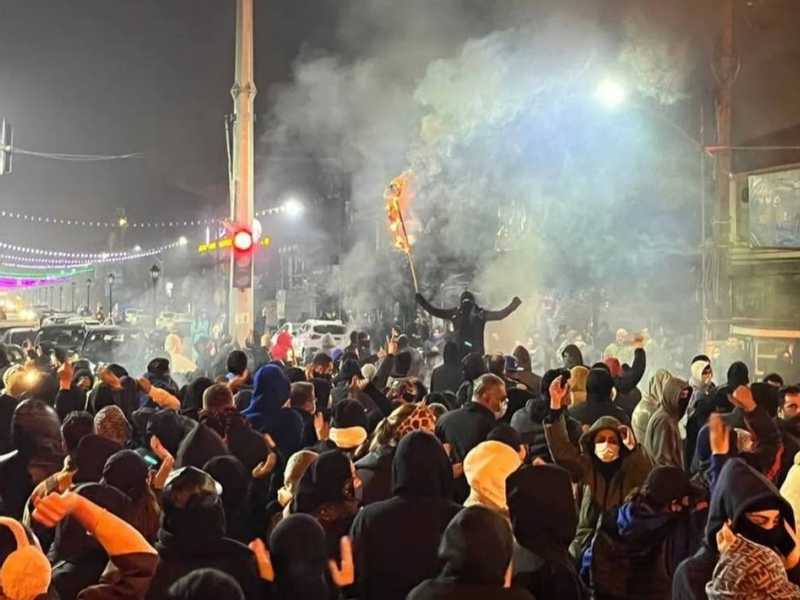
Reports indicate that more than 30,000 people have been killed in Iranian protests, as U.S. forces prepare for a potential military campaign.
Translated by Alqyas from Al-Qabas — Original source
Tensions with Iran have reached a peak as the United States completes the deployment of its forces in the region, preparing for a potential military campaign. The aircraft carrier USS Lincoln is positioned near the Arabian Sea, carrying approximately 90 fighter jets. Alongside it is a strike group comprising destroyers and submarines equipped with Tomahawk missiles. Meanwhile, F-15E aircraft have been transferred to various bases, and an additional force consisting of three destroyers and a submarine has been deployed off the coast of Spain, capable of rapid deployment to the region to effectively target Iran if necessary. The U.S. air defense system in the area has also been reinforced with Aegis missile-intercepting ships and THAAD batteries. According to Israel’s Channel 13, the prevailing assumption within the Israeli military is that a U.S. attack on Iran is imminent. Senior officers stated that this week is critical in preparations for a potential U.S. strike.
This comes amid alarming reports from Iran regarding the death toll of protesters. While the U.S. magazine Time cited senior officials in Iran’s health system stating that the death toll exceeds 30,000, body bag supplies have run out, and trucks have replaced ambulances. The Iranian opposition news website Iran International reported that more than 36,000 people have been killed.
For its part, The New York Times interviewed approximately twenty Iranians in Tehran, Isfahan, Shiraz, Rasht, and Ahvaz who participated in the protests, as well as relatives of victims. Reha Bahreini, a lawyer and researcher on Iranian affairs at Amnesty International, stated: “This is not merely a violent crackdown on protests; it is a state-orchestrated massacre.”
Details follow:
Tensions with Iran peaked this morning (Sunday). Senior officers in the Israeli military told Israel’s Channel 13 that this week is critical in preparations for a potential U.S. attack on Iran.
Meanwhile, the Iranian human rights organization Hrana reported that more than 22,000 people have been killed in the wave of protests sweeping the country. The U.S. magazine Time, citing senior officials in Iran’s health system, reported that the death toll exceeds 30,000, while the opposition-affiliated Iranian news website Iran International stated that more than 36,000 people have been killed during the protests that erupted earlier this month.
In a related development, The New York Times reported that instructions were issued to security forces on January 9 to “crush” demonstrations in the country “by any means necessary.” Troops were ordered to “shoot with intent to kill and show no mercy.”
Despite internet blackouts and disrupted phone services, some Iranians managed to bypass restrictions to publish eyewitness accounts and hundreds of videos showing security forces firing on protesters in at least 19 cities. In Tehran, the capital, security forces fired on protesters from the roof of a police station. In Karaj, live ammunition was fired at a march, hitting one person in the head. In Isfahan (central Iran), young people barricaded themselves in an alley amid the sound of gunfire and explosions.
On Friday, January 9, Sahba Rashtian, an aspiring animation artist, joined her friends in the streets of Isfahan, known for its beauty. A friend told Time magazine: “Before anyone started chanting, Sahba was seen lying on the ground. Her sister noticed blood on her hand.” Sahba died on an operating table at a nearby hospital. She was 23 years old. “She always joked about her beautiful name,” her friend said. “She would laugh and say: Sahba means wine, and I am forbidden in the Islamic Republic.”
Al-Siddiq said that religious rituals were banned at the funeral, and Rashchiyan’s father wore white clothes. He told mourners, according to his friend, “Congratulations, my daughter has become a martyr in the cause of freedom.” Two senior officials in Iran’s Ministry of Health told Time magazine that as many as 30,000 people may have died in the streets of Iran on January 8 and 9 alone, indicating a sharp rise in the death toll. The large number of deaths caused by Iranian security forces on Thursday and Friday, when protests peaked and the Iranian government cut off internet and communications nationwide, overwhelmed the state’s capacity to dispose of bodies. The officials explained that the supply of body bags had run out, and eighteen-wheeler trucks replaced ambulances. The internal death toll, previously undisclosed by the government, far exceeds the 3,117 fatalities announced on January 21 by hardliners in the system who report directly to Supreme Leader Ali Khamenei (while ministries report to President Masoud Pezeshkian). It also far surpasses the figures compiled by activists who precisely identify the names of the deceased. Even on Saturday, the U.S.-based Human Rights Activists News Agency reported that it had confirmed 5,549 deaths and was investigating 17,031 other cases. The figure announced by the Ministry of Health over approximately two days aligns with the tally collected by doctors and first-response teams, also published in Time. This secret count of hospital-registered deaths reached 30,304 by Friday, according to Dr. Amir Baraasta, an Iranian-German ophthalmic surgeon who compiled the data. Baraasta clarified that this number does not include protest-related deaths among individuals registered in military hospitals, those whose bodies were taken directly to the morgue, or those who died in areas not covered by investigations. The Iranian National Security Council announced that protests erupted at around 4,000 locations across the country. Dr. Baraasta said, “We are approaching reality, but I believe the true numbers are still much higher.” This appears to be the underlying truth behind the government’s internal figure indicating more than 30,000 deaths in two days. A massacre of this scale within 48 hours has prompted mass-casualty experts to seek comparisons. Les Roberts, a professor at Columbia University and specialist in the epidemiology of violent death, said, “Most waves of killing do not result from gunfire. In Aleppo in northern Syria and Fallujah in Iraq, when waves of killing of this magnitude occurred over a few days, the primary cause was explosives, with some gunfire.” On the evening of Friday, January 9, an Islamic Revolutionary Guard Corps official warned via state television anyone daring to take to the streets: “If you are hit by a bullet, do not complain.” Meanwhile, The New York Times interviewed about twenty Iranians in Tehran, Isfahan, Shiraz, Rasht, and Ahvaz who participated in the protests, as well as relatives of victims. Raha Bahreini, a lawyer and Iran affairs researcher at Amnesty International, said, “This is not just a violent crackdown on protests; it is a state-planned massacre.” Meanwhile, the United States is completing the deployment of its forces at sea, in the air, and on land in preparation for a potential military campaign against Iran. U.S. troops have been deployed to strategic points in the Middle East and the Mediterranean basin as part of preparations for an attack that could last several weeks.
The aircraft carrier USS Lincoln is positioned at the heart of the naval force, stationed near the Arabian Sea, carrying thousands of troops, approximately 90 fighter aircraft, including F-35s, and 10 Black Hawk helicopters. Alongside it is a strike group comprising destroyers and submarines equipped with Tomahawk missiles. Meanwhile, F-15E aircraft have been transferred to various bases in the region, including Jordan, to bolster air presence. An additional force consisting of three destroyers and a submarine has been deployed off the coast of Spain and is stationed south of Greece. These forces can be rapidly deployed to effectively target Iran if necessary. The U.S. air defense system in the region has also been reinforced with Aegis missile-interceptor ships and THAAD batteries, the American equivalent of Israel’s Arrow system.
In parallel, the Israeli Defense Forces (IDF) are currently maintaining their full operational routine, though this routine can be altered at any moment. During a meeting between U.S. Central Command (CENTCOM) commander Brad Cooper and IDF Chief of Staff Eyal Zamir, along with the heads of Israeli intelligence and operations in Tel Aviv, military coordination for defense and offensive operations was discussed. Cooper conveyed the U.S. message that President Donald Trump has not made a final decision regarding an attack, but that the United States has completed preparations and equipped tools for a potential operation over the weekend. According to Channel 13, the prevailing assumption within the IDF is that a U.S. attack on Iran will occur soon.
In this context, the IDF’s Central Command announced that it launched a pre-planned exercise on Sunday morning aimed at improving readiness for “extreme scenarios.” The Central Command is responsible for the West Bank and most of the border with Jordan. The exercise involved several units and the Civil Administration.
