Thomas Friedman: Trump, a narcissist, insists on putting his name on everything
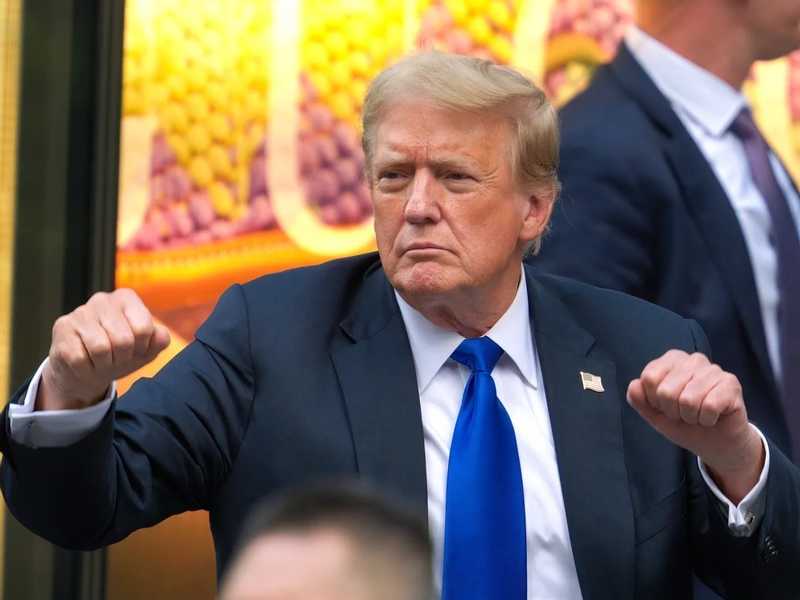
Friedman describes Trump as a narcissist who puts his name on everything and diminishes the value of American leadership
Translated by Alqyas from Al-Qabas — Original source
Writer Thomas Friedman launched a scathing attack on the performance of U.S. President Donald Trump, describing him as the most “un-American” president in United States history, one who shares no values with any president since World War II regarding America’s role in the world, nor any understanding of the meaning of leadership and international responsibility. In an article published in The New York Times, Friedman characterized the current U.S. president as a narcissistic individual obsessed with branding everything with his name, even at the expense of his country’s higher interests.
Friedman noted that he had never been a proponent of conspiracy theories about Donald Trump’s relationship with Russia, nor did he believe Trump was an agent for Moscow or that Vladimir Putin held financial leverage or moral scandals over him for blackmail. He continued, “I have always believed that Trump’s value system is fundamentally distorted. It is not based on the Constitution or American founding principles, but on a single logic: admiration for every strong leader, no matter how he abuses his power; bias toward every wealthy leader, as long as he can personally benefit Trump, regardless of the source of his wealth or how he spends it; and preference for anyone who heaps praise on him, no matter how fake and transparent.”
He added that because Vladimir Putin meets these criteria more than the democratically elected Ukrainian president, Trump treated him as a friend, indifferent to American interests and values, requiring Putin to exert little effort to make Trump an easy tool in his hands. The writer argues that these reasons make Trump the most “un-American” president in U.S. history, adding, “This became clear from the day he attacked Senator John McCain, a real war hero and national symbol, simply because his plane was shot down in combat and he was captured.”
Friedman asked, “What kind of president attacks a man who spent more than five years as a prisoner in North Vietnamese jails after refusing early release to avoid being used for propaganda? This is behavior unlike what we know about American leaders.”
Friedman pointed out that during Trump’s first term, his impulsiveness and worst intellectual tendencies were restrained by a team of serious advisors. Today, however, he is surrounded only by “yes-men and sycophants,” as he described them, and thus runs the country in the same way he managed his businesses: through unilateral decisions, improvised deals, without vision or institutions to regulate the pace.
He described Trump’s behavior as “the most reckless” to the point of raising a serious question: Is the United States today governed by a “mad king” mentality? He added that Trump’s actions are no longer mere departures from tradition, but starkly contradict American interests as understood by Republicans even before Democrats.
Continuing his sharp criticism of the U.S. president, the writer said, “If we wanted to speak to him in his preferred language—the language of business and deals—we would say that the United States resembles a giant corporation built by an entire generation of politicians, soldiers, diplomats, and investors. The greatest asset of this corporation is its alliance with Europe through NATO, which emerged from the ashes of World War II.”
He continued, “Through a relatively modest investment via the Marshall Plan, Europe became a stable economic and political partner, and both sides prospered. The continent transformed from a battlefield of national wars into a global center for free markets and the rule of law.”
He went on to say, “It is true that Europe today faces complex crises, from migration to the rise of the far right, and it is true that there are security challenges in the Arctic. But no American statesman in recent decades would have considered sacrificing the foundations of the Atlantic partnership over a dispute regarding Greenland’s sovereignty.”
He stated that “only a narcissistic individual obsessed with putting his name on everything, even at the expense of his country’s higher interests, would dare embark on such an adventure, especially since the United States already possesses military bases and extensive investment rights in Greenland.” Friedman emphasized that “if America were truly a company, its board of directors would have immediately intervened to halt this behavior by the CEO.” However, Congress, dominated by Republicans, chose to paralyze itself, leaving the country to proceed down this path. Ultimately, it is the American people—who are the true shareholders—who will foot the bill. He added that, meanwhile, America’s adversaries, led by Russia and China, can hardly believe their luck. For decades, they have recognized that the secret to U.S. strength lies not only in its economy or military, but in its network of allies who share its values and interests, and who fought alongside it in Iraq and Afghanistan. Among these allies is Denmark, the sovereign state over Greenland. The author concluded his article by stating, “Thus, under Trump’s leadership, the United States is not heading toward a future of ‘America First,’ but rather a future of ‘America Alone’… and ‘Me First.’”
