Trump Considers Issuing Authorization to Attack Iran
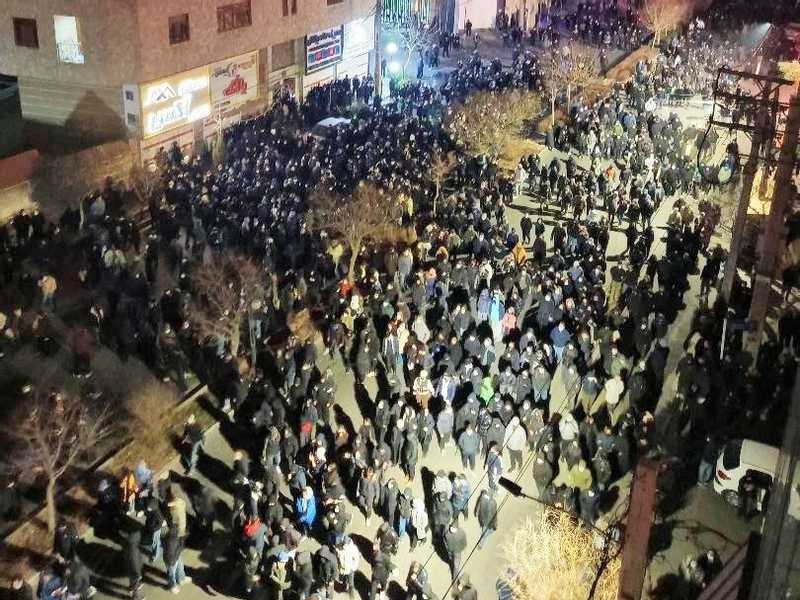
The United States is considering supporting protests in Iran and issuing a military authorization, amid Iranian threats of a military response.
Translated by Alqyas from Al-Qabas — Original source
In the greatest challenge Iran has faced in five decades, anti-government protests have entered their third week amid a wave of unrest sweeping the country. U.S. President Donald Trump expressed his country’s “willingness to help,” prompting Israel to raise its readiness to the highest level in anticipation of any U.S. intervention in Iran. Prime Minister Benjamin Netanyahu stated that Tel Aviv is “closely monitoring developments and hopes that Iran will soon be liberated from tyranny.” Meanwhile, Iranian leaders warned that the U.S. military and the “occupation entity” would be “legitimate targets” if the United States launched an attack on Iran due to the ongoing protests, as threatened by Trump.
These threats came after protests erupted across all 31 Iranian provinces. Streets in the Iranian capital and its second-largest city were flooded with demonstrators well into Sunday morning, surpassing two weeks of protests before subsiding and resuming with the same momentum in the evening. Activists reported that at least 538 protesters were killed in violence accompanying the demonstrations, amid fears that the death toll could rise significantly. More than 10,600 people have been arrested.
In a related development, the U.S. website Axios cited American and other Tel Aviv-based officials as saying the actual number of deaths is likely many times higher than the figure announced by the human rights organization Hrana. The opposition channel Iran International reported on Saturday evening that 2,000 protesters were killed in the past 48 hours, while an Israeli official claimed the total death toll had exceeded 1,000. Other estimates suggest lower figures. A U.S. official merely stated that the death toll was “high.” None of these numbers have been confirmed.
Assessing the protests has become more difficult due to internet blackouts and disrupted telephone lines in Iran. Videos posted online from Iran, believed to have been broadcast via commercial Starlink satellites, showed protesters gathering in the Bonak neighborhood of northern Tehran. It appeared that authorities had blocked streets there while protesters waved their illuminated mobile phones. Others clanged metal objects as fireworks went off.
The Human Rights Activists News Agency reported that “the pattern of protests in the capital has largely taken the form of scattered, short-lived, and shifting gatherings, an approach adopted in response to intense security presence and growing field pressure.” Reports also mentioned surveillance drones flying and security forces moving around protest sites. In Mashhad, Iran’s second-largest city, footage showed protesters facing security forces. Protests also appear to have erupted in Kerman, located 800 kilometers southeast of Tehran.
Two senior officials in the “occupation entity” stated that the Iranian regime and its security apparatus seemed surprised by the scale of the protests, which have grown since last Thursday. An Israeli official familiar with intelligence related to Iran said, “After Thursday, the Iranian regime felt great concern and conducted a serious assessment of the situation.” A U.S. official and a high-ranking Tel Aviv official noted there were some indications of opposition within Iran’s security forces, but it was unclear how widespread it was. However, neither official suggested that the regime appeared on the verge of imminent collapse.
Trump and His Options
U.S. President Donald Trump expressed support for the protesters, stating on social media: “Iran is looking for freedom, perhaps more than ever before. The United States of America is ready to help!”
The New York Times and the Wall Street Journal, citing U.S. officials who spoke on condition of anonymity, reported that Trump was presented with military options for striking Iran, but he has not yet made a final decision. Two U.S. officials told Axios that Trump is considering several options to support protests in Iran and weaken the regime. These discussions are taking place amid escalating protests and rising death tolls, following Trump’s public statement that he is prepared to use military force if the Iranian regime kills protesters. A U.S. official said, “All options are on the table for President Trump, but no decision has been made yet.” A second U.S. official stated that the discussions included military strikes, but most of the options presented to the president at this stage “are not kinetic.” Officials acknowledged the difficulty of predicting which option Trump will choose. According to three U.S. sources, Secretary of State Marco Rubio and Israeli Prime Minister Benjamin Netanyahu discussed the protests in a phone call on Saturday. In recent days, initial meetings were held within the Trump administration to discuss ways to support the protests. A U.S. official said that while U.S. military strikes against Iranian regime targets are among the options under discussion, many within the Trump administration believe that any major military action at this stage could undermine the protests. Other options include taking steps to deter the regime, such as announcing the deployment of a carrier strike group to the region. The U.S. official added that cyberattacks and information operations against the Iranian regime are also being considered. Bloomberg, citing a White House official, reported that Trump has been briefed on a range of options and is seriously considering issuing authorization for an attack on Iran, including civilian sites. In this context, the Wall Street Journal, citing officials, reported that Trump would receive a briefing on Tuesday regarding specific options to respond to the protests in Iran, with senior administration officials participating in the meeting to discuss next steps that could include bolstering anti-government sources online, conducting covert cyberattacks against Iranian military and civilian sites, imposing further sanctions on the regime, and carrying out military strikes. The newspaper revealed that memos had been sent to government agencies soliciting their views on specific responses, including potential military targets and economic options, as well as instructions to send Starlink stations to Iran.
On the other side, Iran blamed Trump for fanning the protests and accused the United States and Tel Aviv of importing “troublemakers.” President Masoud Pezeshkian warned on Sunday (today) that if the United States launches attacks, Iran will strike U.S. bases and the Zionist entity in retaliation. Pezeshkian also stated that Iran is determined to address the economic turmoil that ignited the protests. Pezeshkian, who had previously sought to calm public anger before the demonstrations erupted, adopted a hardline tone on Sunday. He said, “The people have concerns, and we must sit with them. If it is our duty to address their concerns, then our primary duty is to prevent a group of troublemakers from coming in and destroying society as a whole.” Government rhetoric also intensified; Ali Larijani, a senior security official and advisor to the Supreme Leader, accused some protesters of “killing people or burning some of them, which is very similar to what ISIS does,” according to his remarks. Iranian state television broadcast a parliamentary session live.
Khalilzadeh, a hardliner who previously ran for the presidency, delivered a speech praising the police, the Islamic Revolutionary Guard Corps, and the all-volunteer Basij forces for their “resilience” during the protests, and then directly threatened Israel, or “the occupied territories” as he referred to it, and the U.S. military, possibly with a preemptive strike. Kalibaf said, “In the event of an attack on Iran, the occupied territories and all U.S. military centers, bases, and ships in the region will be legitimate targets for us. We do not consider ourselves bound to respond only after an attack occurs; rather, we will act based on any objective indicators of a threat.” Lawmakers stormed the podium in the Iranian parliament chanting, “Death to America!” Among the options discussed, U.S. military strikes were considered, but most proposed options “are not viable.” The options include military strikes, which risk undermining deterrence efforts such as the deployment of a carrier strike group, cyberattacks, and information operations against the regime; deploying Starlink satellite internet service stations; and economic measures, including imposing additional sanctions on the regime.
