Criminal Court Sentences Salman Al-Khalidi to 15 Years with Hard Labor
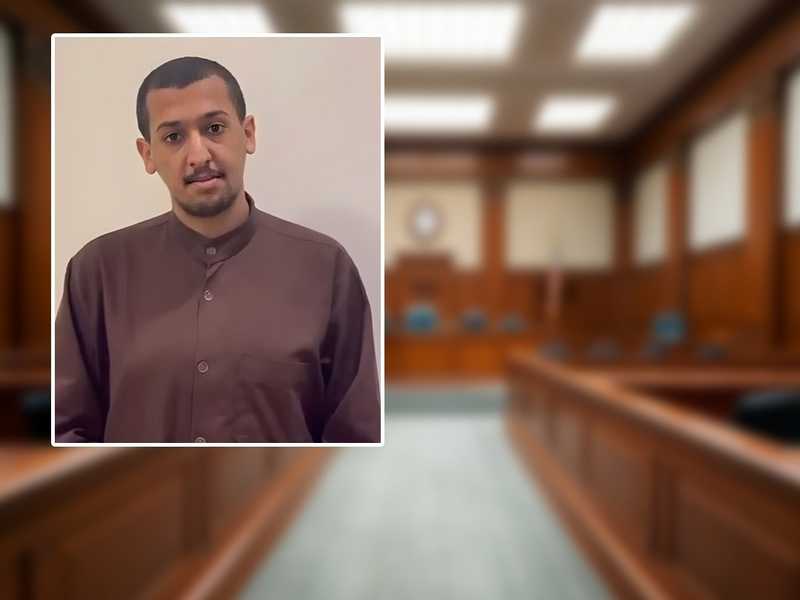
The Criminal Court sentenced Salman Al-Khalidi to 15 years in prison with hard labor for insulting the Amir and publishing offensive content.
Translated by Alqyas from Al-Qabas — Original source
Mubarak Habib: The Criminal Court, presided over by Senior Judge Abdulwahab Al-Muaili and composed of Judges Abdulrahman Fouad Al-Rifai and Waqian Najib Al-Waqian, sentenced Salman Al-Khalidi to 15 years in prison with hard labor, deportation, and banishment from the country after serving his sentence, on charges of endangering state security. The court also fined a second defendant in the same case 1,000 dinars and ordered the permanent closure of the electronic media outlet on the social media platform “Instagram,” as well as the deletion and destruction of the video clips, images, and statements obtained.
The first defendant was accused of “publicly insulting the Amir through cartoons and images, and affronting the institution of the Emirate, as well as carrying out hostile acts against a sister state, thereby exposing Kuwait to the severance of political relations.” He also published, via the information network and using technological means, content deemed to harm the dignity of the head of the Central Agency for Addressing the Status of Illegal Residents.
The court attributed to the second defendant the publication of insulting video clips produced by the first defendant.
In the reasoning behind its verdict, which was obtained by Al-Qabas, the court affirmed that state security is a comprehensive entity upon which the nation’s sovereignty, stability, unity, and prestige—both domestically and internationally—rest. Therefore, any act that touches upon its symbols, diminishes its status, or endangers its political relations constitutes a serious transgression that does not warrant leniency. The court stressed that the Amir’s person is a red line, and freedom of expression does not justify affronts.
It firmly emphasized that freedom of expression, although a right, does not extend to serving as a cover for insult, a shield for affront, or a tool to harm state symbols or publicly demean sovereign institutions. There is no freedom to dismantle the state’s entity, nor any right to undermine its prestige. The position of His Highness the Amir of Kuwait is at the core of state security, a symbol of sovereignty, and a manifestation of unity. Thus, publicly harming him, by any means, is not merely a linguistic transgression, but an act that strikes at the very essence of the system itself.
Furthermore, since Kuwait’s political relations with sister states constitute an essential dimension of its security, any public insult to the symbols of those states, in a tangible context, is inherently hostile and capable of creating political risk. This is precisely what the legislator explicitly intended to criminalize.
In such crimes, the court does not stop at the literal wording of statements or at claims of intent, but rather assesses the seriousness of the act, its context, and its impact, in order to safeguard the state, protect its prestige, and deter anyone who uses expression as a conduit for insult. Freedom is not established through loud voices, nor is it squandered through disguised frivolity; rather, it is built on a precise balance that assigns freedom its proper place and sets appropriate limits.
Freedom of expression. The court stated that freedom of expression must have its limits; it should not turn opinion into insult, expression into aggression, or criticism into overreach. Freedom of expression does not permit disparaging state symbols, nor does it justify demeaning sovereign statuses, nor does it justify insults under the guise of speech, images, or broadcasting. Freedom is not chaos, opinion is not hostility, and expression is not aggression. Although a word may be light on the tongue, it can weigh heavily on the scales of law if it exceeds the bounds of opinion and pursues a path of aggression. The Constitution, in Articles 6, 36, and 37, made freedom of thought and expression a crown adorning the forehead of the state, but it erected around it a fence of responsibility. Thus, it should not be used to violate dignities or breach sanctuaries, because freedom born without regulation devolves into chaos, and thought unbound by truth plunges into abysses of injustice and aggression. Although the law recognizes freedom of expression, it does not permit it to be used as a weapon to undermine the prestige of state symbols, to act aggressively toward sister and friendly states, or to infringe upon personal dignity. Permissible criticism is that which adheres to the path of etiquette and is grounded in truth. As for those who use communication media as a conduit to ignite hatred, they have distanced themselves from the protection of the law.
Insulting the rulers of Gulf states constitutes a complete hostile act. The Criminal Court stated that the relations linking Kuwait to sister states are not incidental, but rather firm bonds, a historical fabric, a shared destiny, intertwined security, and political and economic integration, based on mutual respect. The court noted in its reasoning that any public act involving the demeaning of symbols of those states, when issued in a tangible, perceptible form, constitutes a departure from the path of opinion and entry into the sphere of political danger that the legislator intended to criminalize. Hostile acts are not limited to images of war or violence; the legislator expanded them to include any public, tangible, perceptible act that demonstrates contempt, hostility, or belittlement of a state, provided it is inherently capable of causing harmful political effects. Since the first defendant published images and phrases disparaging the rulers of the Arab Gulf states in a public context, through an open medium, and in a manner reeking of contempt and ridicule, his act does not constitute opinion, political criticism, or general analysis, but rather a complete hostile act that gathers the elements of publicity, infringement, and potential danger, as intended by the legislator. The law does not require that harm actually occur or that relations be severed; it is sufficient that the act is capable of exposing the state to this risk.
Key points of the court’s reasoning: The emirate is the foundation of the state’s prestige and security; the security of the state is the security of a comprehensive entity upon which national sovereignty and stability rest. Any act that touches the symbols of the country or diminishes their status cannot be tolerated. Freedom of expression does not extend to serve as a cover for insult or a shield for overreach. There is no freedom to dismantle the state’s entity, nor is there opinion that undermines the country’s prestige.
