Gold Plunges Sharply to $3,883 Amid US Dollar Strength and Rising Bond Yields
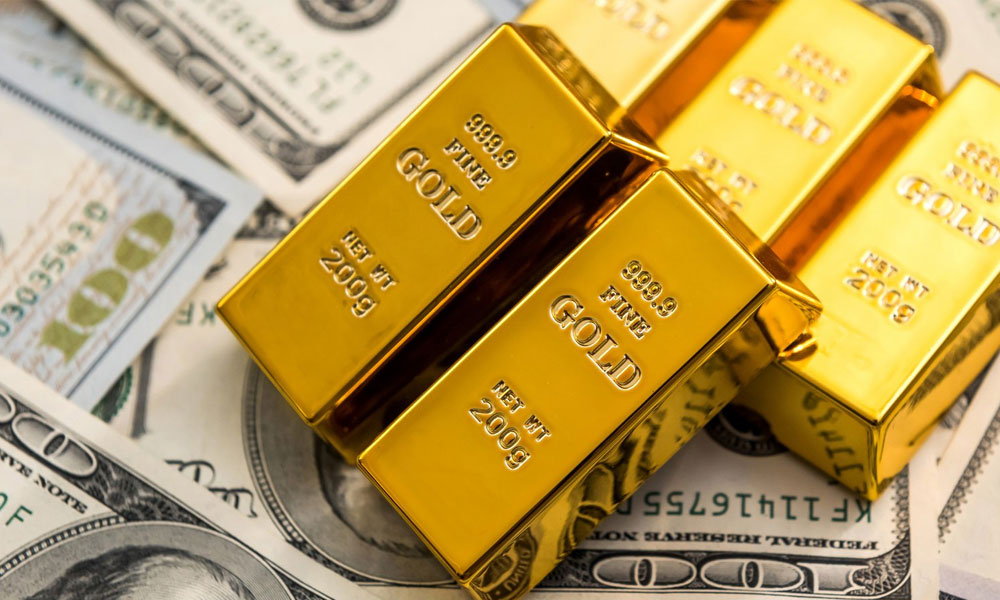
Gold prices record sharp losses due to tightening US monetary policy and dollar strength
Translated by Alqyas from Kuwait News — Original source
Gold prices ended last week’s trading with sharp losses of approximately 4.5%, closing at $3,883 per ounce under pressure from the rise in the US dollar, Treasury yields, and expectations of continued tight US monetary policy.
According to a report issued today by Kuwait Mint Company, a strong wave of selling pushed the yellow metal to shed the $4,000-per-ounce level and retreat to levels near $3,852, reflecting the extent of the pressure gold faced during the week despite limited recovery attempts at the close of trading.
The report clarified that markets witnessed a notable shift in expectations regarding US monetary policy last week, as inflation data and statements by several US Federal Reserve officials strengthened the likelihood of further interest rate hikes at the upcoming December meeting. This development negatively impacted gold’s appeal as a non-yielding asset.
It added that US producer price data for October came in below market expectations but were insufficient to alleviate concerns about persistent inflation, particularly following the release of consumer price data, which showed rising price pressures.
The report noted that market expectations for a 25-basis-point US interest rate hike in December rose to approximately 90%, while the probability of a 50-basis-point increase reached about 10%, according to market estimates cited in last week’s report.
It highlighted that these developments reflect a continued shift toward more hawkish expectations for US monetary policy, which may limit gold’s recovery prospects in the near term, especially if the dollar and bond yields remain at elevated levels.
It pointed out that markets are entering a new week amid anticipation of several key economic indicators, foremost among them the minutes of the US Federal Open Market Committee meeting, scheduled for release on November 18. These minutes will attract widespread attention as investors seek additional signals regarding monetary policy direction and the likelihood of rate hikes in December.
The report stated that markets are also awaiting US retail sales data for October, to be released on Tuesday, alongside industrial production data, which will provide important indicators regarding the strength of economic activity and levels of consumer and industrial demand.
It said that if economic data come in stronger than expected, pressure on gold could intensify due to increased bets on continued tight monetary policy. Conversely, signs of slowing economic activity could lead to lower yields and a weaker dollar, giving the yellow metal a chance to recover some of its losses.
It noted that markets will monitor statements by Federal Reserve officials for additional signals regarding their assessment of inflation, the strength of the US economy, and the central bank’s readiness to continue tightening monetary policy at upcoming meetings.
The Kuwait Mint report mentioned that the US Dollar Index regained the 103-point level and approached its highest in 19 months, coinciding with the rise in yields on 10-year US Treasury bonds to approximately 5.15%, which added further pressure to gold prices during last week’s trading.
It explained that the relationship between the dollar and bond yields will remain among the most significant factors influencing the precious metal’s movement; their continued rise may limit upside opportunities, while a decline could stimulate investment demand for gold and silver.
The report indicated that any signs of a slowdown in the US economy or a decline in inflationary pressures could alter investors’ expectations regarding the interest rate trajectory, potentially having a positive impact on the performance of precious metals.
It added that investors’ attention will focus on a number of key international economic indicators during the current week, as markets in China await data on industrial production, retail sales, housing prices, fixed-asset investment, and the unemployment rate.
It clarified that these indicators will be crucial in assessing the strength of the world’s second-largest economy and their implications for global industrial demand and precious metal markets.
It noted that geopolitical developments in the Middle East, along with oil supply and maritime navigation risks, will remain important factors this week, given their continued impact on energy markets and global inflation expectations.
Dar Al-Su’ayk’s report stated that rising oil prices could fuel inflation concerns and support demand for gold as a risk-hedging tool, but could simultaneously lead to continued monetary policy tightening and higher yields, making the impact of energy prices on the precious metal twofold.
From a technical perspective, it reported that gold experienced a sharp corrective wave during last week’s trading after failing to maintain the $4,000-per-ounce level, retreating to levels near $3,852 before closing the week at $3,883.
It added that this performance reflects ongoing selling pressure and weakening buying momentum, amid dominance by negative factors linked to the strength of the US dollar, rising Treasury yields, and increasing expectations of tighter US monetary policy.
It explained that the zone between $3,850 and $3,852 represents a key support level for gold during the current week, as a break and sustained close below it could pave the way for further correction toward $3,800, and then $3,750 if selling pressures intensify.
Conversely, it noted that the $3,900 zone represents the first resistance level that gold needs to surpass to alleviate current pressures, followed by the $4,000 level, which serves as a significant psychological and technical barrier for regaining upward momentum.
The report considered that if prices succeed in breaking through and sustaining above the $4,000 level, attention may shift to the zone between $4,115 and $4,155, which represents a major resistance range before targeting $4,200, and then $4,300, should supportive economic and financial factors for the precious metal improve.
It viewed that gold’s movements during the current week will remain contingent on its ability to hold above the support zone at $3,850 and its success in reclaiming the $4,000 level, alongside monitoring developments in the dollar, bond yields, and the Federal Reserve’s meeting minutes.
On the local front, Dar Al-Su’ayk’s report stated that gold prices in the Kuwaiti market continue to be influenced by global ounce movements. The price of 24-karat raw gold per gram stood at approximately 3.170 Kuwaiti dinars (about $126 US), while the price of 22-karat gold reached around 3.905 dinars (approximately $116). The price of a kilogram of silver stood at about 5.559 dinars (approximately $1,811).
