Foreign Minister reaffirms Kuwait's steadfast support for the UN and its firm commitment to its Charter principles
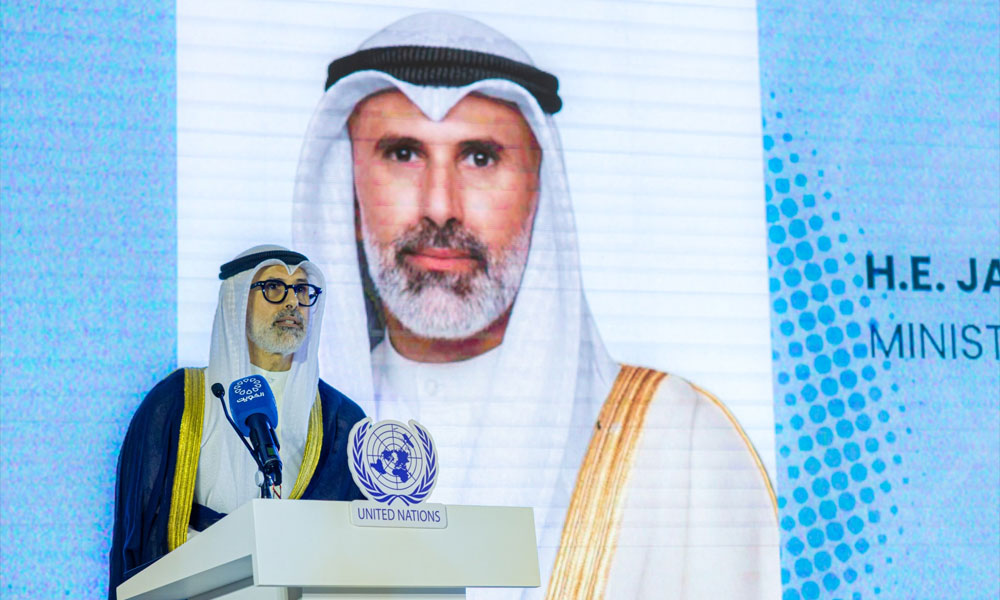
The Foreign Minister affirmed Kuwait's support for the UN and diplomacy.
Translated by Qiyas from كويت نيوز — Original source
Kuwait’s Foreign Minister, Sheikh Jaraah Jaber Al-Ahmad Al-Sabah, affirmed on Tuesday Kuwait’s unwavering support for the United Nations and its firm commitment to the principles of its Charter, emphasizing that enhancing the effectiveness of the organization and prioritizing diplomacy and international cooperation are fundamental pillars for building a safer, more peaceful, and prosperous future.
This statement came during a speech by Sheikh Jaraah Jaber Al-Ahmad Al-Sabah at an event commemorating United Nations Day, hosted by the UN mission in Kuwait under the patronage of the Foreign Minister, with the theme “The Power of Diplomacy.” The event was attended by ambassadors and heads of diplomatic missions accredited to Kuwait, heads of international representative offices, and several senior state officials.
The Foreign Minister praised the pivotal role played by the United Nations since its establishment in 1945 in preserving international peace and security, promoting sustainable development, protecting human rights, and consolidating dialogue and cooperation among nations.
He highlighted the significance of this year’s event theme, “The Power of Diplomacy,” against the backdrop of successive global crises, conflicts, and escalating geopolitical tensions, noting that diplomacy serves as an effective tool for conflict prevention, bridging differences, and building trust, particularly when grounded in the UN Charter and international law.
He stressed that diplomacy is a core element of Kuwait’s identity, explaining that since joining the United Nations in 1963, Kuwait has pursued a balanced and moderate foreign policy based on respecting the sovereignty and territorial integrity of states, non-interference in their internal affairs, and upholding the values of dialogue and mediation to resolve disputes.
He added that over the past decades, Kuwait has continued its efforts to contain regional and international crises and de-escalate tensions, whether through public initiatives or quiet diplomatic endeavors, driven by its belief in diplomacy’s capacity to find solutions even under the most difficult circumstances.
With deep appreciation and gratitude, he recalled the historic stance of the United Nations, particularly the Security Council, regarding the Iraqi invasion of Kuwait in 1990, affirming that Kuwait’s liberation in 1991 stands as one of the UN’s most notable success stories, demonstrating the effectiveness of international law and the UN Charter in safeguarding state sovereignty.
In the context of the enduring partnership between Kuwait and the United Nations spanning more than six decades, Sheikh Jaraah Jaber Al-Ahmad Al-Sabah commended the outcomes of this collaboration, including humanitarian and development initiatives that have supported communities affected by conflicts and natural disasters, and bolstered efforts to achieve the Sustainable Development Goals in cooperation with various UN agencies, programs, and funds.
He emphasized that humanitarian action represents an authentic and deeply rooted value in Kuwaiti society, reflected in the country’s foreign policy and manifested in numerous initiatives, most notably the establishment of the Kuwait Fund for Arab Economic Development in 1961. He underscored the close interconnection between peace and development, stating that there is no peace without development, and no development without peace.
He further affirmed that under the wise leadership of His Highness the Amir of Kuwait, Sheikh Meshal Al-Ahmad Al-Jaber Al-Sabah, may God protect and guard him, and His Highness the Crown Prince, Sheikh Sabah Khaled Al-Hamad Al-Sabah, may God protect and guard him, Kuwait will continue to play its role as an active and reliable partner to the United Nations, supporting multilateralism, peaceful diplomatic solutions, and humanitarian efforts, thereby contributing to achieving security, stability, and prosperity.
For her part, Ghada Fathi Al-Tajer, the Representative of the UN Secretary-General and Resident Coordinator in Kuwait, affirmed in a speech that Kuwait has made mediation and humanitarian diplomacy a distinctive feature of its foreign policy since joining the United Nations in 1963, praising its enduring partnership with the international organization and its humanitarian and developmental contributions over the past decades.
Al-Tajer expressed gratitude to the Government and people of Kuwait under the wise leadership of His Highness the Amir, Sheikh Meshal Al-Ahmad Al-Jaber Al-Sabah (may God protect and safeguard him), and His Highness the Crown Prince, Sheikh Sabah Khaled Al-Hamad Al-Sabah (may God protect and safeguard him), emphasizing the importance of the existing partnership in supporting international efforts to achieve peace and sustainable development.
She stated that diplomacy requires greater courage than the use of force, noting that dialogue, listening, reliance on reason, and consensus-building are essential tools for resolving conflicts. She pointed out that diplomacy holds particular significance in Kuwait given its history of mediation, hosting humanitarian conferences, and mobilizing support for millions in need.
She added that Kuwait’s developmental aid has reached more than 100 countries over six decades, a legacy embodied by the exhibition “Diplomacy through Development,” and noted the United Nations’ pride in honoring this role by naming the late His Highness the Amir, Sheikh Sabah Al-Ahmad Al-Jaber Al-Sabah, as Leader of Humanitarian Action.
She stressed that the need for diplomacy has become more urgent than ever, amid escalating conflicts and tensions, as well as global challenges that exceed the capacity of individual states to address alone, including climate change, water scarcity, pressures on food systems, and the rapid transformations the world is undergoing due to artificial intelligence, along with the associated opportunities and risks that require appropriate governance.
Kuwait was also congratulated on its re-election to the membership of the Human Rights Council, with the United Nations expressing its hope to continue joint efforts to promote decent work and safeguard the rights of all, including migrant workers who make significant contributions to the Kuwaiti economy and society.
