Kim Jong Un Returns to North Korea After Short Visit to Chinese Border City of Dandong
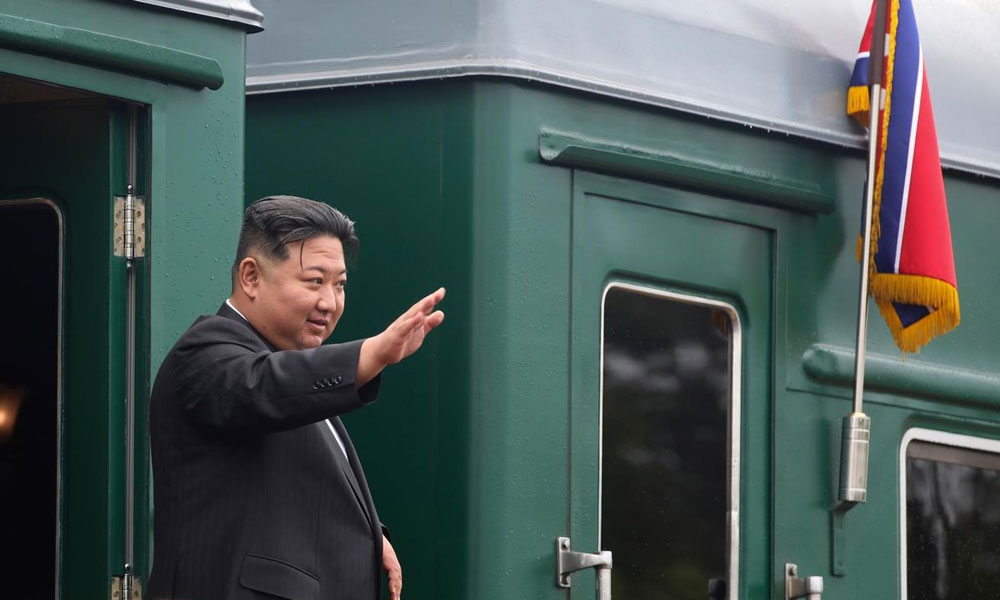
North Korean leader Kim Jong Un returned to his country after a brief visit to the border city of Dandong, where he met with high-ranking Chinese officials.
Translated by Qiyas from كويت نيوز — Original source
North Korean leader Kim Jong Un returned to his country on Saturday after a one-day visit to the Chinese border city of Dandong, where he met with a senior Chinese official, crossing the newly opened bridge that connects the two countries.
Wang Huning, China’s top political advisor, met with Kim Jong Un in Dandong, conveying “President Xi Jinping’s warm greetings and best wishes,” according to the official Xinhua News Agency.
The agency added, “When Kim Jong Un left Dandong, Wang Huning escorted him to the new Yalu River bridge between China and North Korea.”
South Korean government sources, cited by Yonhap News Agency earlier on Saturday, reported on the visit, which had not been previously announced by either North Korea or China. South Korean lawmaker Yun Kun-young stated that it was “believed” that Kim met with Chinese Premier Li Qiang on Saturday.
The new bridge, opened more than two weeks ago, is expected to strengthen economic ties between one of the world’s most isolated countries and its powerful neighbor.
Construction of the four-lane, 3,026-meter-long bridge was completed in 2014, but its opening was delayed due to several issues, including the lack of access roads and customs facilities on the North Korean side, according to South Korean media.
The opening of the new bridge comes about a month after North Korea and Russia inaugurated the first land bridge connecting the two countries, a move Pyongyang described as evidence of strengthened relations following its dispatch of troops to support Moscow in its war in Ukraine.
The ruling Democratic Party of South Korea had previously told Agence France-Presse (AFP) that it had received information suggesting Kim would return to his country later on Saturday.
Another government source told AFP that the North Korean leader entered China via the newly opened Yalu River bridge.
The South Korean lawmaker said he had received information on Friday regarding the potential visit.
He stated that the purpose of the visit was unclear, but it might carry a “positive signal” regarding the possibility of a summit between the United States and North Korea, according to a statement he issued to AFP.
Kim’s visit to Dandong precedes the APEC summit in November in Shenzhen, China, fueling speculation about a potential meeting between the North Korean leader and U.S. President Donald Trump.
Yang Moo-jin, former president of the University of North Korean Studies in South Korea, told AFP that Kim Jong Un “may have sought to reaffirm the economic cooperation agreed upon during Xi Jinping’s visit to North Korea” earlier this year, and to “press China to accelerate the implementation of its commitments.”
He added, “He may also have sought to secure Beijing’s active support and cooperation in preparation for a potential summit with Trump.”
China is North Korea’s largest trading partner and a vital source of diplomatic, economic, and political support for the nuclear-armed state.
Kim Jong Un hosted Xi Jinping in Pyongyang in June, shortly after the Chinese president met with Donald Trump and Vladimir Putin in Beijing.
Earlier on Saturday, the official North Korean news agency reported that Kim Jong Un urged his military to train to become the strongest in the world, during a two-day meeting of military unit commanders in Pyongyang.
The meeting, held on Thursday and Friday, aimed to formulate a plan “to create the strongest army in the world,” according to the North Korean news agency.
South Korea offered North Korea on Friday to hold military talks on demarcation lines in the center of the Demilitarized Zone separating the two Koreas, following a number of dangerous incidents, according to South Korea’s Ministry of National Defense. In September, three South Korean soldiers were injured by the explosion of two landmines in the DMZ. Seoul accused the North of planting them, a charge that Pyongyang firmly denied.