Sheikha Al-Bahr: Diversification Supports National Bank of Kuwait's Resilient Performance Amid Regional Challenges
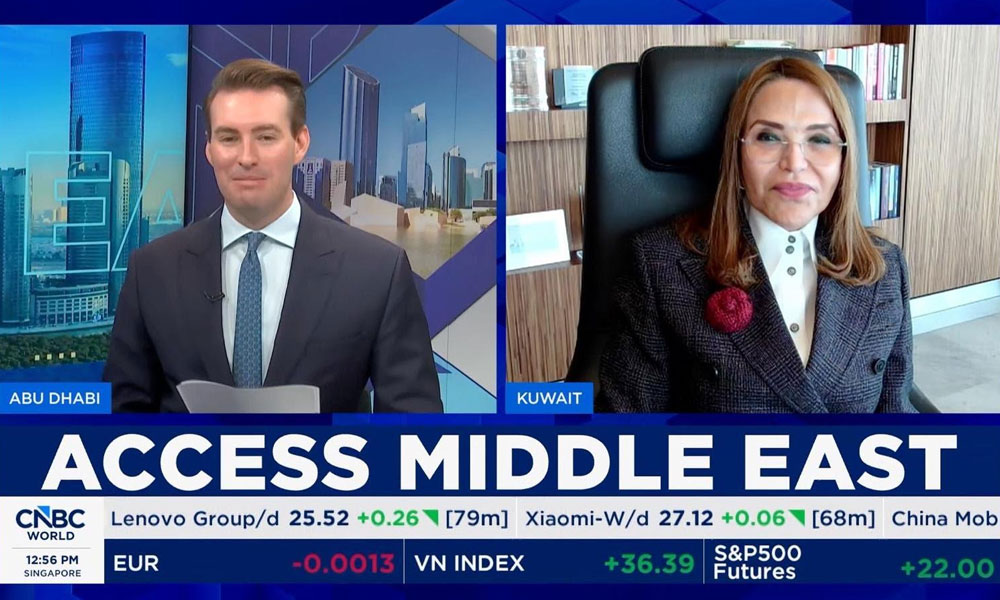
Deputy CEO of the National Bank of Kuwait confirms growth in profits and assets thanks to diversification strategy and the resilience of the banking model.
Translated by Qiyas from كويت نيوز — Original source
Sheikha Al-Bahr, Deputy Chief Executive Officer of National Bank of Kuwait (NBK), confirmed that the Group achieved strong financial results during the first nine months of 2026, despite escalating geopolitical tensions in the region, driven primarily by the performance of its core banking activities.
In an interview with CNBC, Al-Bahr stated that the Group’s net profit reached 481.7 million Kuwaiti dinars ($1.6 billion) during the first nine months of the year, representing growth exceeding 3% compared to the same period last year. Total assets rose by 4.5%, while the loan portfolio grew by more than 8%, reflecting the resilience of NBK’s business model and its ability to adapt to various economic and geopolitical changes.
Al-Bahr attributed the profit growth in the first nine months of 2026 to a 4% year-on-year increase in revenues, alongside improved operating cost trends and lower provision burdens. She noted that the strength of the balance sheet, asset growth and quality, diversified funding sources, and robust capital ratios all contributed to supporting the Group’s financial performance.
Al-Bahr emphasized that NBK continues to achieve balanced growth across its main business lines and geographic markets, supported by a regional and international diversification strategy that has proven effective in enhancing the Group’s capacity to withstand geopolitical challenges.
She explained that the Group has continued to navigate growing uncertainty stemming from geopolitical developments, leveraging its diversified business model, conservative risk management and governance framework, and disciplined strategy execution.
She added that since the outbreak of the war, NBK has focused on maintaining operational resilience, successfully supporting its customers and monitoring credit and operational risks across all markets where it operates. She highlighted that the diversification of the bank’s business portfolio, its established and long-standing customer relationships, and its ability to access funding from multiple geographic markets are among its key strengths in the current challenging and volatile environment.
Al-Bahr stressed that diversification strategy will remain a cornerstone of NBK’s growth in the coming period, noting that the bank has significant opportunities for expansion across multiple global markets, not limited to the domestic market.
She confirmed that NBK will continue to focus on diversifying its revenue sources and growing fee and commission income to mitigate the impact of interest rate movements on profits. Additionally, the bank aims to better leverage its international operations and enhance cross-selling of products and services across its markets to create new growth opportunities. She pointed out that the bank holds strong positions in personal banking, wealth management, and non-cash business segments such as letters of credit and guarantees.
Al-Bahr anticipated that efforts to improve the asset mix will continue, with the issuance of government debt instruments under the new Public Debt Law providing additional opportunities to deploy liquidity into high-quality assets, thereby supporting the stability of the net interest margin.
Commenting on the impact of geopolitical challenges on the Kuwaiti economy and the banking sector, Al-Bahr noted that while the growth pace has undoubtedly slowed compared to periods preceding regional geopolitical tensions, economic activity remains at healthy levels. She highlighted that NBK Group’s international presence has provided important opportunities to support and enable customers to expand into multiple markets.
Al-Bahr highlighted the strong growth in the pace of project awards in Kuwait, noting that the value of projects awarded since the beginning of the year reached approximately 3 billion Kuwaiti dinars ($9.7 billion), representing a 36% year-on-year increase. Meanwhile, the value of projects expected to be launched in the near future is estimated at around 10 billion Kuwaiti dinars ($32 billion), presenting promising opportunities for the banking sector to contribute to project financing and support economic growth.
She said, “We observe the government’s commitment to sustaining this momentum and accelerating project implementation through enhanced governance, accountability, and transparency, as well as intensified monitoring of work progress and completion stages, which helps mitigate the impact of geopolitical tensions on the national economy.”
Regarding the approval of the mortgage financing law, she affirmed it was a positive development, adding that its implementation in the coming period would bring about a fundamental shift and provide significant growth opportunities for the consumer banking sector over the medium to long term, benefiting National Bank of Kuwait and the Kuwaiti banking sector as a whole.
On her outlook for the Kuwaiti economy, Al-Bahr explained that the short-term view remains influenced by regional geopolitical tensions, but the medium-term outlook is positive due to the strength of Kuwait’s economic fundamentals, robust financial reserves, and the pivotal role played by the sovereign wealth fund, all of which enhance the resilience of the national economy and its capacity to withstand challenges.
She noted that the return of operating conditions to normal levels would gradually boost economic momentum and support investments and financing activities. She added that in the medium term, with shipping movements through maritime routes returning to normal, Kuwaiti oil production is expected to recover, potentially surpassing pre-conflict levels. Demand for rebuilding inventories is also likely to continue supporting prices, even as Gulf Cooperation Council (GCC) countries’ supplies return to the market.
Al-Bahr expressed optimism about the future of the Kuwaiti economy, stating that growth prospects would improve as regional political tensions ease and development projects and economic reforms continue, which would have a positive impact on the banking sector.
