Three scientists win Nobel Prize in Medicine for their research in optogenetics
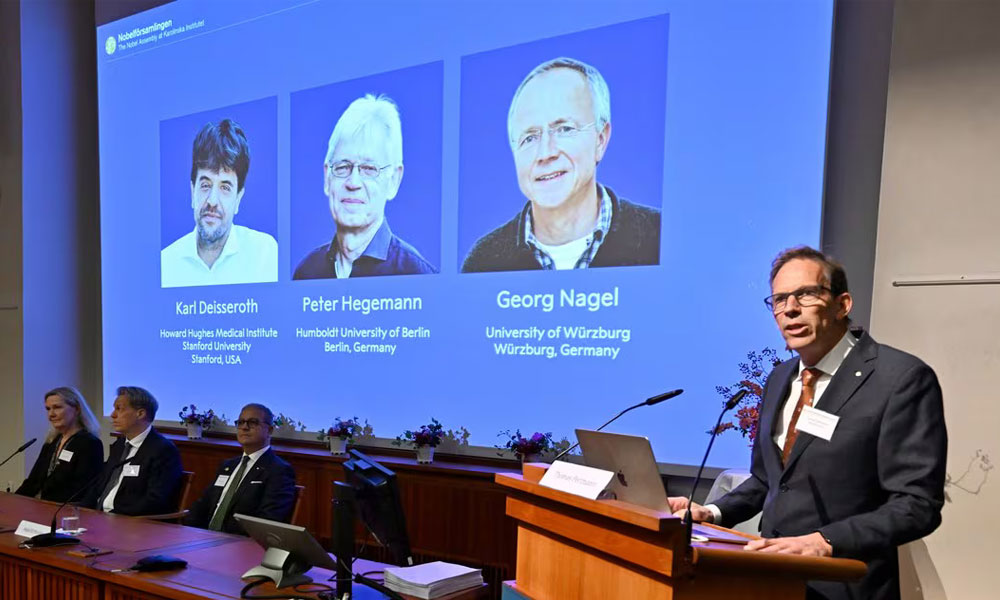
The Nobel Prize in Physiology or Medicine was awarded to American Karl Deisseroth and Germans Peter Hegemann and Jorg Nagel for their research in optogenetics, the Nobel Committee announced in Stockholm on Monday, the first day of the 2026 season for this prestigious award.
The committee stated that it awarded the prize to the three researchers “in recognition of their discoveries concerning ion channels activated by light and the field of optogenetics.”
This field helps researchers understand how specific types of cells contribute to behaviors such as learning, fear, addiction, and movement, and may one day lead to the development of treatments for neurological and sensory disorders, such as Parkinson’s disease and epilepsy.
The Nobel Committee said, “Using the technique of optogenetics, researchers have been able to uncover the neural circuits that control specific memories, emotions, and behaviors associated with neurological and psychiatric disorders.”
In the field of clinical medicine, researchers are using this approach in attempts to restore vision in people with impaired sight.
The committee added, “Optogenetics has radically changed our understanding of the brain. Every day brings new discoveries that help solve one of humanity’s greatest puzzles: how our amazing brain works.”
By using light, researchers have become able to activate or deactivate individual neural circuits in the brain.
Last year, the Nobel Prize in Medicine was awarded to Mary Brunkow and Fred Ramsdell of the United States, and Shimon Sakaguchi of Japan, in recognition of their research on how the body controls the immune system.
The winners of this year’s prize, which includes a certificate, a gold medal, and a sum of $1.2 million, will receive their awards from King Carl XVI Gustaf at a formal ceremony in Stockholm on December 10, marking the anniversary of the death of the prize’s founder, Alfred Nobel, in 1896.
In the early 2000s, Hegemann and Nagel were studying why single-celled algae can swim toward a light source.
They discovered a unique algal protein known as “channelrhodopsin,” which is located on the cell surface.
When this protein is exposed to blue light, a channel opens through it, allowing charged ions to flow into the cell, generating an electrical impulse. They found that any cell into which this protein is introduced becomes sensitive to light.
Subsequently, Deisseroth inserted the gene responsible for producing the “channelrhodopsin” protein into nerve cells taken from rats.
By shining blue light on these cells, he was able to stimulate a nerve signal.
Deisseroth published the results of his groundbreaking discovery in 2005, and two years later, he succeeded in activating this light-controlled switch in nerve cells within the brains of live mice.
In 2021, Deisseroth and Hegemann won the Lasker Award in recognition of their work in this field, a prize often considered a precursor to the Nobel Prize.
Deisseroth, 54, is a professor at Stanford University in the United States, while Hegemann, 71, is a professor of neuroscience at Humboldt University in Berlin.
Nagel, 73, is a professor of biophysics at the University of Würzburg.
The Nobel Prize in Physics is scheduled to be announced on Tuesday, followed by the Chemistry Prize on Wednesday, and the Literature Prize on Thursday.
Some observers have suggested that the Swedish Academy may choose a female writer for this year’s Literature Prize, possibly from Central or South America, following last year’s award to Hungarian author László Krasznahorkai.
In this context, literary critic Lina Al-Kalmuti told Agence France-Presse that Argentine writer Samantha Schweblin, 48, could be among the potential candidates for the award.
The Peace Prize, to be announced on Friday, is likely the most anticipated and intriguing, as it is the only Nobel Prize awarded in Oslo, Norway’s capital, rather than in Stockholm.
Some experts believe the selection committee may opt this year for a winner who enjoys broad consensus, following the controversy sparked by last year’s award to Venezuelan opposition figure Maria Corina Machado.
Last year, US President Donald Trump exerted intense pressure to receive the prize, to the extent that Machado ended up gifting him her Nobel medal. The committee is aware that Trump is also closely following the prize this year.
Kristian Berg Harpviken, secretary of the Nobel Committee, told Agence France-Presse in an interview, “There is always a great deal of lobbying, and perhaps attempts to ultimately pressure the committee,” adding, “We are quite accustomed to that.”
Among this year’s potential laureates, there is speculation that the prize might be jointly awarded to Save the Children and Mykola Koliuba, an Ukrainian children’s rights activist leading a campaign to demand the return of Ukrainian children illegally transferred to Russia from territories occupied by Moscow.
The list also includes Sudan’s Emergency Rooms, a wide network of volunteers risking their lives to assist populations facing the dual threats of war and hunger, as well as the Committee to Protect Journalists (CPJ), after 2025 recorded the highest number of fatalities in the profession’s history.
The Nobel Prizes conclude with the announcement of the Economics Prize on October 12.
