Gold prices fall to $4,142 per ounce as US bond yields continue to rise
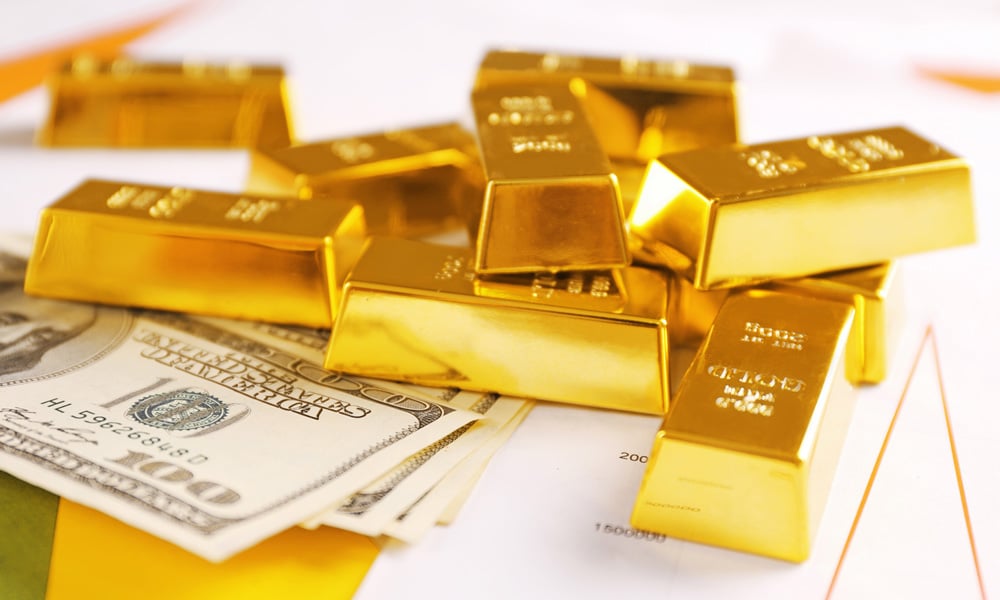
Gold prices ended last week’s trading session lower, closing at $4,142 and recording losses for the second consecutive week, as rising yields on U.S. Treasury bonds limited the precious metal’s ability to capitalize on weak U.S. labor market data.
Kuwait-based Dar Al Sana’iq reported in a statement issued on Sunday that gold experienced volatile movements last week, attempting to reclaim the $4,200 per ounce level but failing to sustain gains above it. The price declined by the end of the week amid persistent pressure from rising U.S. yields.
The report noted that gold’s decline occurred despite weaker-than-expected U.S. jobs data. The non-farm payrolls report showed the U.S. economy added only 29,000 jobs in September, compared to expectations of around 90,000, while the unemployment rate rose to 4.2% from 4.1%.
It added that these figures reinforced market expectations that the Federal Reserve would keep interest rates unchanged at its next meeting. However, rising Treasury yields limited the impact of the weak data on the dollar and gold prices.
The report stated that rising U.S. Treasury yields remain one of the most significant headwinds for the precious metal, as higher yields increase the opportunity cost of holding gold, which is a non-yielding asset.
It pointed out that despite weak labor market data, U.S. yields remained at elevated levels, prompting investors to reassess their expectations regarding the trajectory of monetary policy in the coming months, particularly amid ongoing inflation concerns.
The report highlighted that the Federal Reserve had raised interest rates in September by 25 basis points to a range of 3.75% to 4.0%, while markets are now awaiting new signals that could shape the direction of monetary policy in upcoming meetings.
It added that the U.S. dollar continued to influence gold’s movement, as a stronger dollar makes the precious metal more expensive for investors using other currencies, potentially limiting demand.
The report noted that markets are also monitoring oil and energy price movements and their impact on inflation rates. Rising energy prices are seen as a factor that could reignite inflationary pressures and affect interest rate expectations, while a decline could provide central banks with more room to ease monetary policy.
It pointed out that geopolitical developments in the Middle East remained a key driver of market movements, with investors continuing to turn to gold as a hedge during periods of heightened uncertainty.
The report indicated that investors’ attention this week will focus on a range of U.S. economic data and events, including a services sector index, the minutes of the Federal Open Market Committee meeting, statements by Federal Reserve officials, and consumer confidence data.
It noted that these data points are particularly significant following the weak jobs report, as new indicators will help determine the extent to which the slowdown in the labor market affects U.S. monetary policy expectations.
The report concluded that if data show continued strength in economic activity and rising inflationary pressures, bond yields and the dollar may remain headwinds for gold. Conversely, additional indicators of economic slowdown could support expectations of stable or lower interest rates, providing support for the precious metal.
From a technical perspective, the report stated that the $4,200 per ounce level represents a significant barrier to recovery efforts, after gold failed to sustain trading above it during last week’s sessions.
It clarified that if prices manage to reclaim and hold above the $4,200 level, attention may shift to higher resistance levels, while nearby support zones are concentrated at $4,100, followed by the $4,000 mark, which constitutes a key psychological and technical barrier.
It added that the movement of the US dollar and yields on US Treasury bonds will remain among the most prominent factors determining gold’s direction in the coming period, alongside developments in energy prices and geopolitical risks.
On the local front, the report said the price of 24-karat gold reached approximately 4.460 Kuwaiti dinars per gram (about $134 US), while 22-karat gold recorded around 3.380 Kuwaiti dinars (about $123). Meanwhile, the price of a kilogram of silver stood at approximately 6.570 Kuwaiti dinars (about $2,133).
