Kuwait Diving Team: Coral Bleaching Rate in 'Arawijan' Very Low and Within Annual Average
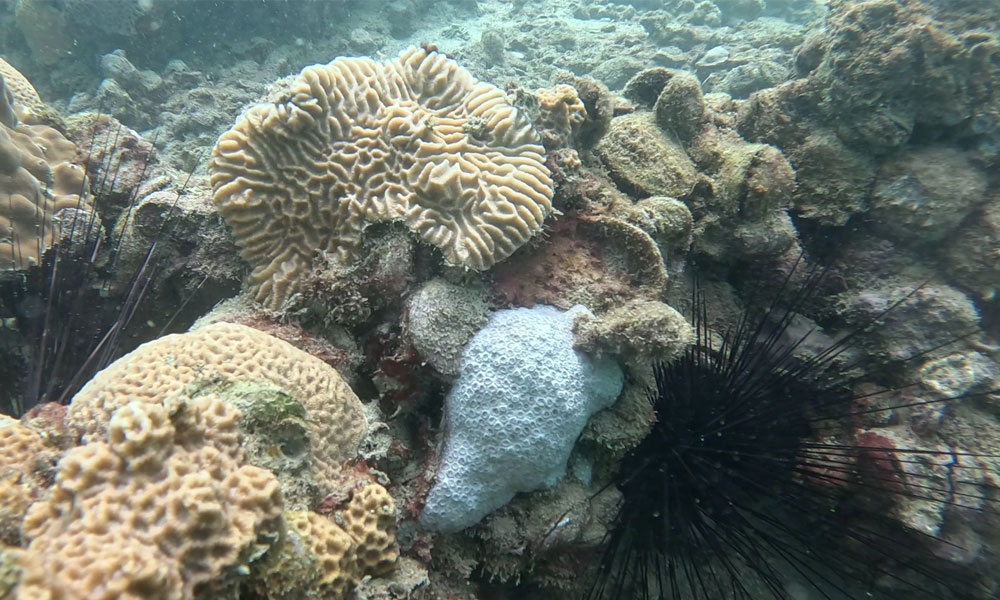
The Kuwaiti diving team affiliated with the Environmental Volunteer Foundation (Al-Mabra) confirmed on Wednesday that the bleaching rate in the Arwajan reef patch is very low and within the annual bleaching average.
Mahmoud Ashkanani, the team’s environmental projects manager, told the Kuwait News Agency (KUNA) that coral and reef monitoring is ongoing, particularly following the end of the marine heatwave period that lasted from July 21 to late August last year.
Ashkanani explained that after inspecting the site, it was found that the infection was limited to only four coral species: Montastrea annularis (honeycomb coral), Montastraea cavernosa (grooved brain coral), Montastraea faveolata (smooth brain coral), and Diploria labyrinthiformis (grooved brain coral).
He added that the team observed a black band phenomenon in a colony of grooved brain coral, a disease known as “black band disease,” which appears as a distinct band sharply separating living and dead tissue.
He noted that the black line consists of microscopic microbes made up of several types of bacteria that secrete hydrogen sulfide compounds and other toxins, depriving coral tissues of oxygen, poisoning them, and causing immediate death.
Regarding the factors stimulating the emergence of these microbes, he stated that they are linked to rising water temperatures, as thermal stress and deteriorating water quality reduce coral immunity, making them more susceptible to bacterial attacks.
He emphasized that the team recommends continued scientific monitoring and warns divers to avoid touching the black band with hands or equipment to prevent the transmission of bacterial infection to other healthy coral colonies.
Ashkanani pointed out that the coral condition there is thriving, according to coral monitoring under the “Coral Watch” program of Australia’s University of Queensland. The colors indicated coral health and recovery, although levels had not yet returned to those seen before 2010; however, this is a strong indicator that corals have adapted to record-high temperatures.
He clarified that water temperatures ranged from 33.3 degrees Celsius near the surface to a low of 31.6 degrees Celsius at a depth of 10.2 meters. Most colonies experiencing total bleaching were located at depths exceeding 8 meters, while those near the surface, at around 2.6 meters, were the healthiest and most vibrant.
Ashkanani noted that Kuwait’s coral reefs have suffered several major bleaching events over the past three decades, specifically in the years 1998, 2010, 2015, 2016, and 2020.
He explained that bleaching occurs when zooxanthellae algae, which live within coral tissues, are expelled due to loss of stability caused by rising temperatures. As a result, the coral loses the color it derives from these algae, its tissue becomes transparent, and the white calcium carbonate skeleton becomes visible.
He further stated that corals also lose more than 75 percent of their food supply provided by algae, which obtain energy through photosynthesis by absorbing carbon dioxide from the water and light, converting them into carbohydrates. If conditions do not return to normal, the longer the stress persists, the higher the likelihood of coral mortality.
He mentioned that the Arwajan reef is Kuwait’s second-largest coastal reef after the Al-Zour patch, located 14.5 kilometers southeast of Al-Fahaheel and nine kilometers east of the Abdullah Port coast. It has an oval shape, with a maximum length of 625 meters, a width of 480 meters, a perimeter of 8.1 kilometers, and an area of 221,000 square meters.
He added that its reefs are characterized by the Montastraea family, particularly the grooved brain coral, featuring large sizes, significant heights, and dark colors that distinguish them from similar species in other reefs. Their sizes vary, with some peaks of these formations reaching a depth of one meter below the water surface at their lowest points, as well as nodular hump coral.
Ashkanani clarified that the site is also characterized by the presence of green sea fan coral and sea pen coral on the sandy seabed surrounding the reefs to the west, as well as a navigational beacon and the wreckage of a trailer on the eastern side at a depth of ten meters. He noted that the team identified more than 19 species of coral and over 36 species of organisms and fish. Additionally, they installed and secured six mooring buoys adjacent to its eastern boundary for use by visitors, and established two coral colonies in its vicinity.
