Deputy Emir and Prime Minister of Kuwait Delivers Kuwait's Address at the United Nations General Assembly
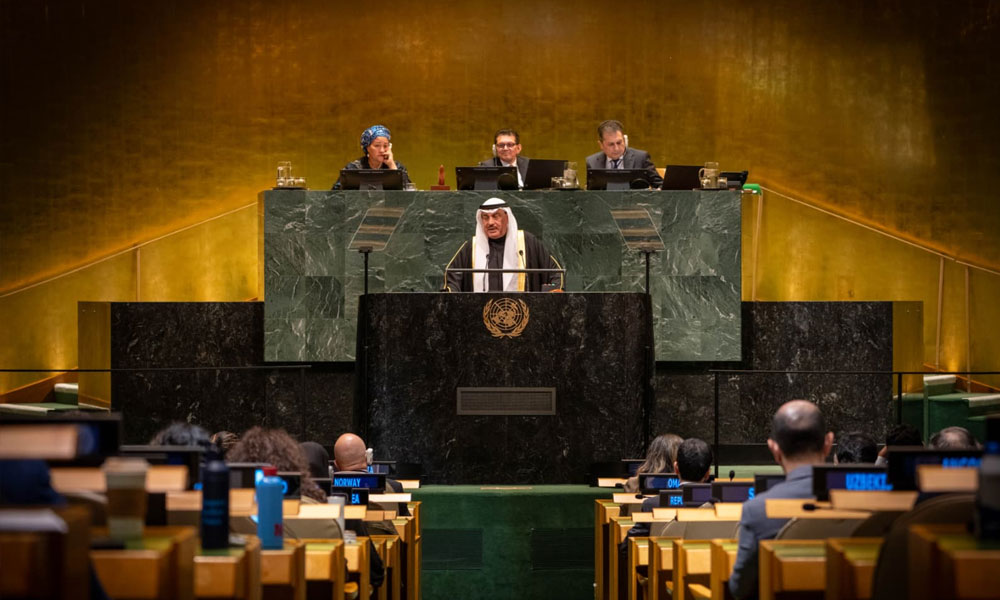
The representative of His Highness Sheikh Meshal Al-Ahmad Al-Jaber Al-Sabah, the Amir of the Country, may God protect him, was addressed by His Highness Sheikh Sabah Khaled Al-Hamad Al-Sabah, the Crown Prince, may God protect him, stating that Kuwait, the countries of the Gulf Cooperation Council, and the Hashemite Kingdom of Jordan have been subjected since February last year to an unjust Iranian aggression involving ballistic and cruise missiles and drones, despite not being parties to the ongoing conflict in the region, in blatant violation of international law, international humanitarian law, and the UN Charter.
This statement was made by the representative of His Highness Sheikh Meshal Al-Ahmad Al-Jaber Al-Sabah, the Amir of the Country, may God protect him, delivered by His Highness Sheikh Sabah Khaled Al-Hamad Al-Sabah, the Crown Prince, may God protect him, before the proceedings of the eighty-first session of the UN General Assembly at the Organization’s headquarters in New York. The text is as follows:
“In the name of God, the Most Gracious, the Most Merciful”
Your Excellency, President of the General Assembly,
Your Excellency, Secretary-General,
Your Majesties, Excellencies, and Highnesses,
Ladies and Gentlemen,
Peace, mercy, and blessings of God be upon you.
I am pleased at the outset to convey to you the greetings of His Highness the Amir of the State of Kuwait, Sheikh Meshal Al-Ahmad Al-Jaber Al-Sabah (may God protect him), and his wishes for the success of the work of this session. We congratulate Your Excellency Dr. Khalilur Rahman and the friendly People’s Republic of Bangladesh on his election as President of the General Assembly, affirming our support for Your Excellency and for his wise choice of the theme for this session: “Restoring Trust and Navigating Transformations: The United Nations Delivering on the Interests of All.”
We also express our gratitude to Your Excellency Annalena Baerbock for the commendable efforts she exerted during her presidency of the previous session. We do not fail to commend the efforts, initiatives, and proposals of the Secretary-General in strengthening multilateral international action, such as the UN80 initiative, the Pact for the Future, and the ongoing efforts to confront global challenges and crises, including conflicts, wars, climate change, and terrorism, as well as assisting Member States in achieving the Sustainable Development Goals and enhancing international action on artificial intelligence. We hope that efforts will continue after the end of the Secretary-General’s term at the end of this year, ensuring the continuity of work to reform and develop the Organization’s organs, activate its role, and elevate its performance in fulfilling its responsibilities.
In this context, we emphasize that reforming the Security Council – the organ entrusted with maintaining international peace and security – has become a necessity to keep pace with the significant increase in the number of Organization members and the changes that have occurred in international relations since its establishment. There is an urgent need for the Council to be more representative, effective, and transparent in fulfilling its responsibilities.
Mr. President, Kuwait, the countries of the Gulf Cooperation Council, and the Hashemite Kingdom of Jordan have been subjected since February last year to an unjust Iranian aggression involving ballistic and cruise missiles and drones, despite not being parties to the ongoing conflict in the region, in blatant violation of international law, international humanitarian law, and the UN Charter.
These brazen attacks – carried out systematically and repeatedly – targeted civilian objects and vital facilities, including Kuwait International Airport, power and water stations, and oil facilities, revealing an aggressive approach aimed at disrupting the foundations of life and vital infrastructure. These unjust attacks have claimed the lives of martyrs and innocent civilians, caused numerous injuries, and inflicted severe material and economic damage.
In a continued effort to harm the economies of the countries in the region and the world, and to impact global trade and oil markets, Iran is obstructing maritime navigation and closing the Strait of Hormuz, using it as leverage in the war in violation of international law and relevant Security Council resolutions.
In this regard, the State of Kuwait expresses its deep appreciation to the sister and friendly countries that stood by its side and showed solidarity with it, as well as to the countries that sponsored Security Council Resolution 2817 and other international resolutions issued by the Human Rights Council and the International Maritime Organization, which condemned the Iranian aggression as a threat to international peace and security, called for its cessation, and affirmed the natural right of states to self-defense under Article 51 of the UN Charter, as well as the importance of ensuring freedom of navigation without any conditions.
Guided by its conviction that the security and stability of the Arabian Gulf region constitute a fundamental pillar of regional and international security and stability—evidenced by the repercussions of the war and Iranian aggressions—the State of Kuwait reaffirms its support for all diplomatic efforts aimed at de-escalation and achieving a peaceful resolution to the ongoing conflict. It commends the efforts and mediation led by the sister State of Qatar and the friendly Islamic Republic of Pakistan, emphasizing the necessity of reaching sustainable regional understandings based on a firm commitment to the principles of good neighborliness, respect for state sovereignty, non-interference in internal affairs, refraining from the use or threat of force, halting support for proxies and militias, and addressing the security concerns of all countries in the region, including the Iranian nuclear file, ballistic missiles, and drones, while reaffirming the guarantee of freedom and safety of navigation and the right of passage through the Straits of Hormuz and Bab al-Mandab in accordance with international law and the 1982 UN Convention on the Law of the Sea.
Mr. President, the State of Kuwait adheres in its foreign policy to the principles of the UN Charter, particularly respecting the principle of good neighborliness, state sovereignty, and non-interference in internal affairs. From this standpoint, the State of Kuwait views the sister Republic of Iraq as a neighbor with whom it shares close ties, and as a partner in security and stability. Since the fall of the previous regime in 2003, Kuwait has been keen to support Iraq and stand by its side in facing security, political, and economic challenges, in order to restore its regional and international role and status, believing that a stable, secure, and prosperous Iraq represents a shared interest for Kuwait and the entire region.
In this context, the State of Kuwait commends the steps taken by Iraqi Prime Minister Ali Al-Zaidi to consolidate state control over weapons and strengthen Iraq’s bilateral relations with neighboring countries. We look forward to enhancing confidence-building measures between the two countries, expanding bilateral relations to broader horizons, and resolving all outstanding files between the two countries, foremost among them completing the maritime border demarcation beyond Marker 162 in accordance with international law and the 1982 UN Convention on the Law of the Sea, and adhering to the bilateral security and technical agreements and understandings signed between the two countries, foremost among them the Agreement on Regulating Maritime Navigation in the Shatt al-Arab and the 2008 Security Exchange Protocol, as they represent legal and practical tools for regulating navigation, protecting the environment, combating terrorism, and illegal arms and drug trafficking, and enhancing joint security.
Mr. President, the State of Kuwait calls on Iraq to cooperate with the High Representative of the Secretary-General in implementing Security Council Resolution 2792, in order to achieve the desired progress and outcomes in uncovering the fate of Kuwaiti prisoners and missing persons, third-country nationals, and Kuwaiti property, including the National Archives.
Mr. President, the State of Kuwait reiterates its principled and steadfast position condemning the continuous violations committed by the Israeli occupation forces against the brotherly Palestinian people, who continue to endure difficult living conditions under the weight of policies of displacement, arrests, and settlement. We call for the full implementation of the comprehensive peace plan and its subsequent phases, as adopted by the Security Council in its Resolution 2803, which includes the complete withdrawal of Israeli occupation forces from the Gaza Strip, ensuring the flow of humanitarian aid, and the return of the Palestinian Authority to the Strip, while emphasizing that the Gaza Strip is an inseparable part of the occupied Palestinian territories.
In this regard, we welcome the measures and decisions taken by the United Kingdom, France, and several other countries condemning settlement activities, imposing sanctions on settlers involved in acts of violence and terrorism against Palestinians, and imposing import bans on goods and products from settlements.
The State of Kuwait affirms that achieving a just, comprehensive, and lasting peace in the region remains contingent upon ending the Israeli occupation of all Arab territories, enabling the Palestinian people to exercise their inalienable legitimate rights, and establishing an independent Palestinian state on the borders of June 4, 1967, with its capital in East Jerusalem.
Mr. President, the brotherly Republic of Yemen is witnessing a serious military escalation resulting from Houthi group attacks on several governorates and areas along the western coast, threatening navigation in the Bab al-Mandab Strait. In this context, the State of Kuwait reaffirms its full support for the efforts led by the United Nations aimed at reaching a comprehensive and sustainable Yemeni-led settlement in accordance with the three agreed reference points and relevant Security Council resolutions, particularly Resolution 2216. The State of Kuwait emphasizes that any political settlement must safeguard Yemen’s unity, sovereignty, independence, and territorial integrity, put an end to the suffering of its brotherly people, and open avenues for security, stability, and economic development. We also stress the importance of preserving the security and safety of international maritime navigation in the Red Sea and the Bab al-Mandab Strait.
We also strongly condemn the Houthi group’s attacks on the brotherly Kingdom of Saudi Arabia, targeting civilian and economic installations in several cities. In this context, we affirm that the security of the Kingdom is an integral part of the security of the State of Kuwait and the Gulf Cooperation Council countries.
Mr. President, the State of Kuwait reaffirms its solidarity with the brotherly Arab Republic of Syria and welcomes the steps and measures taken by the international community to lift sanctions against it and remove its name from the list of state sponsors of terrorism. We also reaffirm our support for all efforts aimed at rebuilding state institutions and advancing a comprehensive and inclusive political process led by Syrians and involving the active participation of all components of the Syrian people, in order to meet their legitimate aspirations for security, stability, and a decent life. In this same context, we stress the importance of respecting Syria’s sovereignty, unity, and territorial integrity. We condemn and reject the attacks and incursions by Israeli occupation forces into Syrian territory, as they constitute a serious escalation and a violation of the 1974 Disengagement Agreement, undermining security and stability in the region.
With regard to the sisterly Republic of Lebanon, the State of Kuwait reaffirms the importance of Lebanese state institutions and the necessity of empowering them to fully exercise their authority over all its territory, monopolizing weapons in the hands of the state alone, thereby enhancing Lebanon’s sovereignty and safeguarding its security and stability. In this regard, it also underscores the importance of maintaining an independent international presence along the Blue Line to ensure the full implementation of United Nations Security Council Resolution 1701. We reiterate our call for Israel’s withdrawal from all occupied Lebanese territories.
Regarding developments in the Republic of the Sudan, the Federal Republic of Somalia, and the State of Libya, we emphasize the necessity of adhering to peaceful solutions and engaging in political dialogues to resolve differences, in accordance with relevant Security Council resolutions and the rules of international law, thereby ensuring the unity and territorial integrity and sovereignty of these sister states.
Mr. President, since its independence, Kuwait has grounded its foreign policy on firm principles characterized by moderation, balance, and a steadfast commitment to the UN Charter and international law, support for multilateral international action, and the belief that dialogue and the peaceful settlement of disputes are the optimal means of preserving international peace and security. Kuwait also believes in the complementary relationship between security and development: there can be no security without development, and no development without security.
Guided by this vision, Kuwait has embodied its developmental and humanitarian diplomacy through the pioneering role of the Kuwait Fund for Arab Economic Development, which, since 1961, has contributed to financing developmental projects in 107 countries worldwide. This reflects the conviction that addressing the root causes of crises extends beyond security approaches and requires supporting developmental programs, providing the prerequisites for dignified living, and building societies more capable of resilience and stability.
At the national level, Kuwait confidently advances toward achieving Kuwait Vision 2035 by accelerating the implementation of developmental projects, diversifying its economy and revenue sources, continuing digital transformation, empowering women and youth, developing its legislative framework, and consolidating governance and transparency. These efforts enhance institutional efficiency and economic competitiveness, and solidify Kuwait’s position as a leading financial, commercial, and cultural hub in the region.
In conclusion, my country has experienced the harshness of occupation and the bitterness of aggression, and has suffered from the wars that have ravaged and continue to ravage our region for four decades. Based on its experience, it has come to realize that it is the peoples who bear the cost of conflicts, and it recognizes the importance of the world standing united in defense of justice and adherence to the principles of the Charter and international law. From this experience, we have become convinced that peace is a stance dictated by wisdom and protected by capability; that dialogue does not diminish rights but safeguards them; and that security is not maintained by force alone, but is entrenched by justice, preserved by the rule of law, and protected by the principles of international legitimacy.
The message of the State of Kuwait, which it has believed in and acted upon, and which it will continue to uphold, is: “Just peace is the path to stability, and respect for state sovereignty, protection of the rights of peoples, and recourse to international law in resolving disputes are indispensable pillars for the security and stability of states.” Kuwait will remain, as the world has known it, a voice of wisdom and moderation, supporting dialogue, cooperation, and openness to partnerships that serve common interests and benefits, standing for justice, and partnering in consolidating international peace and security, firmly believing that peace is the means to a future where rights are protected, homelands are secure, and generations enjoy safety and prosperity.
Peace, mercy, and blessings of God be upon you.
