Asala performs her first concert in Damascus after 15 years of absence
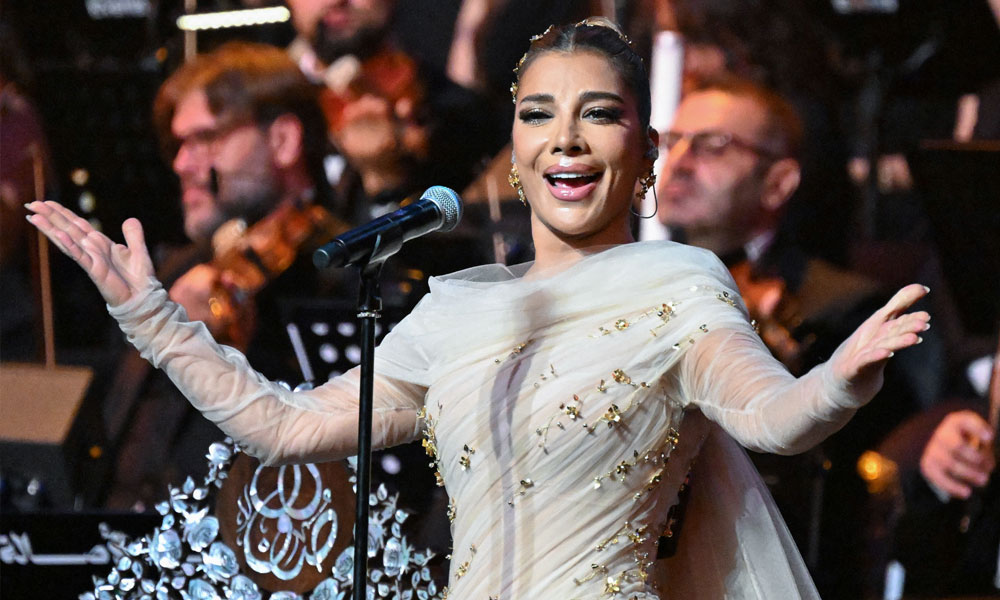
After a 15-year absence, Syrian artist Assala Nasri, known for her stance against the former President Bashar al-Assad’s rule, held a concert in Damascus on Thursday, attended by thousands of her fans.
At the Al-Fayhaa Sports Hall, Assala’s audience gathered amid tight security measures, following a campaign by Salafi activists who called for the cancellation of the concert and all other musical events across the country, arguing that they violated religious values.
Addressing an audience of approximately 5,000 people, including ministers and senior officials, Assala said at the start of the concert, “How much I have dreamed of this meeting, and how much I have wished that we could meet now that we have begun the healing process… Healing can only be achieved through art and music.”
During the years of conflict (2011–2024), which began with protests demanding the overthrow of Assad’s rule, Assala voiced her support for the peaceful uprising that soon turned into a bloody war. During that period, she refused to participate in events supporting the former regime, which made her a target of a fierce media campaign in state-aligned outlets. The Artists’ Syndicate expelled her from the union, and she subsequently left the country.
Sousan Wadha (56) said, “Assala’s return is a beautiful dream. When I saw her, I was deeply moved, because I never expected to attend her concert in Damascus” after everything that had happened.
Over the past few years, Assala has moved between Egypt and the United Arab Emirates, continuing her artistic activities in several Arab countries. Her last public appearance before a Syrian audience in Damascus was in 2010.
In Syria, anti-Assad protests were met with repression, and the devastating conflict claimed more than half a million lives and led to the division of the country. In December 2024, armed opposition factions led by Ahmad al-Sharaa, who has an Islamist background, overthrew Assad’s rule.
Assala (57) returned to Damascus this week accompanied by several family members, amid a warm welcome from Syria’s new authorities.
Before honoring her on stage, Culture Minister Mohammad Yassin Saleh described the Syrian artist as “a daughter of Sham.”
He added, “Assala’s return is the return of every sincere Syrian and every free person to their homeland.”
The Ministry of Culture sponsored the concert, titled “The Return of Authenticity,” as Syria, particularly the capital Damascus, witnesses a gradual revival of artistic and musical events, despite objections from the country’s hardline religious faction, which views such manifestations as “contrary to Islamic Sharia.”
Amid official and artistic attendance, the audience swayed to Assala’s songs on Thursday night, singing along with lyrics and melodies they had memorized and loved, while many in the audience were overcome with tears.
Assala performed tracks from her new album, “The Syrian Album,” which includes 14 songs rooted in the local heritage of several Syrian governorates, as well as a song in the Kurdish language.
The project revives musical styles and dialects from Damascus, Aleppo, Hauran, Suwayda, the Coast, Al-Jazeera, the Badia, and other Syrian regions, in a work Assala described as a celebration of the country’s cultural and social diversity.
The album carries special symbolism in a country still trying to overcome the divisions left by years of conflict, which have been exacerbated by waves of sectarian violence in several regions following the fall of the former regime.
Assala dedicated the song “Mahboob Qalbik” to Suwayda, a predominantly Druze governorate, which was met with enthusiastic applause from the audience. The governorate witnessed violent events in July 2025 that killed more than 2,000 people, according to the Syrian Observatory for Human Rights, while an official investigation documented the deaths of at least 1,760 people.
The Syrian Coast was also represented through the songs “Ala Rawd al-Habib” for Latakia and “Ala Dalouna” for Tartus. The Coast witnessed widespread violence in March 2025, during which 1,426 civilians were killed, most of them from the Alawite minority.
Political advisor to the government, Farah al-Attassi, told AFP, “This is the Syria we know, and this is the Syria that will remain. Poetry, the word, thought, song, and culture are an integral part of Syrian identity.”
