Kuwait Foundation for the Advancement of Sciences and Kuwait Banks Association Review Study on Banking Sector's Role in Supporting National Development Plan
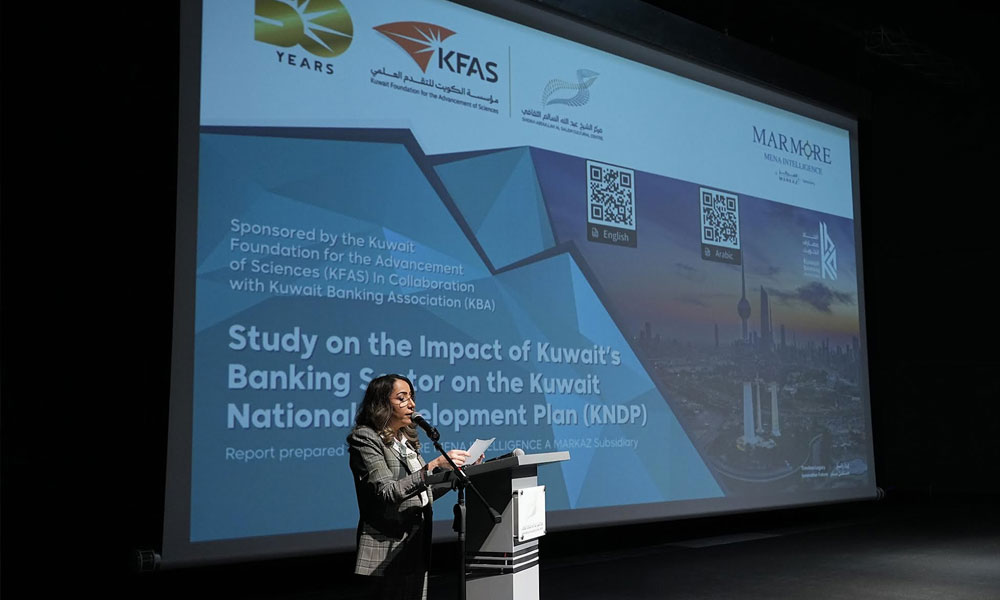
The Kuwait Foundation for the Advancement of Sciences and the Kuwait Banks Association reviewed a study on the role of the banking sector in supporting the national development plan.
Translated by Alqyas from Kuwait News — Original source
The Kuwait Foundation for the Advancement of Sciences (KFAS), in collaboration with the Kuwait Banks Association and Marmore MENA Intelligence, a subsidiary of the Kuwait Financial Centre, organized a seminar to present the findings of a study on the impact of the Kuwaiti banking sector on the national development plan. The event was held at the Sheikh Abdullah Al-Salem Cultural Centre and attended by various leaders, specialists, and representatives from the banking and financial sectors, as well as relevant authorities.
In a press statement, the foundation said the study’s funding stems from its role in supporting applied research addressing national priorities and challenges, contributing evidence-based insights to inform policy development and enhance cooperation among government entities, the private sector, and financial institutions.
The study examines the role the banking sector can play in supporting the implementation of the national development plan and achieving the goals of the “New Kuwait 2035” vision, particularly in financing major development projects, public-private partnerships, supporting small and medium-sized enterprises (SMEs), digital transformation and fintech, financing non-oil sectors, and green and sustainable projects.
The seminar featured a presentation of the study’s key findings and recommendations, along with opportunities and challenges related to enhancing the banking sector’s contribution to financing development priorities, and ways to develop financing models and accelerate project implementation.
For his part, the Kuwait Banks Association clarified that the study addressed the state of the Kuwaiti economy and the banking sector, reviewed a number of relevant regional and international practices and experiences, and analyzed key opportunities and challenges associated with the banking sector’s role in supporting economic development and financing strategic projects.
The association emphasized that the study offers a practical and comprehensive vision to support the implementation of the national development plan through a set of actionable recommendations aimed at developing the financing system, strengthening public-private partnerships, and supporting innovation, digital transformation, and sustainable finance, in line with the goals of the “New Kuwait 2035” vision. The study also serves as a model of collaboration between research institutions, the private sector, and development stakeholders, and as a reference to support decision-making and the formulation of economic and financial policies on a scientific basis.
The association also noted that the study highlighted the importance of building on the Kuwaiti banking sector’s strength, stability, and advanced financing capabilities, underpinned by prudent regulatory policies and continuous efforts led by the Central Bank of Kuwait to enhance financial stability and develop the banking system.
The study pointed to the importance of directing more financing toward priority sectors and development projects, expanding banks’ participation in financing public-private partnership projects, developing more flexible financing solutions for SMEs, and strengthening partnerships with fintech companies while expanding the scope of green and sustainable financing.
The study’s recommendations stressed the importance of developing governance frameworks and institutional coordination among relevant entities, enhancing project monitoring mechanisms, expanding the use of public-private partnership models, and diversifying financing tools through bank lending, financial markets, and co-financing, alongside developing credit guarantees and incentives aimed at financing sectors and projects aligned with the national development plan’s objectives.
The institution and the Kuwait Banks Association emphasized that achieving national development targets requires the integration of efforts and financing sources among government entities, the banking sector, the private sector, and investment institutions, thereby contributing to mobilizing financial resources, accelerating the implementation of development projects, enhancing the role of non-oil sectors, and supporting Kuwait’s transition toward a more diversified, sustainable, and knowledge-based economy.
