NASA to Launch the "Roman" Telescope on Sunday, Tasked with Mapping an Unprecedented Map of the Universe
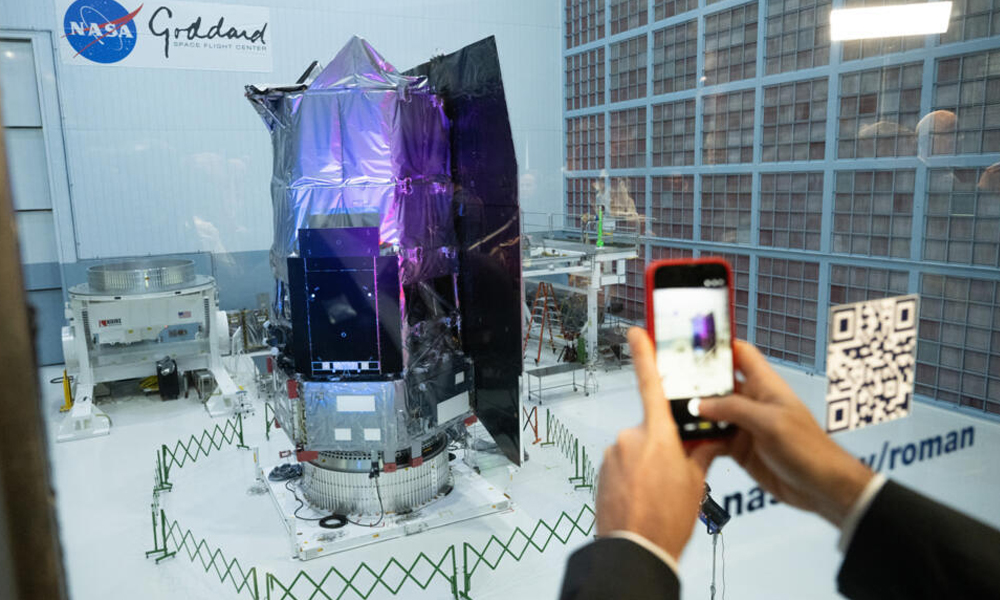
NASA is preparing on Sunday to launch the Roman Space Telescope, a mission aimed at creating an unprecedented map of the universe as part of a multi-year project designed to uncover some of the most prominent puzzles in physics.
US President Donald Trump said during a ceremony held on Friday at NASA headquarters, “This next-generation telescope will reveal the secrets of the universe.”
The telescope, which stands more than 12 meters tall, is scheduled for launch at 7:26 a.m. (11:26 GMT) via a Falcon Heavy rocket operated by SpaceX, from Florida.
Manufacturing the telescope took more than a decade and cost over $4 billion. It is named after Nancy Grace Roman, one of America’s most prominent female astronomers, known as the “Mother of Hubble,” referring to another of NASA’s flagship telescopes.
While the Hubble telescope revealed that the universe is expanding at a faster rate than previously thought, the Roman telescope will attempt to answer remaining questions about this expansion.
It will also create a “new atlas of the universe,” according to NASA Administrator Jim Bridenstine when the telescope project was unveiled in April.
With a field of view more than 100 times wider than Hubble’s and far exceeding that of the famous James Webb Space Telescope, Roman will be able to scan vast areas of the sky from a unique vantage point 1.5 million kilometers from Earth, which it will reach after a journey of approximately 100 days.
Designed to operate in tandem with other instruments, such as the more powerful and precise James Webb Space Telescope, Roman aims to discover thousands of exoplanets and tens of thousands of supernovae, which are massive stars at the end of their life cycles.
Technical manager for the telescope, Dave Content, told Agence France-Presse that what the telescope will achieve “will be the largest catalog of celestial objects ever compiled, and will help us understand how common solar systems similar to ours are.”
It will also provide a better understanding of the unseen, namely dark matter and dark energy, whose origins remain unknown but are believed to constitute 95% of our universe.
The first phenomenon is considered a type of attractive force, while the second is understood as a repulsive force that contributed to the well-known expansion of the universe.
Thanks to its infrared imaging technology, the telescope will be able to detect light emitted by celestial objects from billions of years ago, effectively traveling back in time to understand them better.
These observations, which will complement the work of the Rubin Observatory in Chile and the European Space Agency’s Euclid probe, are highly anticipated as they could revolutionize our current understanding of the structure of the universe.
Julie McEnery, the astrophysicist responsible for the Roman telescope, said in a press conference on Saturday that scientists have recently realized that “the expansion of the universe in its early stages was not entirely consistent with what our models predicted.”
She noted that this conclusion, which “suggests that our standard model of the universe is incorrect,” will be tested by the telescope.
She added, “This will allow us to definitively determine whether the model is successful or not. If it is not successful, it will provide us with accurate, high-quality data sufficient to enable us to begin distinguishing” between possible explanations.
Whether studies focus on the invisible or not, all data from the telescope will be made available to the public and scientists worldwide.
However, these images will be large in size, according to Content, as the data streamed by the instrument daily is far too large to be uploaded to any laptop.
Due to this vast amount of data, NASA expects the discoveries from the Roman Space Telescope to be “surprising and unexpected, opening the door to a new set of profound questions,” according to Mackey.
