At least 165 dead and more than 1,000 missing in floods in Nepal and Tibet
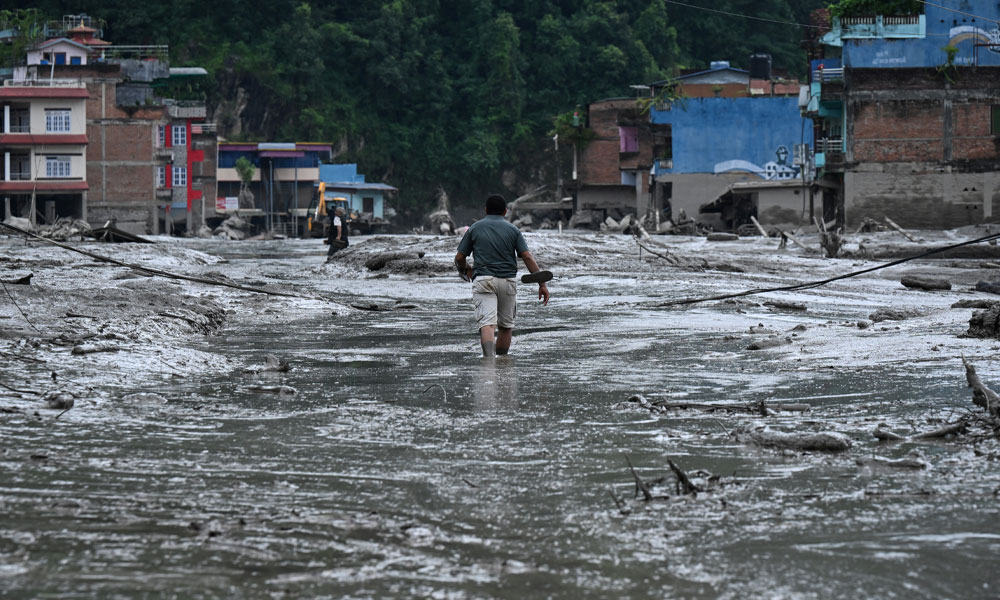
Rescue teams are intensifying their efforts to locate more than 1,000 missing persons following devastating floods that claimed the lives of at least 165 people on Wednesday along the border between Nepal and China’s Tib
Translated by Qiyas from كويت نيوز — Original source
Rescue teams are intensifying their efforts to locate more than 1,000 missing persons following devastating floods that claimed the lives of at least 165 people on Wednesday along the border between Nepal and China’s Tibet Autonomous Region.
Nepalese authorities announced on Thursday morning that 823 people were missing, with at least 165 fatalities confirmed. This toll includes 393 foreign tourists.
Chinese authorities stated that 558 people remain missing on their territory.
The US Geological Survey reported that the floods were triggered by a landslide powerful enough to generate a magnitude 5.2 earthquake, along with soil slides.
Initially, Chinese state media reported a landslide on the Tibetan side of the border near the Gyirong border crossing, located at an altitude of 1,800 meters, citing three deaths and 265 missing persons. However, it later revised the figure, stating that 558 people were missing in the incident, including 260 foreigners.
Nepal, situated in the heart of the Himalayas, is a popular destination for hikers and mountaineers from around the world, particularly those aiming to climb Mount Everest.
The floods subsequently swept through the Trishuli River valley in Nuwakot district, north of Kathmandu, as well as the Bhote Koshi River valley in the eastern part of Nepal’s capital.
Many of the missing are foreign tourists, and the death toll is expected to rise, according to officials.
In a video verified by AFP from surveillance cameras, a large multi-story building is shown with people attempting to flee before being suddenly engulfed by raging torrents.
Another verified clip shows a massive wave, resembling a tsunami, surging toward a parking lot overlooking a river, sweeping away buses and buildings with destructive force.
Nepalese Prime Minister Pushpa Kamal Dahal (Prachanda) pledged to deploy all available resources to address the disaster, stating, “The pain and loss you have suffered are not trivial, but I assure you that you are not alone. The state stands by you with all its means and capabilities.”
On the Chinese side, state broadcaster CCTV aired footage on Wednesday showing turbulent waters sweeping away tree branches and debris, as well as a flooded road. Approximately 800 rescue personnel, 150 vehicles, police dogs, and speedboats were deployed to participate in rescue operations, according to the Xinhua News Agency.
Xinhua quoted Chinese President Xi Jinping as saying, “The most urgent task is to make every possible effort to search for and rescue the missing, evacuate and resettle residents at risk, treat the injured promptly, and minimize the number of casualties.”
On the Nepalese side, security forces continued to evacuate families residing in flood-prone areas, while rescue teams searched for survivors amidst mud and rubble, after muddy floodwaters inundated the lower floors of multi-story buildings.
Australia reported the loss of 34 of its citizens, Japan five, South Korea nine, and Ukraine 53.
A travel agency told AFP on Thursday that 47 people, including two children, were missing in Nepal.
Sanket Pandey, managing director of the Nepalese company Himalayan Glacier, said the group included 15 Australians, 10 Canadians, nine Nepalese, eight Americans, two British nationals, two Singaporeans, and one person holding dual Russian and American citizenship.
David Fisher, the representative of the International Federation of Red Cross and Red Crescent Societies in Nepal, said that “villages and commercial areas were wiped off the map,” adding that the federation would send emergency supplies to the affected areas.
Earlier, Nepali Foreign Minister Chhe Sher Bahadur Khanal noted that an earthquake may have triggered a landslide that dammed a river, causing water to surge forcefully downstream. The National Disaster Risk Reduction and Management Authority (NDRRMA) suggested that a glacial rockslide on the Nepal-China border may have caused the floods.
According to the NDRRMA, satellite data from Planet Labs indicate that a “snow and rock slide” at the China-Nepal border may have triggered the flooding.
Experts warned that continued blockage of a river could lead to new floods.
Raju Bhandari, 56, said, “I received a call this morning from my brother-in-law. They were crying and said the water had swept away their house. Three family members were rescued, but his brother is still missing.”
The Nepali military is conducting aerial operations, and residents living along the river have been ordered to evacuate their homes.
Floods and landslides recur during the summer monsoon season (June to September) in Nepal, Tibet, and across South Asia.
Scientists say that climate change is increasing the frequency and intensity of extreme weather events in the region.
