Zelensky rejects holding elections during the war, warning of "dividing the ranks" in Ukraine
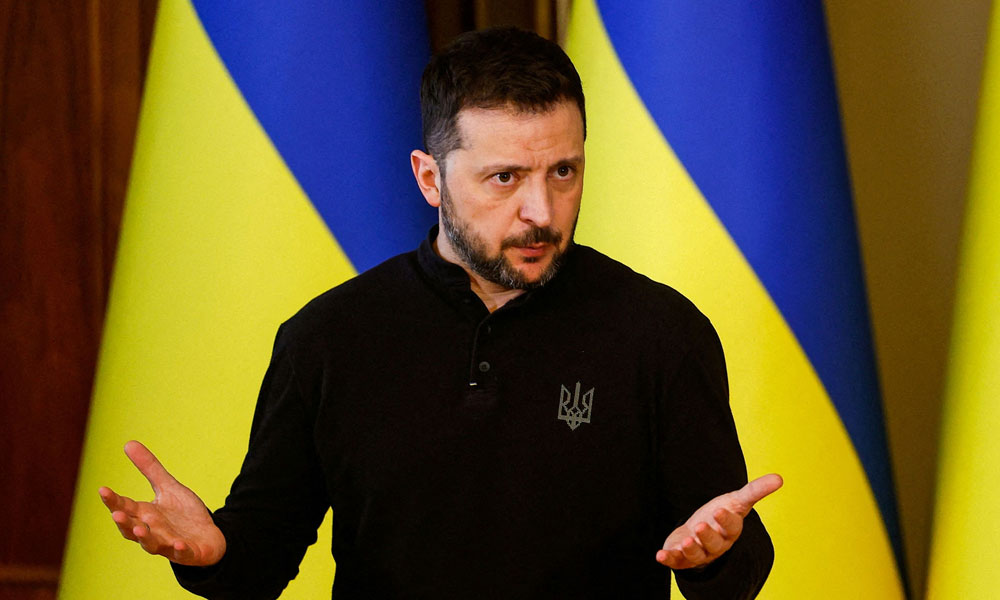
Ukrainian President Volodymyr Zelenskyy said that holding elections in the country amid the ongoing war with Russia would be extremely dangerous, following a call by his former defense minister to organize polls.
Zelenskyy added in statements published on Sunday, “I believe that in a war like this, elections themselves would pose a tremendous risk. Holding elections now would be like a tsunami striking the country and splitting Ukrainian society.”
Ukraine has suspended elections under martial law, a measure that still enjoys broad public support, as the country focuses on countering the Russian invasion that began in 2022.
Zelenskyy, 48, who took office in 2019, said, “If we want to destroy the country, we can then proceed toward holding elections during these times of war.”
On Saturday, Zelenskyy held a briefing with several journalists, including reporters from Agence France-Presse, in his first media engagement in months, amid several political crises.
The briefing came ahead of events scheduled to mark Ukraine’s Independence Day on Monday.
Ukraine’s allies also plan to hold talks on Monday regarding ways to strengthen the country’s air defenses amid intense Russian strikes.
Ukraine has recently experienced a wave of unrest, with thousands of citizens taking to the streets after Zelenskyy dismissed former Defense Minister Mykhailo Fedorov in July.
A few days ago, Fedorov unexpectedly called for a way to organize elections in the country without proposing a roadmap, prompting even some of his supporters to distance themselves from him.
Experts pointed to a number of obstacles that could prevent elections in Ukraine, including how soldiers, millions of Ukrainian refugees, and residents of occupied territories would vote, as well as disinformation campaigns originating from Russia.
The call for elections comes as Ukraine struggles to repel daily Russian missile and drone attacks targeting Kyiv and other cities.
According to a poll conducted by the Kyiv International Institute of Sociology, only 15 percent of Ukrainians believe elections should be held before the end of hostilities.
During the briefing, Zelenskyy leveled several criticisms at his opponents, saying of Fedorov, “I believe he is either walking on his own or being pushed toward wrong decisions.”
The former defense minister was one of the strongest proponents of the drone-centric war strategy that has come to dominate combat with Russia. He also sought to implement reforms but clashed with the military leadership, known for its rigidity and adherence to traditional approaches.
Initially, public opinion was on his side, with calls for the dismissal of Army Commander-in-Chief Oleksandr Syrskyi.
Zelenskyy affirmed citizens’ right to protest but warned against any behavior or attitudes that are “disrespectful” toward members of the armed forces.
He added, “Since when have propaganda considerations taken precedence over those who sacrifice their lives?”
Zelenskyy has managed to present himself as a bulwark against division in Ukraine, following a previous political crisis that had weakened his position.
He said, “I believe there should be no division between society and the soldiers,” adding, “We must recognize that this risk exists and that there is a possibility of sliding in that direction, toward dangerous developments.”
