The Kuwaiti Cabinet holds a meeting chaired by His Highness Sheikh Ahmad Abdullah Al-Ahmad Al-Sabah
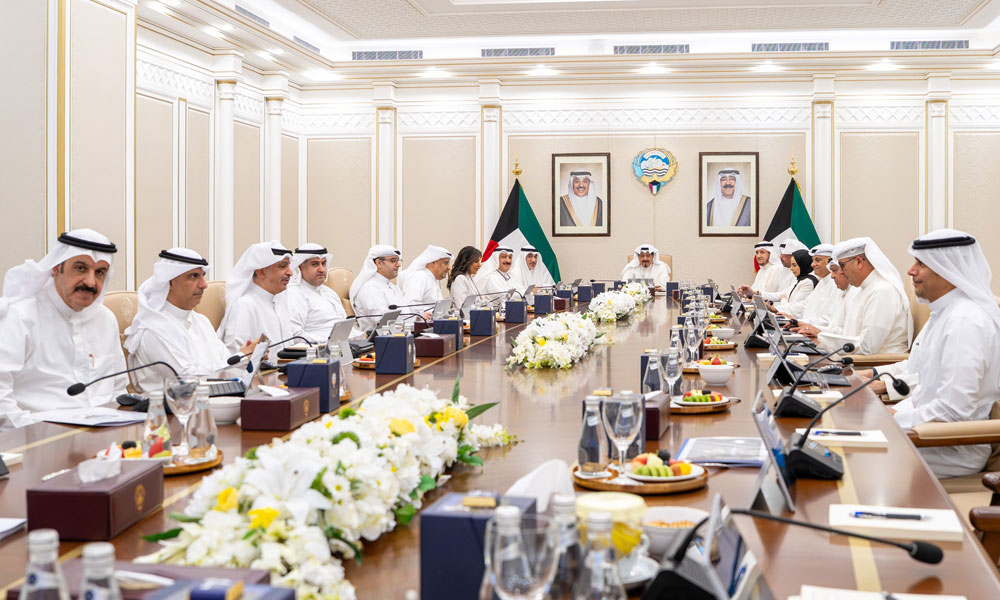
The Cabinet held its meeting today, Tuesday, August 18, 2026, presided over by His Highness Sheikh Ahmad Abdullah Al-Ahmad Al-Sabah, Prime Minister, may God protect him. Following the meeting, His Excellency Sheikh Shari
Translated by Qiyas from كويت نيوز — Original source
The Cabinet held its meeting today, Tuesday, August 18, 2026, presided over by His Highness Sheikh Ahmad Abdullah Al-Ahmad Al-Sabah, Prime Minister, may God protect him. Following the meeting, His Excellency Sheikh Sharida Abdullah Al-Muwasharji, Deputy Prime Minister and Minister of State for Cabinet Affairs, issued the following statement:
“At the outset of its meeting, the Cabinet was informed of His Highness the Amir’s approval, Sheikh Meshal Al-Ahmad Al-Jaber Al-Sabah, may God protect and guard him, to attend the opening ceremony of a number of new health projects in the country, and to delegate His Highness Sheikh Ahmad Abdullah Al-Ahmad Al-Sabah, Prime Minister, may God protect him, to attend on his behalf.
On another note, the Cabinet was informed of the contents of a written letter received today, Tuesday, by His Highness the Amir, Sheikh Meshal Al-Ahmad Al-Jaber Al-Sabah, may God protect and guard him, from His Excellency Andy Burnham, Prime Minister of the United Kingdom of Great Britain and Northern Ireland. The letter pertained to the deep-rooted historical relations between the two countries and their friendly peoples, and ways to develop these ties across various fields. It also addressed a number of issues of mutual interest and the latest developments on the regional and international scenes. The letter was delivered to His Excellency Sheikh Hamad Jaber Al-Ali Al-Sabah, Minister of Diwan Amiri Affairs, by His Excellency Qadisi Rashid, Ambassador of the United Kingdom of Great Britain and Northern Ireland to the State of Kuwait, in the presence of His Excellency Sheikh Thamer Jaber Al-Ahmad Al-Sabah, Head of the Deputy Amir’s Diwan.
For its part, the Cabinet expressed its strong condemnation and rejection of the egregious Iranian attacks that targeted two tankers and a vessel belonging to the UAE’s ADNOC company while they were transiting the Strait of Hormuz. It affirmed that targeting commercial ships and international sea lanes constitutes a blatant violation of international law and UN Security Council Resolution 2817, and poses a threat to the security and safety of maritime navigation, global energy supplies, and international trade. It stressed the necessity of halting all actions that could escalate tensions in the region, respecting freedom of navigation and safe passage through international waterways, and fully and unconditionally reopening the Strait of Hormuz. It reiterated Kuwait’s full solidarity with sisterly the United Arab Emirates and its steadfast support for all measures the UAE takes to safeguard its sovereignty, protect its security, and defend its interests.”
On another note, the Council of Ministers expressed the State of Kuwait’s condemnation of the Israeli occupation authorities’ explicit rejection of the roadmap aimed at completing the implementation of the comprehensive plan by His Excellency Donald Trump, President of the United States of America, to end the conflict in Gaza, which was endorsed by United Nations Security Council Resolution (2803). It also condemned the occupation authorities’ refusal to establish the State of Palestine, affirming that these stances constitute an outright rejection of moving forward with the comprehensive plan and fundamentally undermine collective efforts to achieve a just and lasting peace, including those undertaken by the State of Qatar, the Arab Republic of Egypt, the Republic of Turkey, the United States of America, the Peace Council, and all concerned parties. The Council stressed the necessity for the international community to fulfill its responsibilities and compel the Israeli occupation authorities to fully comply with the commitments and arrangements stipulated in the comprehensive plan and its associated roadmap, and to prevent any further obstacles to its implementation. It reiterated the urgent need for the full and immediate implementation of the comprehensive plan, which would contribute to addressing the dire humanitarian situation and ensuring security and stability for all in Gaza, paving the way for reconstruction, recovery, and progress toward a just and lasting peace based on the Palestinian people’s right to self-determination and the establishment of an independent State on the borders of June 4, 1967, with East Jerusalem as its capital, in accordance with international law and relevant United Nations resolutions.
On another note, the Council of Ministers heard a briefing from His Excellency the Minister of Foreign Affairs, Sheikh Jaraah Jaber Al-Ahmad Al-Sabah, regarding the political and diplomatic efforts undertaken by the Ministry of Foreign Affairs and its diplomatic missions abroad to keep pace with the latest developments on the regional and international fronts.
His Excellency the Minister of Foreign Affairs also informed the Council of Ministers about the substance of telephone communications he held and received over the past few days with several foreign ministers of sister and friendly countries. These calls reviewed the latest regional developments and diplomatic efforts aimed at de-escalating tensions, enhancing security and stability in the region, and ensuring the safety and freedom of maritime navigation.
On another note, the Council of Ministers approved a draft law decree amending certain provisions of Emiri Decree No. 15 of 1959 concerning Kuwaiti Nationality. Article One of the aforementioned draft law decree stipulates the following:
Article 14, Paragraph 4: If an individual intentionally adds to their own nationality file, or to the nationality file of another person, any individual who is not their child or descendant, and this is established through an investigation conducted by the Supreme Committee for Kuwaiti Nationality or through a final judicial ruling, the nationality of any of their children or descendants may be revoked, provided their knowledge of such act is established.
Article 19: The Minister of Interior shall issue a certificate of Kuwaiti nationality to every Kuwaiti after verifying its establishment in accordance with the provisions of this Law. This certificate shall be issued in electronic form. The Minister shall issue a decision outlining the technical and procedural controls and requirements for issuing, storing, and using the electronic certificate, as well as the procedures for verifying its authenticity, revoking it, or suspending its validity.
Article Two further stipulates the following:
A new paragraph is added to the text of Article 7 of the aforementioned Emiri Decree No. 15 of 1959, reading as follows:
Article 7, New Paragraph: No person who has acquired Kuwaiti nationality through naturalization shall have the right to vote, stand for election, or be appointed to any legislative body.
Article 3 stipulates the following: “The electronic certificate provided for in this Decree-Law shall have the same legal force and effects as the certificate of nationality, and shall replace the paper certificate in the application of the laws, decrees, and regulations in force.”
The Council of Ministers submitted a draft decree-law amending certain provisions of Emiri Decree-Law No. 15 of 1959 on Kuwaiti Nationality to His Highness the Amir of the State, Sheikh Meshal Al-Ahmad Al-Jaber Al-Sabah, may God protect him and guard him.
The Council of Ministers also approved a draft decree-law concerning the organization of the judiciary, which is part of efforts to develop the judicial system, enhance judicial efficiency, and consolidate guarantees of judicial independence and integrity. This is achieved by updating the rules governing the affairs of the judicial authority and the Public Prosecution, and establishing a more integrated framework for justice institutions through several interrelated key pillars.
The first pillar involves developing the organization of the judicial authority by updating the rules governing the selection, appointment, and promotion of its members, as well as enhancing the jurisdiction of the Supreme Council of the Judiciary and the rules governing its work.
The second pillar focuses on strengthening the oversight and accountability system and litigation guarantees by developing rules for judicial inspection, accountability, and discipline, enhancing the rights of litigants, updating the regulations governing the work and jurisdiction of the Public Prosecution, and reinforcing its role in overseeing detention facilities.
The third pillar aims to develop judicial work and enhance the stability of legal principles by establishing a comprehensive mechanism to unify judicial precedents of the Court of Cassation, thereby ensuring the stability of legal principles and consistency of judicial rulings. It also regulates trials and judicial procedures conducted using electronic means, in response to legislative and technological developments, and to elevate the efficiency of the justice system.
The Council of Ministers submitted the draft decree-law concerning the organization of the judiciary to His Highness the Amir of the State, Sheikh Meshal Al-Ahmad Al-Jaber Al-Sabah, may God protect him and guard him.
The Council of Ministers also approved a draft decree replacing the schedule attached to Decree No. 126 of 2018 regarding the minimum periods required for retention in the ranks of judges and members of the Public Prosecution, and submitted it to His Highness the Amir of the State, Sheikh Meshal Al-Ahmad Al-Jaber Al-Sabah, may God protect him and guard him.
Furthermore, the Council of Ministers approved a draft decree-law issuing the law establishing Economic Courts, aimed at keeping pace with modern global and regional legislation and leveraging advanced technological systems to serve justice. This necessitates the issuance of a law establishing Economic Courts, which is a procedural law designed to achieve the required balance between the right to defense and the expeditious resolution of cases brought before the courts. This is pursued through three interrelated objectives that the law seeks to achieve:
The Council of Ministers submitted the draft decree-law issuing the law establishing Economic Courts to His Highness the Amir of the State, Sheikh Meshal Al-Ahmad Al-Jaber Al-Sabah, may God protect him and guard him.
The Council of Ministers also approved a draft decree-law issuing the law establishing Economic Courts, aimed at keeping pace with modern global and regional legislation and leveraging advanced technological systems to serve justice. This necessitates the issuance of a law establishing Economic Courts, which is a procedural law designed to achieve the required balance between the right to defense and the expeditious resolution of cases brought before the courts. This is pursued through three interrelated objectives that the law seeks to achieve:
The Council of Ministers forwarded a draft decree-law establishing the law on the creation of economic districts to His Highness the Amir of the State, Sheikh Meshal Al-Ahmad Al-Jaber Al-Sabah, may God protect and guard him.
On another note, the Council of Ministers reviewed a visual presentation delivered by the Deputy Secretary of the Amir’s Diwan, Sheikh Abdulaziz Meshal Mubarak Abdullah Al-Ahmad Al-Sabah, and the committee responsible for the management and supervision of the third phase of the Martyr’s Park project. The presentation outlined the final stages regarding the operation and opening of the project, which is scheduled to open to visitors on Thursday, October 1, 2026. It was noted that on this occasion, a carnival featuring entertainment activities for visitors will be held, including musical bands, light shows, and family and children’s entertainment segments. The vision for the park is to establish an exemplary and integrated facility encompassing various sports and recreational amenities. The total area of the project site amounts to 243,605 square meters, with a total built-up area of 203,162 square meters. The green area covers 190,661 square meters, while the investment area totals 16,232 square meters. The components of the project are as follows:
For his part, the Council of Ministers commended the efforts undertaken by the leaders, officials, and staff of the Amir’s Diwan, as well as the committee responsible for the management and supervision of the third phase of the Martyr’s Park project, in opening this cultural and recreational facility, which will serve as a tourist landmark attracting visitors from within and outside the State of Kuwait.
The Council of Ministers reviewed a number of items on the agenda, along with reports and minutes of ministerial committees, and approved them. It also decided to refer several items to the relevant ministerial committees for study and to submit appropriate recommendations to complete the necessary procedures for their implementation.
