7.7-magnitude earthquake strikes eastern Indonesia, killing at least 20
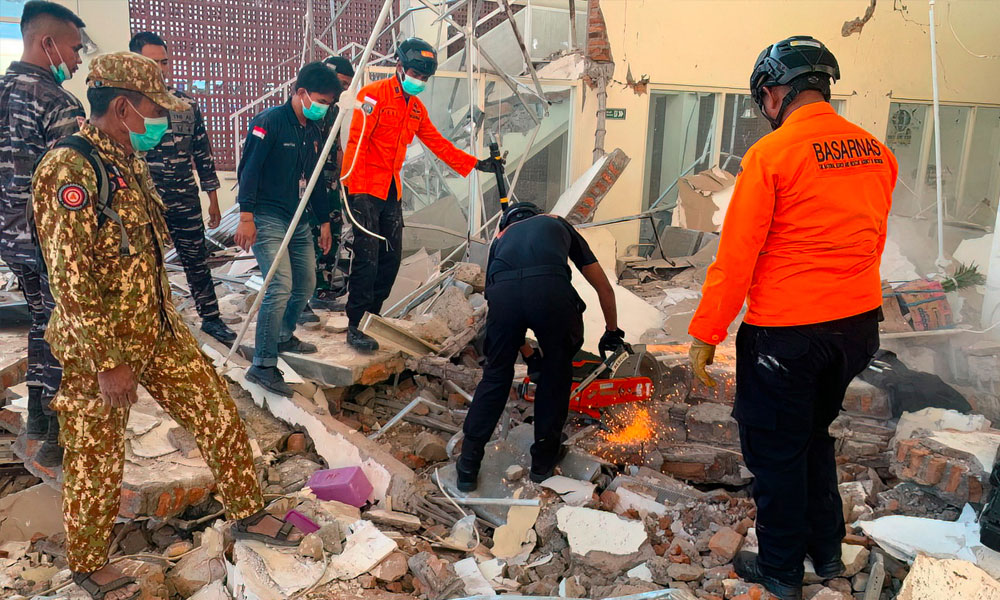
A powerful earthquake struck eastern Indonesia on Saturday morning, killing at least 20 people and prompting thousands of residents to evacuate coastal areas out of fear of rising waters. Agence France-Presse journalists
Translated by Qiyas from كويت نيوز — Original source
A powerful earthquake struck eastern Indonesia on Saturday morning, killing at least 20 people and prompting thousands of residents to evacuate coastal areas out of fear of rising waters.
Agence France-Presse journalists witnessed residents from the northern part of Flores Island rushing away from the shores to avoid potential tsunami waves, while entire sections of some house facades collapsed.
The US Geological Survey located the epicenter of the quake, which occurred at 5:58 a.m. (21:58 GMT), off the northern coast of the island, approximately 68 kilometers northwest of Ende Regency, at a shallow depth of just 10 kilometers.
“Everything started shaking suddenly, and I felt panic,” Lucas Lotar, an official at one of the region’s hospitals, told AFP.
He added, “Patients also fled the hospital. The earthquake was very strong; I saw cracked walls.”
The main shock was followed by several aftershocks, one of which measured 6.1 on the Richter scale.
Fathur Rahman, an official in search and rescue operations in the city of Momekati, told AFP by phone, “According to the information we received, 20 people were killed, six were injured, and two remain trapped under the rubble.”
Indonesia and its neighboring countries frequently experience earthquakes due to their location within the Pacific Ring of Fire, a chain of seismically active zones stretching from Japan through Southeast Asia and across the Pacific basin.
Indonesian authorities issued a tsunami warning, which was lifted shortly afterward.
However, Wijayanto, head of the Earthquake and Tsunami Division at the National Agency of Meteorology, Climatology, and Geophysics, stated during a press conference, “We will continue to monitor sea levels.”
Prior to the warning being lifted, residents in the area were asked to stay away from the coast or move to higher ground.
Abdul Muhari, an official at the National Disaster Management Agency, announced, “We urge residents living along the northern coastal strip of Flores Island, as well as in the southern regions, southern islands, and the southern territory, to evacuate immediately on their own initiative.”
An AFP reporter on Flores Island observed residents leaving the village of Momekati. Johannes Papu, 56, who was at the market when the earthquake struck, recounted, “The tremor was very strong. Fortunately, we had already stepped outside.”
He continued, “People panicked and fled in all directions. We are currently evacuating the area… and trying to head to higher ground,” adding, “My family is safe; no one was injured.”
Earlier in July, a 6.2-magnitude earthquake struck eastern Indonesia without causing casualties or major damage.
In 2018, 2,200 people died in Palu, the largest city in Central Sulawesi province in central Indonesia, following a 7.5-magnitude earthquake that triggered a tsunami.
That same year, several earthquakes resulted in approximately 550 deaths on the tourist island of Lombok and in the Sumbawa region (central south).
In 2004, Indonesia experienced one of the most powerful earthquakes in its history, measuring 9.1 on the Richter scale, which occurred off the coast of Sumatra island (west) and triggered a massive tsunami that killed 170,000 people across the archipelago and approximately 50,000 in neighboring countries.
