Drone attacks by the Rapid Support Forces on Khartoum and parts of Sudan
The Rapid Support Forces (RSF) in Sudan launched drone attacks on Wednesday targeting Khartoum and other cities under army control, according to a France Press correspondent, eyewitnesses, and a military source, in a coo
Translated by Qiyas from كويت نيوز — Original source
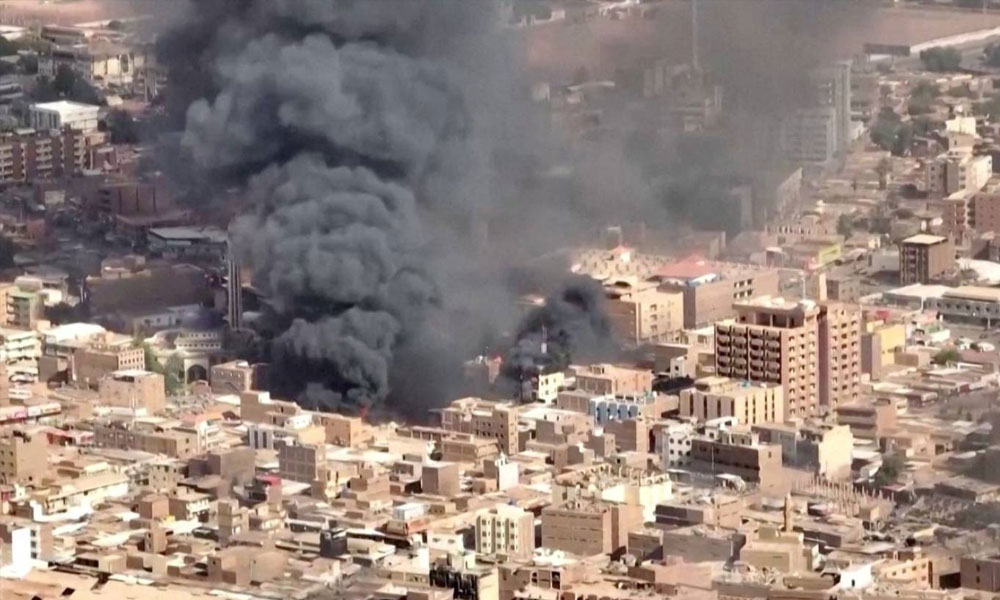
The Rapid Support Forces (RSF) in Sudan launched drone attacks on Wednesday targeting Khartoum and other cities under army control, according to a France Press correspondent, eyewitnesses, and a military source, in a coordinated assault described as the largest in months.
A war has been raging in Sudan since April 2023 between the army and the RSF, resulting in the deaths of more than 200,000 people according to relief workers’ estimates, and displacing over 12 million Sudanese, marking the world’s worst humanitarian crisis according to the United Nations.
Khartoum has been under the control of the Sudanese army since March 2025, after it was recaptured from the RSF in a large-scale military operation. Despite suffering drone strikes, the capital has seen a gradual return to normalcy in recent months, with 2.3 million displaced persons returning, reconstruction efforts beginning, and market activity resuming.
A military source stated that the RSF attacked the capital, the city of Omdurman in the Kordofan region, and the cities of Atbara and Damaturu in northern Sudan with a large number of drones, noting that the army’s air defenses intercepted them.
On the other hand, Fattah Qarshi, spokesperson for the RSF, said in posts on social media that his forces bombed Atbara airport and army warehouses in the city, as well as fuel depots in Omdurman and two military airports in the far south of the country.
A France Press journalist reported a drone attack around 5:00 a.m. (3:00 a.m. GMT) on Khartoum, with the sound of anti-aircraft fire heard from a military base north of Omdurman.
In Khartoum North, on the opposite bank of the Nile, two drones targeted a transformer and a mosque from which worshippers had just exited after prayers, according to one eyewitness.
In northern Sudan, eyewitnesses in Atbara and Damaturu, also under army control, reported seeing drones and hearing explosions.
A military source confirmed to France Press that attacks occurred on the capital and the two northern cities, also mentioning an attack on El Obeid in the center of the country, where clashes have been concentrated in recent weeks.
The source said the RSF launched a large number of drones, noting they were targeted by anti-aircraft defenses.
The attacks also hit other areas of Sudan, such as the city of Tamboul southeast of Khartoum, where “panic” gripped residents after drones appeared in the sky, according to one witness.
Two witnesses in the town of Sufiya, located about 90 kilometers from the border with South Sudan, reported a drone attack on the local airport used by the army as an airbase.
No reports of casualties from these attacks, which targeted sites hundreds of kilometers apart, had been received as of yet.
Army commander Abdel Fattah al-Burhan and his former deputy, RSF commander Mohamed Hamdan Dagalo, known as “Hemedti,” are seeking to resolve their power struggle on the battlefield, rejecting any negotiations.
Fighting intensified after the RSF strengthened its control over the vast Darfur region in the west last year, before escalating its attacks to seize areas in South Kordofan state along the southeastern border with Ethiopia.
In contrast, the army controls the center, east, and north of the country, and achieved a major victory last month by pushing RSF forces westward and taking control of the highway linking Omdurman and El Obeid, the largest city in the Kordofan region, which the RSF had been trying to completely encircle for months.
Dagalo responded by announcing the “loosening of the reins” for his forces. Since then, the RSF has repeatedly threatened to launch a large-scale attack.
Although the army is seeking to portray a return to normalcy in the capital, Khartoum is grappling with widespread destruction of infrastructure, power outages, and water supply disruptions. Vast areas of the city center remain desolate following the looting of buildings, amid fears that unexploded ordnance lies buried beneath the rubble.
International and human rights organizations accuse both sides of committing war crimes during the conflict, including indiscriminate shelling of civilian areas. The Rapid Support Forces, in particular, are accused of systematic sexual violence, looting, and ethnic cleansing.
