Gold records best weekly performance since January, closes at $4,342 per ounce
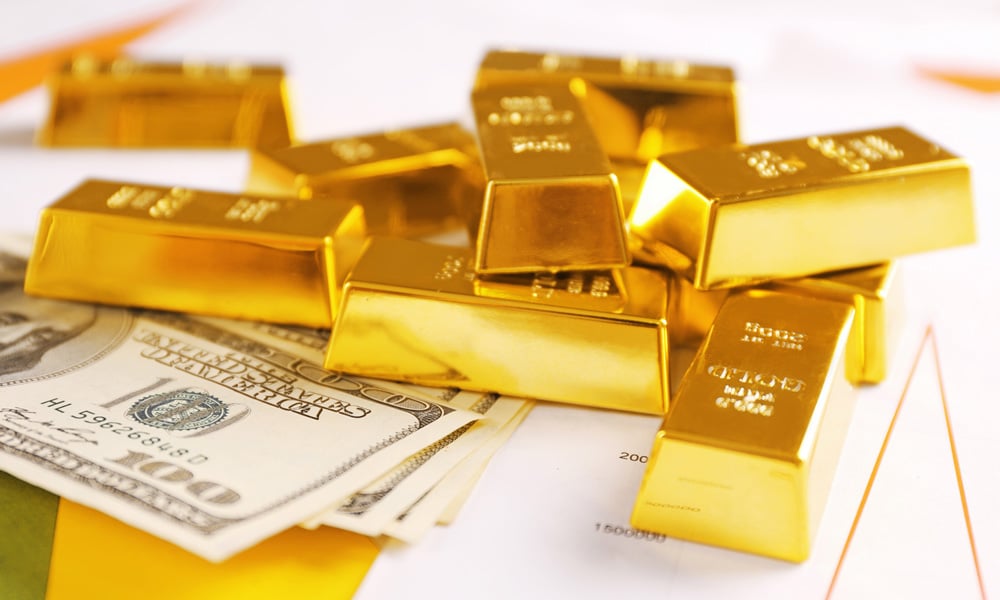
Gold prices ended last week’s trading with a strong rally, posting its best weekly performance since January and closing at $4,342 per ounce, the highest level since June 17. The surge was driven by weak U.S. labor market data and ongoing geopolitical uncertainty in the Middle East.
A specialized report issued on Sunday by Kuwaiti gold dealer Dar Al Sabeek stated that the precious metal rose more than 7 percent last week, benefiting from a noticeable shift in market expectations regarding U.S. monetary policy. A series of economic data points indicated a slowdown in the labor market, reinforcing the belief that the U.S. Federal Reserve (the central bank) may delay any further steps to tighten monetary policy in the coming months.
The report clarified that the standout event of the week was the release of the U.S. non-farm payrolls report, which came in below market expectations. The data showed the U.S. economy lost 23,000 jobs in July, whereas forecasts had anticipated an addition of approximately 80,000 jobs.
It added that data for May and June saw significant downward revisions, with previously reported total jobs being reduced by about 103,000, confirming that the U.S. labor market is slowing at a faster pace than expected.
The report noted that these figures led to a sharp decline in expectations for U.S. interest rate hikes. The probability of the Federal Reserve raising rates at its September meeting dropped significantly, with markets increasingly leaning toward holding rates steady, particularly as pressure from the labor market eased.
It explained that the U.S. Dollar Index fell by approximately 99 points against other major currencies, reaching its lowest level in nearly two months. This bolstered gold’s appeal as a non-yielding asset, which typically benefits from falling interest rates and a weaker dollar.
The report highlighted that geopolitical uncertainty in the Middle East persisted despite cautious optimism over a potential agreement between the United States and Iran. Tehran confirmed that any potential deal would not mean the full reopening of the Strait of Hormuz, but would be limited to a temporary framework to regulate navigation, while studies continue on imposing restrictions on the passage of certain ships. This kept geopolitical risk premiums embedded in gold prices.
It pointed out that investment demand for gold continued to provide strong support for prices. Data showed that Chinese investment institutions continued to increase their positions in gold-backed assets, alongside ongoing purchases by central banks, reflecting sustained confidence in the precious metal as a hedge against risks and economic volatility.
It noted that long-term forecasts issued by a global investment bank enhanced the positive outlook for gold, projecting prices could reach $5,000 per ounce in the first half of 2027. This projection is based on continued official demand from central banks, rising geopolitical risks, and the likelihood of global monetary policy entering a less restrictive phase in the coming years.
It concluded that if gold succeeds in breaking through the $4,390 level and holding above it, gains could extend toward $4,450 and then $4,500. The first support level lies at $4,202, followed by $4,152 and then $4,100, while the $4,019 level remains a key support to maintain the upward trend.
He noted that investors’ attention during the week beginning August 10 is focused on a range of key economic data, led by U.S. inflation figures, alongside producer prices, retail sales, and the consumer confidence index, which will largely determine gold price trends in the coming period.
The “Dar Al Sana’i” report added that markets will also monitor the earnings results of several major technology companies, growth data from Europe and Asia, interest rate decisions in Australia and Norway, as well as developments in negotiations concerning the Strait of Hormuz.
On the domestic front, he pointed out that gains achieved by precious metals in global markets were reflected in Kuwaiti market prices, with the price of 24-karat gold reaching approximately 0.434 Kuwaiti dinars per gram (about $141), while 22-karat gold was recorded at around 0.398 Kuwaiti dinars per gram (approximately $129).
He further indicated that the price of a kilogram of silver stood at about 0.726 Kuwaiti dinars (roughly $2,357), amid the local market’s continued sensitivity to global price movements, fluctuations in the U.S. dollar, and shifting expectations regarding U.S. monetary policy.
