Barzani in Damascus to discuss cooperation and implementation of the agreement between the Syrian government and the Kurds
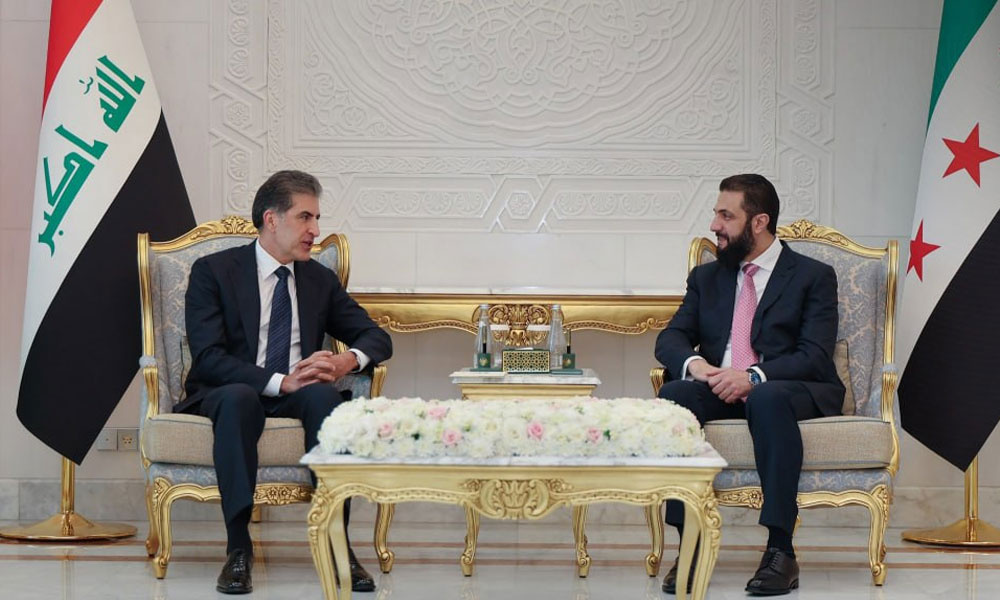
Kurdistan Region of Iraq President Nechirvan Barzani arrived in Damascus on Monday for his first visit since the new authorities took power, focusing on pushing forward the implementation of an agreement to integrate Kurdish institutions into the state framework, according to two Syrian official sources speaking to AFP.
Erbil, the capital of the region, had served as a hub for political communications amid clashes between Syrian government forces and Kurds in early 2026, during which time Syrian Democratic Forces (SDF) commander Mazloum Abdi held meetings with Barzani under US sponsorship. In late January, Damascus and the Kurdish forces reached an agreement stipulating the integration of the Kurdish Autonomous Administration’s institutions and forces into state institutions.
The Syrian Presidency stated in a bulletin that President Ahmed al-Sharaa received Barzani and discussed with him “ways to enhance cooperation and coordination, particularly in the economic field,” alongside regional developments and issues of mutual interest.
For his part, Barzani announced in a statement that he had affirmed to al-Sharaa “our support for a stable and unified Syria, in which the rights of all national and religious components are safeguarded,” and that they also discussed “the importance of Syria’s role in enhancing peace, security, and stability in the region.”
A Syrian government source, who requested anonymity, told AFP that the visit aims to discuss the “January 29 agreement and the procedures for integrating the Syrian Democratic Forces into the Syrian government.”
Meanwhile, a Syrian diplomatic source told AFP that the one-day visit “will primarily focus on following up on the agreement between the state and the Syrian Democratic Forces,” and he anticipated that Barzani would meet with its commander, Mazloum Abdi.
Barzani had previously welcomed the agreement between Damascus and the Kurdish forces, describing it as “an important step in the right direction.” He expressed hope at the time that it would “pave the way for rebuilding a unified Syria, protecting the rights of Kurds and all components in the upcoming constitution, and achieving peace for Syria and the entire region.”
The agreement effectively dealt a severe blow to the Kurds, who had aspired to preserve the gains of the autonomous administration they had built during years of conflict in Syria. This administration included organized and trained civil and military institutions that managed vast areas in the north and east of the country, encompassing oil and gas fields.
Following the signing of the agreement, steps were taken including the entry of Syrian security forces into the cities of Al-Hasakah and Qamishli, followed by the state taking over the administration of Qamishli airport and the major oil fields in the northeast. Additionally, prominent Kurdish military leader Sibah Hamo was appointed as deputy defense minister for the eastern region as part of implementing the agreement’s provisions.
The agreement also mandates the formation of a military brigade comprising three battalions from the Syrian Democratic Forces within the Syrian Army in the northeast, as well as the formation of another battalion for the Kobani (Ayn al-Arab) forces. However, differences in perspectives remain between the two sides regarding the practical mechanisms for completing the integration process.
