Guterres calls for an end to "violations" in the occupied Golan during his visit to Syria
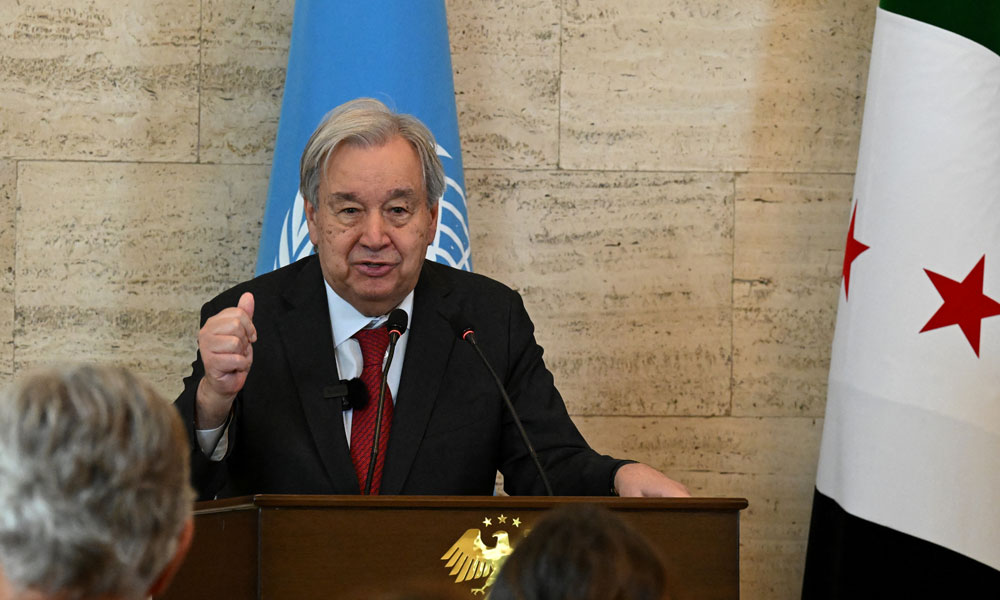
On Saturday, António Guterres called for respect for Syria’s sovereignty and territorial integrity and an end to “violations” in the Golan Heights, which is occupied by Israel. This marked the first visit by a UN Secreta
Translated by Qiyas from كويت نيوز — Original source
On Saturday, António Guterres called for respect for Syria’s sovereignty and territorial integrity and an end to “violations” in the Golan Heights, which is occupied by Israel. This marked the first visit by a UN Secretary-General to Damascus in 17 years, during which he urged the international community to support the country during its transitional phase.
Guterres’s visit, the first by a UN chief since Ban Ki-moon in 2009, comes more than a year and a half after new authorities led by Ahmed al-Sharaa took power following the ouster of President Bashar al-Assad in late 2024.
Subsequently, Israel launched hundreds of airstrikes on Syria, focusing on military targets, and its forces penetrated beyond the buffer zone in the Golan, where it announced plans to establish a demilitarized zone. Israeli officials have repeatedly stated that their troops do not intend to withdraw from that area.
Speaking at a joint press conference with Foreign Minister Asaad al-Shaibani, Guterres said, “Violations of Syria’s sovereignty and territorial integrity are unacceptable and must stop.”
He added, “In addition to violations of the 1974 Disengagement Agreement, I would like to remind the international community that the Golan Heights are Syrian land.” He emphasized, “These violations are extremely dangerous, of course, but they should not make us forget that the Golan Heights are part of Syrian territory.”
He considered “what is happening in the area surrounding the Golan Heights to be absolutely unacceptable,” stressing “the importance of full respect for Syria’s sovereignty, independence, unity, and territorial integrity.”
Israel has annexed the areas it occupies in the Golan, a step not recognized by the international community except by Washington.
Al-Shaibani told Guterres that “establishing regional peace is impossible in the face of serious violations of our national sovereignty,” viewing “the continuation of Israeli military operations and the illegal occupation of our lands beyond the 1974 line as a direct threat to regional security and a drain on our national resources.”
He called for “a firm UN stance pushing for immediate and unconditional withdrawal, while reaffirming our support for the United Nations Disengagement Observer Force (UNDOF) to carry out its mandate fully without any restrictions.”
Also in Damascus, Guterres met with members of UNDOF, which has been stationed in the Golan buffer zone since 1974, according to a UN official speaking to AFP.
Despite tensions, Syria and Israel have held ministerial-level negotiation rounds that have not resulted in a halt to Israeli attacks, which have drawn condemnation from several countries, including the United States. Under US pressure, the two sides agreed in January to establish a joint coordination mechanism, paving the way for a security agreement between the two countries, which remain officially at war.
In addition to meeting al-Shaibani, Guterres met al-Sharaa at the presidential palace.
The presidency stated that they discussed “ways to enhance cooperation… in humanitarian and developmental fields, as well as supporting early recovery and reconstruction efforts.”
According to official Syrian media, the Secretary-General toured the Old City of Damascus and the Umayyad Mosque.
Guterres also visited the Saydnaya prison, one of the largest prisons during the Assad family’s rule, which human rights organizations have described as a “human slaughterhouse” where numerous violations occurred, according to official media.
The UN Secretary-General also met with the head of the National Commission for Transitional Justice, the head of the National Commission for the Disappeared, and other officials in Damascus.
Guterres had previously posted on X that he was undertaking a “solidarity visit.” He wrote, “My message is clear: The United Nations stands with Syria at this pivotal moment, and I urge the international community to do its utmost to support the Syrian people.”
Al-Shaybani viewed Guterres’s visit as heralding Syria’s transition “to the position of an active partner within the United Nations” and as “inaugurating a new phase based on close cooperation to achieve comprehensive national recovery.”
Guterres said that “the international community should help create the necessary conditions for economic recovery, contribute to restoring basic services and infrastructure… and assist in creating conditions that enable the safe, voluntary, and dignified return of refugees and displaced persons.”
The United Nations states that approximately 1.9 million internally displaced persons and 1.7 million have returned to Syria since Assad’s overthrow, while around 5.5 million remain displaced within the country and another six million are abroad. The number of people in need of humanitarian assistance is estimated at 15.6 million.
Guterres is scheduled to meet with representatives of civil society during his visit.
The international community has long urged the new authorities to build institutions and establish governance that strengthens pluralism and includes all components.
During the press conference, Guterres affirmed that the United Nations is ready “to support the political transition, including your efforts to secure transitional justice, draft a permanent constitution, and hold free and fair elections.”
He considered Syria’s recovery to be “an investment in development, peace, and regional stability,” and stated that “Syria today is a pillar of stability in the Middle East,” amid the conflict between Iran and the United States.
Guterres is the highest-ranking UN official to visit Damascus since Assad’s overthrow, more than 13 years after a destructive conflict claimed more than half a million lives.
A delegation from the UN Security Council visited Syria in December, following the new leadership’s participation in the UN General Assembly in September, when the Syrian president became the first head of state since 1967 to address the international organization.
Several senior officials of the international organization have also visited, including UN High Commissioner for Human Rights Volker Türk and International Atomic Energy Agency Director General Rafael Grossi.
