Syrian authorities announce discovery of explosives cache linked to ISIS cell
Syrian authorities announced on Friday that interrogations with members of the cell responsible for the July 7 bombings in Damascus, which occurred during French President Emmanuel Macron’s visit, had led to the discover
Translated by Qiyas from كويت نيوز — Original source
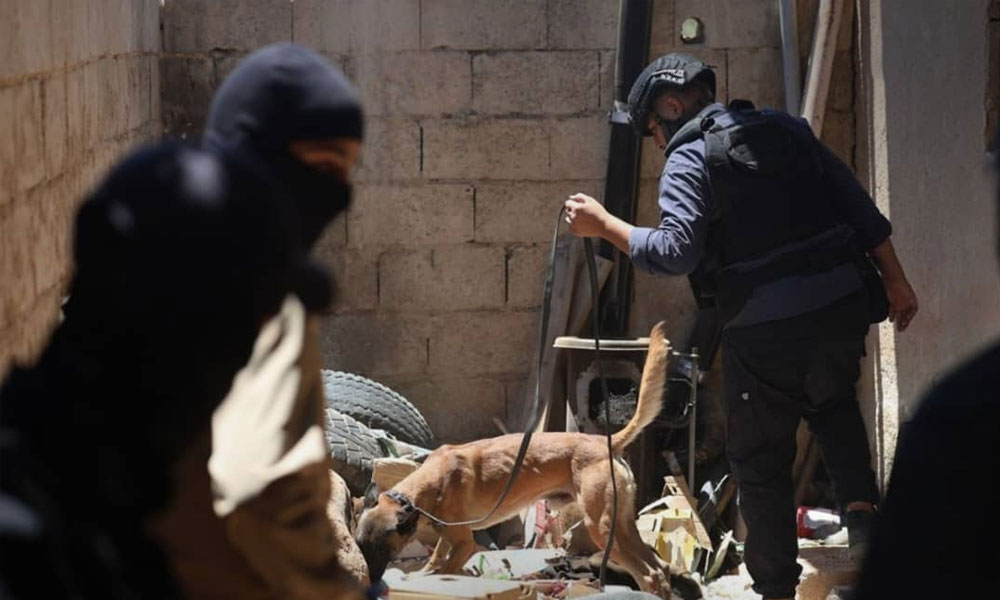
Syrian authorities announced on Friday that interrogations with members of the cell responsible for the July 7 bombings in Damascus, which occurred during French President Emmanuel Macron’s visit, had led to the discovery of an explosives stash.
A security official had previously stated that initial investigations showed links between the cell and the Islamic State (ISIS) group.
The two simultaneous bombings, carried out using two explosive devices—one inside a garbage container and the other inside a car parked on the roadside—targeted the area around the Ramee Amwaj Hotel, where Macron spent the night during his unprecedented visit to Damascus on Tuesday.
Brigadier General Ahmad Al-Dalati, head of Internal Security in the Damascus countryside, announced on Friday that initial interrogations with members of the cell involved in the bombings revealed “its affiliation with the Islamic State,” referring to the so-called Islamic State.
The bombings killed one person and injured 36 others, according to the Ministry of Health, after the French president’s motorcade had left the hotel en route to the presidential palace for talks with his Syrian counterpart, Ahmed al-Sharaa.
In a statement, the Ministry of Interior said that “intensive investigations with members of the terrorist cell responsible for the July 7 bombings in Damascus” led to “the discovery of a secret hideout designated by the cell to store explosives in preparation for carrying out a series of terrorist attacks.”
It added that “in a precise operation, Internal Security forces raided the specified site following confessions from the cell and seized several explosive devices,” noting that engineering teams were able to “disarm and safely neutralize them in accordance with established technical procedures.”
On Thursday, the Syrian Observatory for Human Rights reported that “General Security forces arrested dozens of residents of the Ash Warwar neighborhood in Damascus during a wide-ranging security campaign.”
The Ash Warwar neighborhood, which the Ministry of Interior said was among the sites raided in the Damascus countryside, had previously witnessed security incidents following the overthrow of President Bashar al-Assad’s rule.
One resident of the neighborhood, who requested anonymity, told Agence France-Presse that the arrests carried out on the night of Thursday into Friday did not, to his knowledge, include members of the Alawite sect to which the ousted president belongs, adding that the raids targeted other individuals in the area.
The Damascus bombings occurred less than two weeks after ten people were killed in a car bomb attack at a café in the Syrian capital, an attack claimed by no group.
The Islamic State occasionally claims attacks, particularly targeting Syrian security forces, after urging its members to fight the new authorities following Assad’s ouster in December 2024.
