China Imposes Sanctions on Ten US Companies in Response to Pentagon's Blacklist
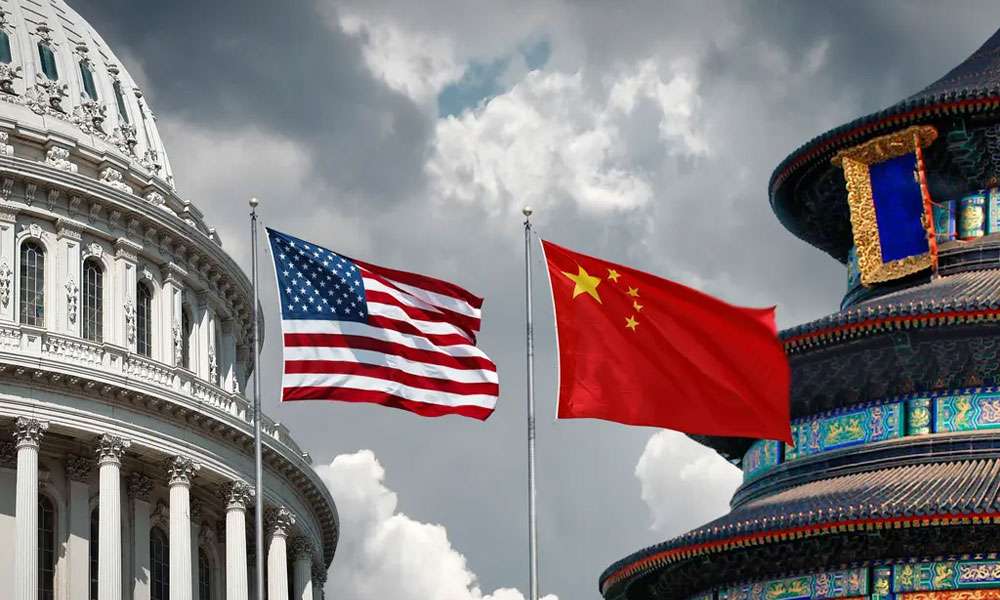
China announced sanctions on ten US companies in the defense and rare metals sectors in response to their inclusion on the Pentagon's blacklist.
Translated by Alqyas from Kuwait News — Original source
China announced on Monday the imposition of sanctions on ten American companies, particularly those operating in the defense and rare metals sectors, a month after President Donald Trump’s visit to Beijing, which was expected to help ease tensions between the two powers.
Beijing justified these measures by citing the US Department of Defense’s inclusion of Chinese companies on a blacklist published in early June, among them Alibaba and BYD, accusing them of cooperating with the Chinese military.
China’s response is likely to complicate diplomatic and commercial relations between the world’s two largest economies, at a time when the White House has invited Chinese President Xi Jinping to visit Washington next autumn.
The Chinese decision, issued on Monday, placed ten US companies and entities on a list of entities subject to Beijing’s ban on exporting products suitable for “dual use,” meaning both civilian and military applications.
A statement from China’s Ministry of Commerce stated, “No organization or individual from any country or region is permitted to transfer or supply these entities with dual-use materials sourced from China.”
The ministry emphasized that “any ongoing export activities must cease immediately,” noting that the measure takes effect as of Monday.
Among the US companies targeted by the sanctions is US Rare Earth, which operates in the rare metals sector. It is part of a group of American companies seeking to reduce the United States’ reliance on China in this vital sector for modern industry.
The list also includes Red Cat, specializing in drones and robotics, and Avionics, specializing in manufacturing high-capacity electro-mechanical systems, both active in the defense sector.
A spokesperson for China’s Ministry of Commerce clarified in a separate statement that the new export restrictions imposed are “in response to the unacceptable decision taken by the US government to add what is called the list of Chinese military companies.”
Two weeks prior, the US Department of Defense had published an update to a list comprising dozens of entities classified as “Chinese military companies,” which operate directly or indirectly in the United States. The ministry added to a previous list several Chinese companies, including major conglomerates such as Alibaba (e-commerce), Baidu (internet), and BYD (electric vehicles).
Beijing had then urged Washington to “cease suppressing” its companies.
Without explicitly referring to the Pentagon’s blacklist, China also prohibited its public administrations and local authorities from purchasing products from 46 US companies in the event they participate in public tenders.
A statement from the Ministry of Finance stated, “Buyers are not allowed to acquire products manufactured by these companies.”
The measure targets entities affiliated with the two giant defense industry groups, Lockheed Martin and Raytheon, as well as the space, defense, and security division of aircraft manufacturer Boeing.
Other targeted companies include branches of General Dynamics (specializing in the design and manufacture of advanced military equipment), as well as Sierra Nevada Corporation, an aerospace industry company also active in the defense sector.
The announcement of these measures comes slightly more than a month after Trump’s visit to China.
Trump and his Chinese counterpart had extended a period of relative thaw that has been noticeable since October 2025 between the two countries, following a fierce trade war lasting several months.
Immediately after Trump’s visit, China announced talks with the United States aimed at reducing tariffs imposed on goods worth tens of billions of dollars.
The Asian giant also pledged to take into account Washington’s “legitimate concerns” regarding rare metals.
