Boubyan Bank CEO Abdullah Al-Tuwaijiri delivers lecture at prestigious Stanford University
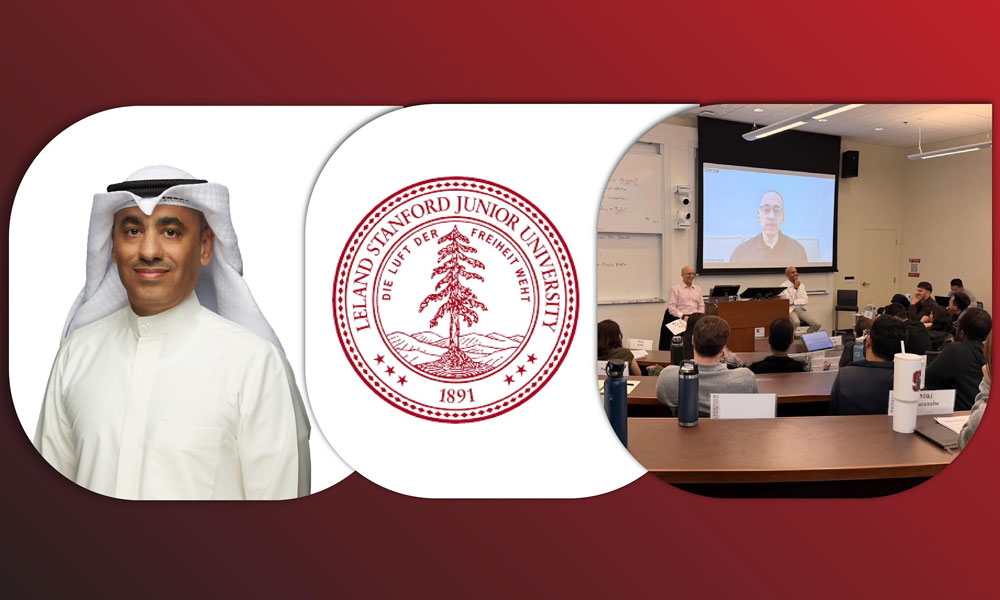
Al-Tuwaijiri participated in a lecture at Stanford University on the development of Boubyan Bank and its success in digital transformation and corporate leadership.
Translated by Alqyas from Kuwait News — Original source
Boubyan Bank today stands as one of the most prominent success stories in Kuwait’s and the region’s banking sector, having consolidated its position over the years as a leading model in Islamic banking, digital services, and corporate innovation. This achievement was highlighted when Stanford University Graduate School of Business hosted the bank’s CEO, Abdullah Al-Tuwaijri, to deliver a lecture dedicated to discussing the development and success story of Boubyan Bank as a case study, as part of an academic program focused on leadership and corporate transformation in the Middle East and North Africa (MENA). The session examined the bank’s journey as a practical model of transformation, growth, and innovation within the banking sector.
Al-Tuwaijri’s participation was part of the course “Systems Leadership and Business Transformation: A MENA Lens,” continuing an academic study that analyzed Boubyan Bank’s experience and strategic transformations under academic supervision within the program designed for Stanford’s Master of Business Administration (MBA) students.
This participation follows Boubyan Bank’s previous appearances on global academic platforms. This marks the second time Stanford University has invited a senior executive from the bank to deliver a lecture on his experience in corporate transformation and the banking sector, following the university’s invitation in 2022 to Adel Al-Majed, Vice Chairman and CEO of Boubyan Bank Group.
The academic program brought together a distinguished group of global leaders and decision-makers. Several prominent figures participated in its sessions, including Reema bint Bandar Al Saud, Ambassador of the Kingdom of Saudi Arabia to the United States; Jeffrey Immelt, former CEO of General Electric; and Faisal Al-Ibrahim, Minister of Economy and Planning of the Kingdom of Saudi Arabia. The sessions were supervised by management professors Robert Siegel and Dr. Ibrahim Al-Muajel.
Al-Tuwaijri stated that Boubyan Bank’s experience represents a practical model of corporate transformation based on clear vision, disciplined execution, investment in talent, customer focus, and the ability to keep pace with changes.
He emphasized that the bank’s rise from ninth to third place among Kuwaiti banks between 2009 and 2020 was the result of comprehensive efforts that included institutional restructuring, product and service development, strengthening digital presence, and market expansion, enabling it to solidify its position as one of the leading Islamic banks in Kuwait and the region.
During the lecture, Professor Robert Siegel outlined Boubyan Bank’s journey from its inception, noting that the bank was established in 2004 and officially began its operational activities the following year, at a time when competition in the Kuwaiti banking market was intense. This was followed by the 2008 global financial crisis, which posed significant challenges to various economic sectors, particularly the banking and financial sectors.
He clarified that 2009 marked a major turning point in the bank’s history, with Adel Al-Majed assuming the role of CEO, bringing extensive experience from Kuwait National Bank. Al-Majed initiated a new phase of institutional restructuring focused on reshaping management, establishing a foundation based on discipline, teamwork, and leveraging opportunities within the Islamic banking sector, which ultimately contributed to building a comprehensive success story.
He noted that what has been achieved was not the result of traditional expansion, but rather the fruit of a clear vision and precise restructuring that included enhancing operational efficiency and building an executive team with deep banking expertise and the ability to lead change and transform challenges into opportunities for sustainable growth.
Al-Tuwaijri emphasized during the discussion and in response to participants’ questions in the program that one of the key secrets behind “Bank Boubyan’s” success lies in assembling a professional team capable of implementing the vision and translating it into tangible results on the ground. He pointed out that the first phase of the transformation involved attracting banking leaders with distinctive expertise, which contributed to building a more efficient, clear, and cohesive operational system.
He added that the success and distinction achieved by the group primarily relied on institutional work and teamwork spirit, alongside a clear strategy and focus on the fundamentals of banking, foremost among which are customer service, investment in human resources, and the development of services and products to keep pace with market developments and needs.
Al-Tuwaijri stated that the bank achieved double-digit growth across several financial and operational indicators within a few years. By 2020, it had transitioned from being the smallest bank in Kuwait to the third largest, while also holding the second-largest number of Kuwaiti customers, reflecting the scale of transformation the bank underwent in a relatively short period.
He clarified that “Boubyan” succeeded in offering a different model in the Kuwaiti market by combining Islamic banking identity with a sophisticated banking experience that meets customer aspirations and aligns with modern best practices.
He added that the bank’s management has been committed since the beginning of the transformation phase in 2009 to continuously improving the quality of services and products, thereby enriching the banking experience and making it more closely aligned with customers’ needs and daily lifestyles. This was later reflected in the bank leading local customer service quality indices and recently receiving the “Best Islamic Bank for Customer Service” award for the sixteenth consecutive year from “Service Hero,” an organization specialized in measuring customer satisfaction levels. As a result, Boubyan has become a leading brand among banking sector institutions, adopting a distinctive path that enhances its customer satisfaction rate of 96% among all local Islamic and conventional banks.
Al-Tuwaijri highlighted that one of the most important strategic transformations the bank underwent was the systematic expansion into retail banking services, after its initial focus had been greater on corporate and institutional financing. He explained that this transformation reshaped the bank’s portfolio in a more balanced and sustainable manner.
Regarding digital investments and infrastructure development, he added that the bank continued to invest in this field through the launch of the Digital Innovation Center, alongside building strategic partnerships with entities in the telecommunications and fintech sectors.
Al-Tuwaijri stressed during the lecture that digital transformation is no longer an option for banks, but has become a fundamental necessity amid rapid technological changes. He affirmed that “Boubyan” was among the first institutions to fully recognize this transformation and treat it as an integral part of its operational model rather than merely a peripheral development path.
He clarified that approximately 99% of the bank’s transactions are now conducted through digital channels, primarily via its mobile application, reflecting the maturity level the bank’s digital experience has reached and the trust customers place in it, as a result of an early-started strategy focused on designing an easy, fast, and flexible banking experience.
Al-Tuwaijri also outlined the bank’s efforts to leverage artificial intelligence within its operational and service framework, highlighting the development of the first local AI model capable of accurately understanding and analyzing the Kuwaiti dialect. This model is used to convert recorded voice calls in the contact center into texts suitable for intelligent analysis, enabling a deeper understanding of customer needs and sentiment analysis. This, in turn, supports work teams with more accurate insights that contribute to service development and more efficient decision-making.
He clarified that the journey to success was not limited to the local market but extended to strengthening the group’s regional and international presence through a strategic expansion aimed at diversifying income sources, expanding the customer base, and enhancing its footprint in international banking and wealth management.
He noted that the group currently includes Boubyan Bank, Bank of London and the Middle East (BLOM), and Nomo Bank, the group’s digital arm, along with several subsidiaries: Boubyan Takaful Insurance and Boubyan Capital for Investment. This reflects a gradual expansion path aligned with the bank’s vision of building an integrated banking group with both local and international presence.
Al-Tuwaijri emphasized that Boubyan’s experience represents a practical model of institutional transformation based on clear vision, disciplined execution, investment in talent, customer focus, and the ability to keep pace with changes. He pointed out that rising from ninth to third place among Kuwaiti banks over ten years is a direct reflection of the success of the adopted strategy and the integrated development efforts across the institutional structure, products and services, digital presence, and market expansion, which enabled it to consolidate its position as one of the leading Islamic banks in Kuwait and the region.
The lecture witnessed notable interaction from participating students, whose questions focused on Boubyan Bank’s digital transformation experience, the foundations of its success in a highly competitive banking market, and its outlook for the Kuwaiti and Gulf banking sectors in light of the academic study that examined its experience.
At the conclusion of his participation, Al-Tuwaijri expressed his appreciation to the university administration and those overseeing the academic program, lecturers Robert Siegel and Dr. Ibrahim Al-Muajjal, emphasizing the importance of transferring successful institutional experiences to global academic circles and providing opportunities for graduate students to examine practical models from the region in the fields of leadership, transformation, and innovation.
For his part, academic Robert Siegel praised the interaction during the lecture, expressing his appreciation for Al-Tuwaijri’s participation and his experiences shared with program students, as well as the rich discussions during the session regarding challenges and success opportunities in Boubyan Bank’s journey. He affirmed that the experience constituted a successful practical model of institutional transformation and its ability to adapt and grow in a rapidly changing world.
