Launch of Global Halal Summit and Halal Expo 2026 in Istanbul
صورة: وكالة الأنباء الكويتية (كونا)
The Global Halal Summit launched in Istanbul with participation from 500 entities, where Omar Bulat emphasized the growth of the halal economy and expectations to exceed 3.5 trillion dollars by 2029.
Translated by Alqyas from KUNA — Original source
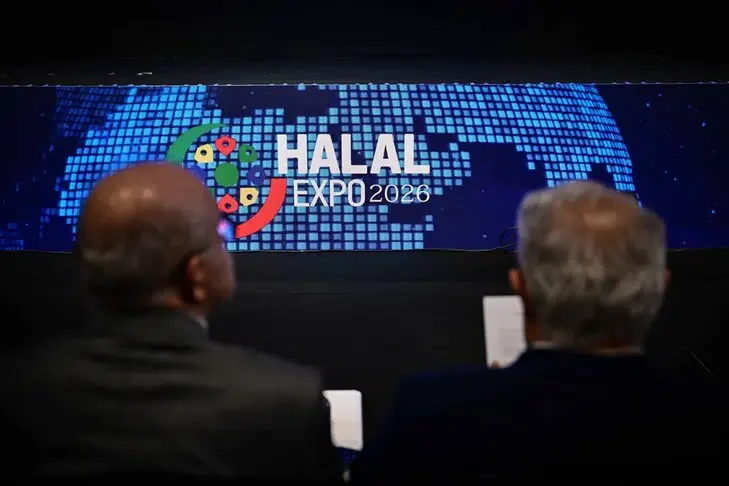
Istanbul, November 25 (KUNA) -- The 12th edition of the Global Halal Summit and the international Halal Expo 2026 trade exhibition kicked off today in Turkey, with participation from more than 500 international entities.
Turkish Minister of Trade Ömer Bolat, in his opening address at the summit and exhibition held at the Istanbul Exhibition Center, stated that the halal economy is experiencing rapid growth, with its global volume projected to exceed $3.5 trillion by the end of 2029.
Bolat emphasized the importance of international cooperation amid geopolitical conflicts and tensions, global economic slowdown, and rising protectionist policies in international trade. He noted that efforts are ongoing to develop common standards among halal certification bodies in the Islamic world and to enhance cooperation among them under a unified institutional framework.
He pointed out that the combined gross domestic product (GDP) of the 57 member states of the Organization of Islamic Cooperation (OIC) approaches $10 trillion, while their intra-regional trade totals approximately $979 billion. Bolat added that trade volume between Turkey and Islamic countries reached $136.5 billion last year, rising to $122.8 billion during the first ten months of the current year, representing a 10 percent increase compared to the same period last year.
Bolat clarified that global halal consumption, which encompasses food, tourism, textiles, pharmaceuticals, cosmetics, media, and entertainment sectors, grew by 7 percent in 2024 to reach $2.6 trillion. He specified that food products accounted for $1.5 trillion of this total, while the Islamic finance sector was valued at $6 trillion.
Regarding certification, Bolat stated that since its establishment in 2017, the Turkish Halal Certification Authority has received approximately 270 applications, granted certification issuance rights to 147 entities, and ensured the validity of 3,000 halal certificates under its guarantee.
For his part, Amr Atah, Vice President of the Global Halal Summit Council, in a similar speech, outlined the size of the halal market, which was estimated at around $1 trillion when the first editions of the summit began, and has now reached between $9 and $10 trillion when including the finance sector. He added that the market is expected to reach $12 trillion within the next four to five years, noting that halal products are not targeted solely at Muslims but also attract a broad segment of consumers seeking reliable, healthy products produced according to ethical standards.
He affirmed that the principle of halal is based on quality and hygiene in production, integrity in trade, trust in social relations, and justice and fairness in international relations.
For his part, Ihsan Ovfut, Secretary General of the Standards and Metrology Institute for Islamic Countries (SMIIC), noted that this year’s summit focuses on sustainability and the halal economy, examining various sectors, notably food, cosmetics, and tourism. Discussions will cover waste management, improving product distribution policies, sustainable lifestyles, halal tourism, and ethical issues.
The event features bilateral business meetings, economic forums, and conferences between Turkey and Vietnam, the Philippines, Yemen, Palestine, and the Sultanate of Oman, aimed at exploring ways to increase trade exchange, joint investments, and cooperation opportunities in the food, manufacturing, tourism, health, and services sectors.
Following the opening ceremony, relevant halal standards and certification institutions in Turkey, Vietnam, Kyrgyzstan, and Saudi Arabia signed cooperation agreements, alongside an agreement between the Qatar Chamber and the Global Halal Summit Council.
The summit, which hosts 225 companies from 25 countries, including 153 Turkish and 72 foreign firms, will discuss international standards, halal certification, accreditation, and quality assurance, alongside efforts to reduce barriers to market access and support sustainable growth. (End) T.A./F.L.A.
