OPEC Secretary General: Oil and gas-producing countries supported COP31 outcomes and were not an obstacle to negotiations
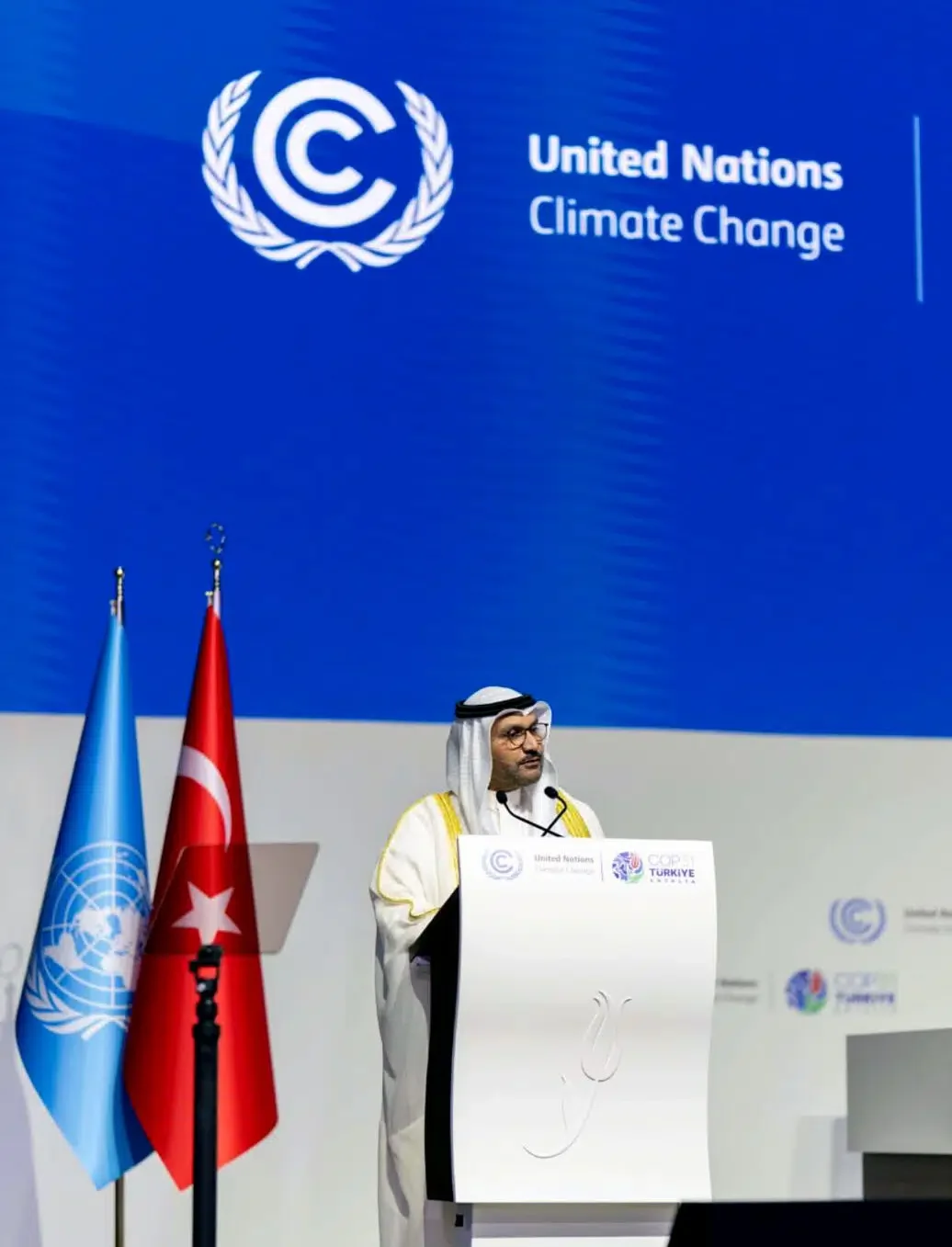
صورة: وكالة الأنباء الكويتية (كونا)
OPEC Secretary General Haitham Al-Ghaiss confirms support from oil and gas-producing countries for COP31 outcomes and denies they were an obstacle to negotiations
Translated by Alqyas from KUNA — Original source
Kuwait – OPEC Secretary-General Haitham Al-Ghaiss confirmed on Wednesday that oil and gas-producing countries supported the draft final decisions of the 31st Conference of the Parties (COP31) to the UN Framework Convention on Climate Change, “despite their reservations,” stressing that they were not “parties to derailing or withdrawing from the negotiations, but acted in good faith throughout all stages of the talks.”
In a statement to the Kuwait News Agency (KUNA), Al-Ghaiss said that some media outlets had blamed oil and gas-producing countries for the failure to reach an agreement on the conference’s final decisions, accusing them of not negotiating in good faith and portraying them as an obstacle to implementing the Paris Agreement. He described these accusations as “far removed from reality.”
He clarified that oil and gas-producing countries endorsed the draft final decisions, known as the “Antalya Charter,” “despite their reservations,” considering it a consensus text that includes practical solutions to advance climate action and enhance the implementation of commitments on the ground. He noted that these countries also supported the conference presidency’s efforts.
Al-Ghaiss added that the “Antalya Charter” draft fully referenced the “UAE Consensus” reached during COP28 in 2023, covering emissions reduction, climate adaptation, and means of implementation. He explained that the conference presidency drafted the text, which was accepted by oil and gas-producing countries, while other parties rejected it due to its omission of the term “fossil fuels.”
Highlighting the importance of climate ambitions, Al-Ghaiss stressed the need to look at the actual policies and measures being implemented. He pointed out that some countries, including the European Union, have adopted initiatives to reduce reliance on hydrocarbons in the energy mix, yet at the same time are easing certain rules regarding the future use of oil and gas.
He noted that the EU expanded its capacity to import liquefied natural gas (LNG) by more than a third between 2021 and 2025, nearly doubled its LNG imports during the same period, and recently emphasized the need to reassess its refining capacities for energy security. Meanwhile, several European countries have delayed plans to phase out coal-fired power plants.
Al-Ghaiss added that the EU postponed the application of methane emission monitoring rules for oil and gas importers until 2029, moved to ease restrictions on the ban of internal combustion engine vehicles by 2035, and reached an agreement to revise sustainable finance rules to allow oil, gas, and coal companies to benefit from transitional funds officially classified by the EU.
He pointed out that these three amendments came in the same month that EU negotiators accused their international partners of backtracking on commitments to phase out fossil fuels during COP31 negotiations.
Al-Ghaiss emphasized the need to recall the principles underpinning the UN Framework Convention on Climate Change and the Paris Agreement. He explained that the Framework Convention is a balanced document that considers the interests of all parties, underscores the importance of the broadest possible cooperation, recognizes the needs of countries and peoples, and works toward just and equitable pathways to address climate change.
He clarified that the Paris Agreement is based on the principle of common but differentiated responsibilities and respective capabilities, as well as a national approach to determining commitments according to each country’s priorities and circumstances. It does not dictate energy sources but focuses on reducing emissions and leveraging appropriate technologies.
He stated that OPEC continues to emphasize that addressing climate change requires leveraging all available solutions, with countries choosing those that suit their national circumstances. Regarding emissions reductions, Al-Ghaith clarified that the Paris Agreement does not specify a particular mechanism for achieving this, questioning why some parties object to including carbon capture, utilization, and storage (CCUS) technologies and related technologies in the draft decisions of COP31, despite their focus on reducing emissions. He noted that the Sixth Assessment Report of the Intergovernmental Panel on Climate Change (IPCC), endorsed by member governments, includes CCUS and carbon dioxide removal technologies within global emissions reduction pathways, as explicitly stated in the final text of COP28.
He added that COP31 revealed the limited collective readiness of developed countries to assist developing nations in adapting to climate change, as the draft final decision omitted reference to the $120 billion climate adaptation finance target. He questioned how to reconcile the removal of one means of implementing climate obligations with calls for a global energy transition. He stressed that developed countries achieved industrialization by consuming approximately four-fifths of the global carbon budget, and that the principles of equity, common but differentiated responsibilities, and historical responsibility require them to lead climate action efforts and provide necessary support to developing countries, including finance, technology transfer, and capacity building.
He pointed out that the issue of developed countries fulfilling their commitments to close funding gaps and increase climate finance directed to developing countries, which have historically contributed a small share to emissions, has remained on the agenda of COPs for decades, underscoring the necessity for governments to implement existing obligations. Al-Ghaith affirmed that the outcomes of COP31 highlight the need to adopt a comprehensive approach that leverages all energy sources and technologies, ensuring energy security amid growing global demand and varying national needs and circumstances.
He said the world needs an “era of all energy sources” to enhance supply security, an “era of all technologies” that contribute to emissions reductions in line with the Paris Agreement, and an “era of all peoples” that leaves no one behind. He added that approximately 655 million people remain without access to electricity, while two billion people rely on harmful fuels for cooking, emphasizing that these figures reflect a human reality requiring access to the energy sources enjoyed by billions worldwide.
He reaffirmed that OPEC member countries renew their strong commitment to multilateralism and the principles and provisions of the Framework Convention and the Paris Agreement, excluding no solutions, and continue working toward solutions that serve the interests of all parties during climate conferences, ensuring that diverse perspectives are taken into account in harmony with the objectives of the United Nations Convention. (End) K.M. / A.M.H.
