China launches (Shenzhou-24) spacecraft with Pakistani astronaut to its space station
Press coverage 3 newspapers covered this event: Al-Jarida · Al-Rai · KUNA →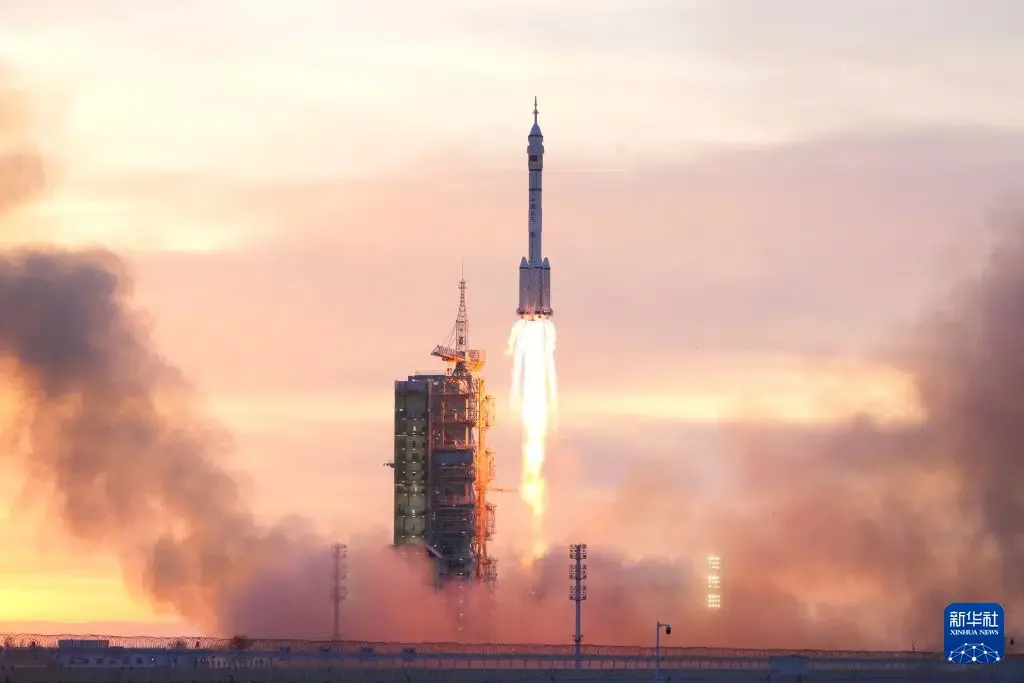
صورة: وكالة الأنباء الكويتية (كونا)
China announced successful launch of Shenzhou-24 spacecraft carrying three astronauts, including Pakistani Muhammad Ali, in historic step for first foreigner to enter Tiangong station.
Translated by Alqyas from KUNA — Original source
Beijing -- China announced on Wednesday the successful launch of the Shenzhou-24 manned spacecraft, carrying three astronauts, including a Pakistani, in an unprecedented move that marks the first time a foreigner has entered its Tiangong orbital space station. Xinhua News Agency reported that a Long March-2F rocket was used to launch the spacecraft from the Jiuquan Satellite Launch Center in northwest China at 08:18 Beijing Time (03:18 Mecca Time). The agency stated that approximately 10 minutes after launch, the spacecraft separated from the rocket and entered its planned orbit, noting that the Shenzhou-24 launch was “completely successful.” The spacecraft later successfully docked automatically with the space station, paving the way for the Shenzhou-24 crew to subsequently enter Tiangong.
The mission crew consists of three astronauts: Chinese pilot and mission commander Tang Hongbo (51), who has previously visited the station twice; Chinese aerospace engineer Wu Yi (39); and Pakistani Muhammad Ali (40), serving as the first foreign astronaut to visit the Chinese space station. The Shenzhou-24 mission represents the first joint flight involving Chinese and foreign astronauts in the history of China’s manned space program. Consequently, Pakistani astronaut Muhammad Ali becomes the first Pakistani to reach Earth’s orbit and the first foreign astronaut to visit the Chinese station.
Zhang Jingbo, spokesperson for China’s manned space program, said that 90 scientific experiments and technology tests are scheduled during the Shenzhou-24 mission, covering areas such as space life sciences, space materials science, fluid physics, combustion science in microgravity environments, fundamental physics, space medicine, and new space technologies. Zhang also revealed at a press conference yesterday that four cooperative projects between China and Pakistan in the fields of biotechnology and materials will be implemented during the Shenzhou-24 mission, with the Pakistani astronaut conducting an orbital experiment on photosynthetic cyanobacteria.
He clarified that after completing the short joint spaceflight, the Pakistani astronaut will return to Earth aboard the Shenzhou-23 spacecraft along with two of its crew members, while the other two Shenzhou-24 astronauts will remain in orbit for approximately six months alongside Shenzhou-23 crew member Zhai Zhigang, who has already spent six months in orbit and will continue his stay on the Tiangong station to complete a one-year residency experiment.
It is worth noting that China has so far sent 31 Chinese astronauts and one foreign astronaut into space. Wednesday’s launch marked the 680th mission in the Long March carrier rocket series. (End) S.L.Q. / T.M.A.
