Lebanese President confirms that any alternative force to (UNIFIL) must operate under the United Nations flag
صورة: وكالة الأنباء الكويتية (كونا)
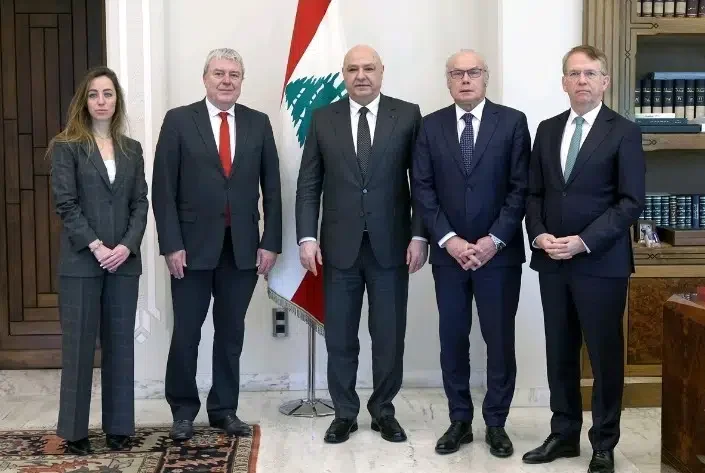
President Aoun confirmed that any alternative force to UNIFIL must operate under the United Nations flag, and handed over the public sector reform plan to Minister Maki
Translated by Alqyas from KUNA — Original source
Beirut -- Lebanese President Joseph Aoun affirmed on Tuesday that any alternative force to the United Nations Interim Force in Lebanon (UNIFIL) must operate under the UN flag and that its legal framework must be based on Resolution 1701, with the possibility of amendments as needed. The Lebanese Presidency stated in a press release that President Aoun, addressing a French parliamentary delegation from the Foreign Affairs Committee, noted a “convergence of views between Lebanon and France on extending UNIFIL’s mandate or enabling it to continue its operations through 2027, while emphasizing the need to avoid any vacuum and agreeing that any alternative forces must operate under the UN flag.”
President Aoun outlined the key tasks that any alternative force to UNIFIL could undertake if an extension proves unfeasible, including “providing logistical support to the Lebanese Army, assisting in the dismantling of unexploded ordnance, addressing tunnels and arms caches if found,” as well as providing humanitarian support to communities in the south by helping to open roads, facilitating the return of residents to their villages, and conducting monitoring and reporting.
He pointed out that the occupation continues to carry out hostile acts in the south, such as demolishing homes and periodically shelling villages, with recent shelling extending to the Bekaa region in northeastern Lebanon. President Aoun noted that the trilateral negotiations have been suspended due to the Israeli elections, with hopes that meetings will resume after the formation of the new Israeli government. He emphasized that the return of southerners to their villages and towns remains a core objective of the negotiations, noting that some displaced persons have already returned to areas not under occupation, awaiting the withdrawal of the Israeli army from occupied towns, the entry of the Lebanese Army, reconstruction efforts, and the return of their inhabitants. He expressed hope that Arab and European countries would contribute to the reconstruction process.
He stressed that Lebanon’s stability is “essential and fundamental for Europe, given that Lebanon serves as Europe’s gateway to the Arab world and the Arab world’s gateway to Europe.” President Aoun thanked France for its steadfast support of Lebanon, the positions of the French President, and the aid provided to Lebanon, particularly during difficult times, including the preparatory conference held in Paris ahead of the international conference to support the Lebanese Army and internal security forces.
In a separate domestic development, the Lebanese Presidency announced that President Aoun received from State Minister for Administrative Development Fadi Makki the strategic roadmap for public sector reform and the detailed implementation plan under the “Rebuilding State Departments and Institutions 2030” project. President Aoun stressed that “rebuilding state departments and institutions is a fundamental step in the project to reconstruct the Lebanese state on modern and sound foundations,” considering that “administrative reform is not an option that can be postponed, but a necessary condition for the establishment of the state that Lebanese people aspire to.”
Following the meeting, Minister Makki held a press conference, stating that this project is “the first comprehensive plan for rebuilding the Lebanese administration in over 60 years,” noting that vacancy rates reach approximately 70 percent in state departments, that “digital infrastructure is dilapidated, services are declining, and citizens are paying the price every day.” He indicated that the strategic roadmap rests on three pillars: (governance and administrative organization), (human resources), and (services and digital transformation), with two cross-cutting paths: change management and communication.
He stated that the plan includes 37 strategic reforms organized under five pillars: strengthening the government’s operational center; organizing state departments and institutions to ensure clarity, accountability, and the protection and development of public funds and state assets; building an efficient, merit-based public service; and making services simple, digital, and reliable. (End) A.Y.B./N.S.A.
