Kuwaiti Academic: Kuwait Has Made Significant Progress in Developing the Reform and Family Reconciliation System
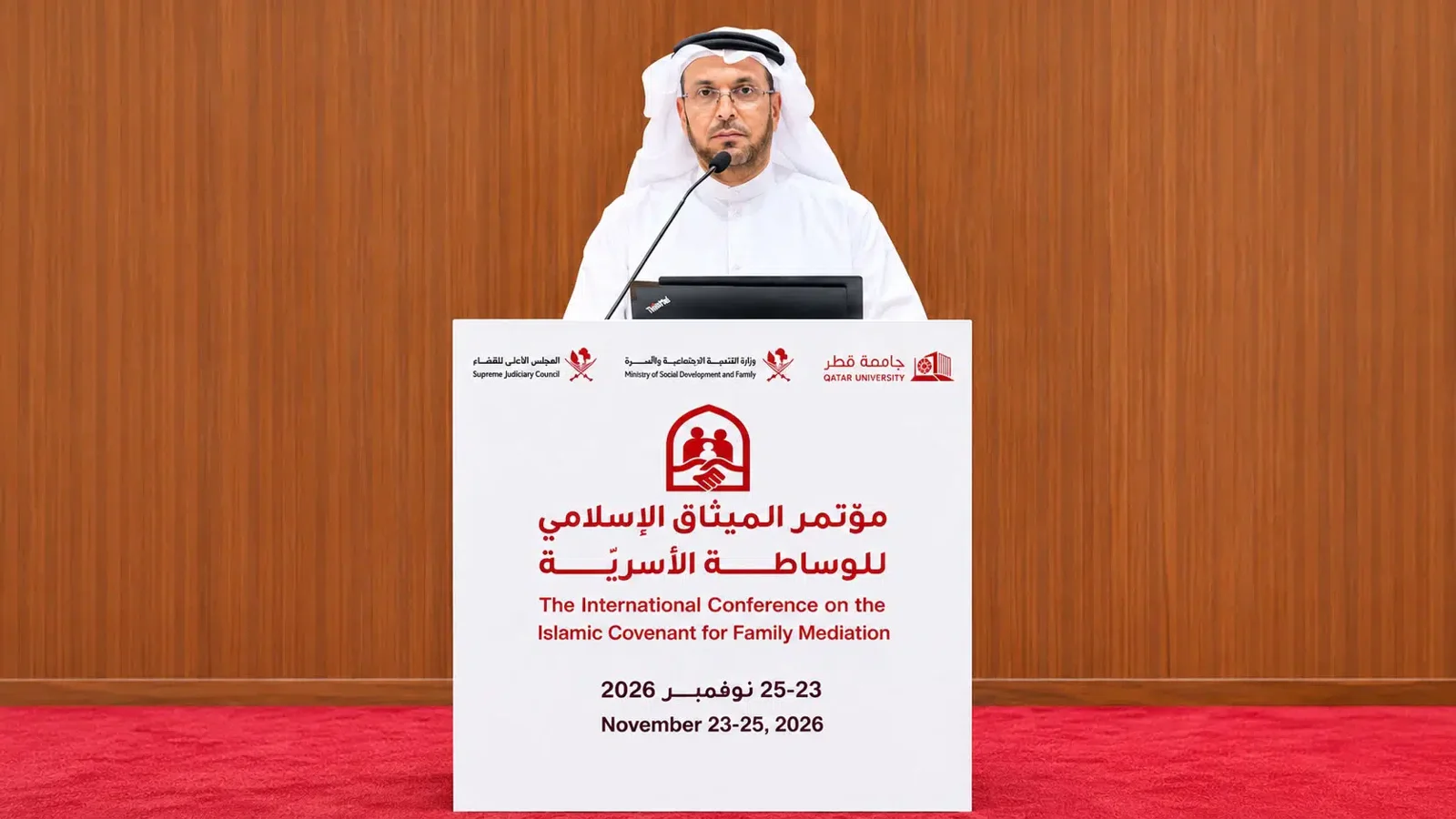
صورة: وكالة الأنباء الكويتية (كونا)
Kuwaiti academic Hamoud Al-Qushaan affirmed Kuwait's progress in family reform during his participation in the Qatar conference
Translated by Alqyas from KUNA — Original source
Doha -- Dr. Hamoud Al-Qushaan, a professor of family and marital counseling at Kuwait University, affirmed on Monday that Kuwait has made significant strides in developing its family reconciliation and reform system, praising the efforts of the Kuwaiti Ministry of Justice in updating legislation and procedures related to personal status cases. This statement came in an interview with the Kuwait News Agency (KUNA) following his participation in the International Conference on the Islamic Charter for Family Mediation, organized by the Faculties of Sharia and Islamic Studies and Law at Qatar University, in partnership with the Supreme Council of the Judiciary and the Ministry of Public Health of Qatar, held in the capital, Doha.
He noted that he participated in the conference with a scientific paper titled “The Family Reconciliation Charter: Between Reality and Ambition – A Reading of the Foundations and Skills of Family Reconciliation: Kuwait as a Model,” through which he reviewed the evolution of Kuwait’s family reform experience and the key legislative and professional transformations associated with it.
Dr. Al-Qushaan, who serves as an arbitrator in personal status cases in Kuwaiti courts, stated that “the institutional beginnings of the Kuwaiti experience date back to 1992, when the Ministry of Justice established a Social Counseling and Family Reform Department within the courts, before these services expanded with the support of the General Secretariat of Waqf to include centers outside judicial buildings, thereby encouraging families to seek help before disputes escalate.”
He added that “Kuwait has strengthened this experience by developing procedures for resolving marital disputes and utilizing arbitrators alongside judges in cases of discord and conflict, thereby enabling the use of specialized expertise to examine the causes of disputes and provide professional opinions to the court.”
Al-Qushaan clarified that the amendments proposed this November reflect Kuwait’s interest in promoting amicable settlements, simplifying judicial procedures, and regulating the engagement of family experts with specializations in Sharia, psychology, and social sciences. He highlighted that among the key developmental aspects of these amendments are enhancing the professional status of family experts, regulating the operations of family dispute resolution centers, and expanding the scope of specialized services to support the capacity of judicial institutions to address disputes from legal, social, and psychological perspectives.
In this regard, he emphasized that “arbitrators and family experts are crucial elements in achieving family justice through examining the circumstances of disputes, analyzing the nature of marital relationships, and providing specialized opinions while preserving judicial independence and its legal jurisdiction.”
He pointed out that “the success of family reconciliation is not measured solely by the number of divorces avoided, but by the ability of professional intervention to rebuild communication between spouses, protect the rights of all parties, and achieve psychological and social stability for children.”
Al-Qushaan called for “adopting a professional and ethical charter for family reconciliation that defines the qualifications of reconcilers and experts, ensures neutrality, confidentiality, and freedom from coercion, and enhances integration among psychological, social, Sharia, and legal disciplines.”
He also stressed the importance of leveraging artificial intelligence applications as supportive tools for organizing services, analyzing information, and improving professional performance, without replacing qualified family reconcilers or the specialized human judgment required in sensitive family cases.
In this context, the Kuwaiti academic emphasized the importance of exchanging experiences among Gulf Cooperation Council (GCC) countries and benefiting from the Kuwaiti experience in developing family reconciliation mechanisms, thereby contributing to building a more integrated Gulf system to protect the family and enhance its stability.
The International Conference on the Islamic Charter for Family Mediation, which launched today and will run for three days, brings together a distinguished group of scholars, researchers, and experts to examine the legal, judicial, and social dimensions of family mediation under Shariah. (End) S S S / N A A
