Egypt: Successive Crises in the Region Prove No Military Solutions Exist for Regional Conflicts
صورة: وكالة الأنباء الكويتية (كونا)
Egyptian Foreign Minister confirms crises prove failure of military solutions, emphasizing political tracks and Trump's peace plans for Gaza
Translated by Alqyas from KUNA — Original source
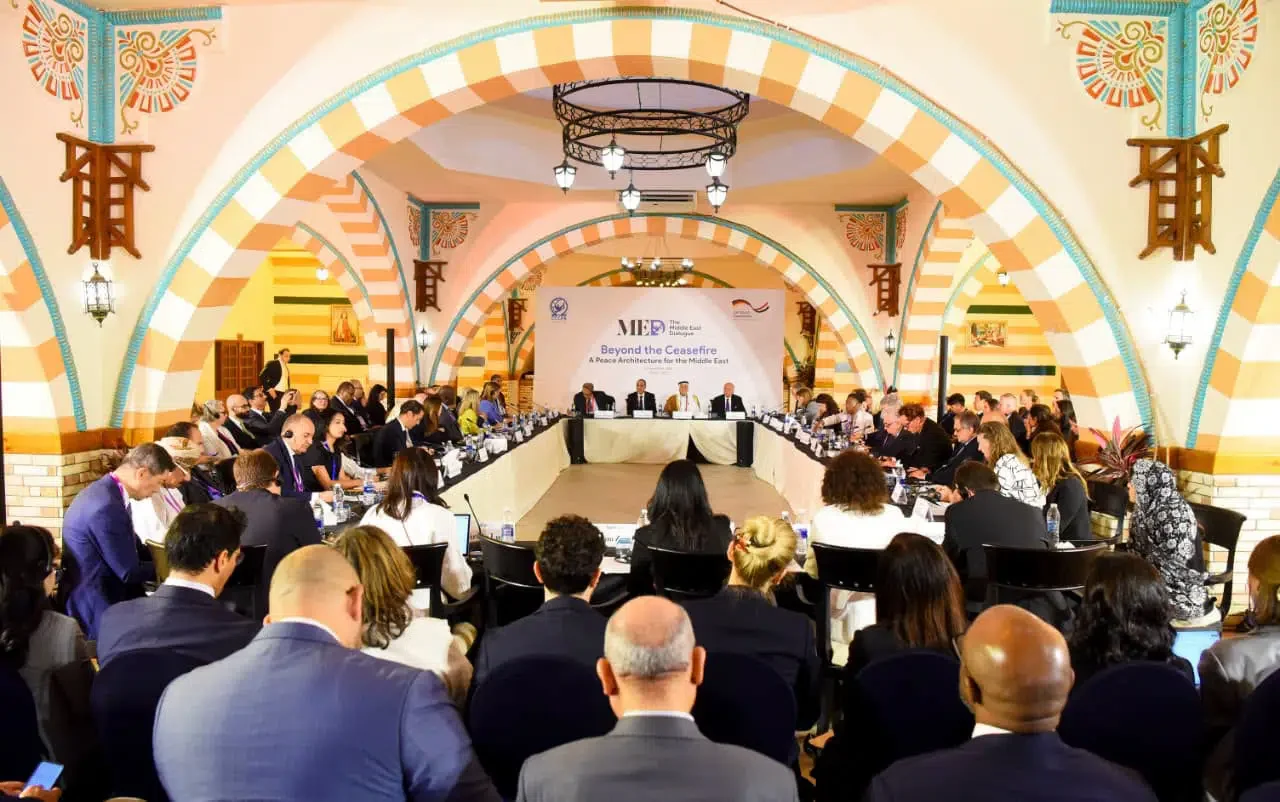
Cairo -- Egyptian Foreign Minister Dr. Badr Abdel Ati affirmed on Sunday that “the successive crises witnessed by the region have demonstrated the absence of military solutions to regional conflicts.” The Egyptian Ministry of Foreign Affairs stated in a press release that these remarks were made during Minister Abdel Ati’s participation in a panel discussion on the Middle East titled “Post-Ceasefire: Toward a Peace Architecture in the Middle East,” held within the framework of the sixth edition of the Aswan Forum for Peace and Sustainable Development.
The statement clarified that Abdel Ati outlined four key determinants of Egypt’s vision for achieving sustainable peace, the foremost being the transition from ceasefires to clear political tracks that address the root causes of conflicts. According to the statement, Abdel Ati stressed the importance of fully implementing the second phase of U.S. President Donald Trump’s comprehensive peace plan for Gaza, which includes the withdrawal of Israeli occupation forces, empowering the National Authority for the Governance of Gaza to assume its responsibilities, and accelerating early recovery and reconstruction efforts leading to the establishment of an independent Palestinian state on the June 4, 1967, lines with East Jerusalem as its capital.
He noted that the second determinant is based on supporting the national state and its legitimate institutions, respecting the sovereignty and territorial integrity of states. He emphasized the importance of supporting Lebanese state institutions and the full implementation of UN Security Council Resolution 1701, preserving Syria’s unity and sovereignty, and reaching a comprehensive political settlement of the Yemeni crisis. He also affirmed the importance of consolidating calm and prioritizing dialogue to address differences with Iran, stressing the close interconnection between the security of Egypt, Gulf states, and other countries in the region.
The Egyptian Foreign Minister pointed out that the third determinant concerns the necessity of providing clear guarantees for the implementation of ceasefire agreements and political settlements through the establishment of effective follow-up and accountability mechanisms, ensuring respect for international law and UN Security Council resolutions without double standards, thereby preventing the recurrence of conflicts and enhancing the prospects for sustainable peace.
As for the fourth determinant, he stated that it involves strengthening regional ownership of security and stability arrangements in the Middle East, emphasizing the importance of regional countries playing the leading role in shaping their regional security architecture, enhancing dialogue and joint coordination, and safeguarding the security of strategic maritime corridors, foremost among which are the Red Sea and the Gulf of Aden. In this regard, he stressed the necessity of transitioning from crisis management to crisis prevention, and from temporary arrangements to comprehensive political settlements.
The session saw wide international participation, including Iraqi Deputy Prime Minister and Foreign Minister Fawzi Hussein, former Secretary-General of the Arab League Amr Moussa, Prince Turki al-Faisal, Chairman of the King Faisal Center for Research and Islamic Studies, Lebanese Minister of Culture Dr. Ghassan Salame, former Deputy Prime Minister of the Netherlands Sigrid Kaag, and Anna Bjerde, Managing Director for Operations at the World Bank.
Also participating in the session were Miguel Moratinos, UN Under-Secretary-General and High Representative for the UN Alliance of Civilizations; Jeffrey Sachs, Professor of Economics at Columbia University; Prince Zeid Ra’ad Zeid al-Hussein, President and CEO of the International Peace Institute; Comfort Ero, Chair of the International Crisis Group; former Lebanese Foreign Minister Dr. Nassif Hitti; and Dr. Mahmoud Mohieldin, UN Special Envoy for Financing the 2030 Sustainable Development Agenda. (End) A.S.M./N.A.A.
