Kuwaiti Health Minister: Antimicrobial Resistance Health Challenge Requires Serious Work and Professional and Institutional Cooperation
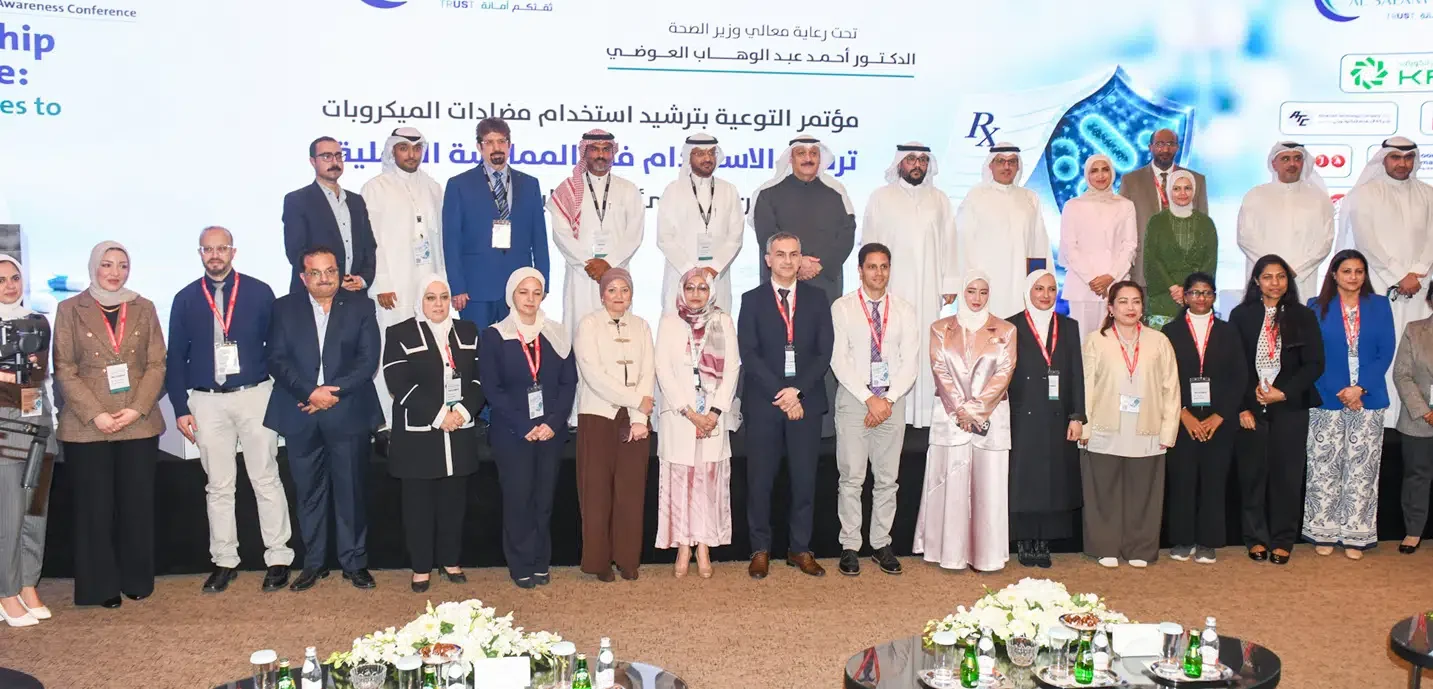
صورة: وكالة الأنباء الكويتية (كونا)
Ahmed Al-Awadi Warns of Antimicrobial Resistance Threat and Reaffirms Importance of Institutional Cooperation with Fawaz Al-Anzi
Translated by Alqyas from KUNA — Original source
Kuwait -- Kuwait’s Minister of Health, Dr. Ahmed Al-Awadi, said on Thursday that antimicrobial resistance (AMR) constitutes a health challenge requiring serious, sustained effort and professional and institutional collaboration, as addressing it transcends any single sector. He made these remarks during his speech at the opening of the awareness conference on the rational use of antimicrobials, organized by Al Salam Hospitals and attended by health leaders and experts from Kuwait and abroad.
Dr. Al-Awadi explained that antimicrobial resistance threatens the effectiveness of infection treatments and could impact delicate medical procedures such as surgeries, organ transplants, cancer treatment, and critical care. He cited World Health Organization estimates linking bacterial resistance to antimicrobials to approximately 5 million deaths in 2019, as well as the 2024 political declaration by the United Nations General Assembly, which set a target to reduce deaths associated with AMR by 10 percent by 2030 compared to the 2019 baseline.
He emphasized that infection prevention is an integral part of antimicrobial stewardship, achieved through infection control, hand hygiene, vaccination, and improved care practices to limit the spread of infections and reduce the need for antimicrobials. He called for cooperation among all health institutions under the “One Health” approach, which links human health to the environment, noting that integrating health institutions across various sectors in research, education, training, and knowledge exchange positively impacts care quality and patient safety.
Dr. Al-Awadi highlighted that Al Salam Hospitals have served as a model since their launch in 1964 as a maternity hospital and their evolution in 1992 into a comprehensive general hospital. He praised their achievements in quality and patient safety, including receiving Canadian accreditation at the Diamond level for three consecutive years, along with three ISO certifications for quality, environmental management, and occupational health and safety. He also commended their commitment to medical education and training.
For his part, Fawaz Al-Anzi, Chairman of the Board of Directors of Al Salam Hospitals, said in a similar address that the rational use of antibiotics is “one of the most prominent challenges and key pillars in the future of healthcare.” He added that “preserving the effectiveness of these drugs is a shared responsibility and a trust toward future generations.”
Al-Anzi clarified that the health sector’s responsibility extends beyond providing treatment services to protecting public health, raising awareness, developing medical competencies, and fostering a culture of quality, excellence, and adherence to best scientific and professional practices to ensure patient safety and enhance healthcare quality. He noted that improving public health is “a shared responsibility that requires integrated efforts from both the public and private sectors,” and commended the distinctive role of the Kuwait Finance House as the main supporter of this initiative, highlighting its model of cooperation among national institutions in supporting initiatives with positive societal impact and strengthening health awareness.
For her part, Conference Chair Dr. Wadha Al-Fawzan said in a similar address that the conference reaffirms a shared commitment to promoting sound health practices and consolidating a culture of responsible antibiotic use, contributing to the protection of human health and the advancement of healthcare standards. She explained that antimicrobial resistance has become one of the most dangerous health challenges facing the world, posing a direct threat to treatment effectiveness, patient safety, and the capacity of health systems to combat infectious diseases.
She pointed to the important steps taken by the State of Kuwait in combating antimicrobial resistance and enhancing programs to promote the rational use of antimicrobials, in line with the recommendations of the World Health Organization and international guidelines. (End) M.N.M. / M.S.A.
