Chinese President calls for finding a path to consensus between Beijing, Moscow and Washington during Tripartite Summit
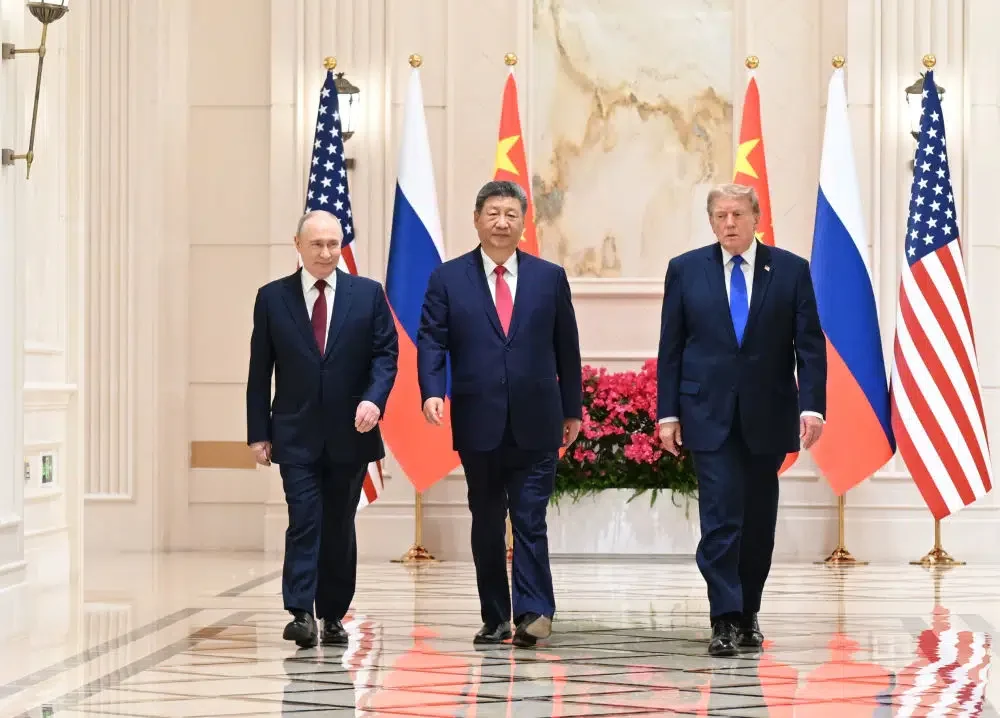
صورة: وكالة الأنباء الكويتية (كونا)
Chinese President calls for consensus between Beijing, Moscow and Washington.
Translated by Alqyas from KUNA — Original source
Beijing, Nov 19 (KUNA) -- Chinese President Xi Jinping called on Thursday for enhanced cooperation and coordination among China, Russia, and the United States to address global challenges and safeguard international peace and security. He emphasized the necessity of forging a path based on consensus and peaceful coexistence among the three countries, contributing to stability and progress for humanity.
Xinhua News Agency reported that this came during an unprecedented trilateral summit bringing together President Xi, his Russian counterpart Vladimir Putin, and U.S. President Donald Trump, held on the sidelines of the 33rd Asia-Pacific Economic Cooperation (APEC) Economic Leaders’ Meeting in Shenzhen, China.
Quoting President Xi, the agency reported that during the summit, he noted the world has witnessed more than 10,000 wars while still enduring over 60 ongoing conflicts. He stressed that consensus among major powers is a fundamental pillar for achieving global peace, whereas their rivalry exacerbates turmoil and chaos.
Xi pointed out that the world today is more interconnected and interdependent in its interests. Countries are no longer isolated entities but have become part of a global village where all parties are affected by the prosperity or crises experienced by others. In this context, he affirmed that “enhancing positive interaction among major powers, which bear special responsibilities toward the international community, is not merely a choice but a duty that must be fulfilled” to ensure global stability.
President Xi proposed four basic principles for establishing a correct path of consensus among major powers: mutual respect, peaceful coexistence, cooperation based on mutual benefit, and prioritizing dialogue and consultation in resolving differences. He underscored the need to respect the sovereignty, territorial integrity, and core interests of all countries, and to refrain from interfering in their internal affairs or crossing red lines that affect their security and stability.
He called on Beijing, Moscow, and Washington to build relationships based on partnership and friendship rather than conflict and confrontation, and to work toward overcoming what is known as the “Thucydides Trap,” which refers to the risks of conflict erupting among major powers due to competition for influence. He affirmed that falling into this trap is “not an inevitable destiny” but is linked to the choices and policies adopted by major powers in managing their relations and differences.
Regarding nuclear security, President Xi called for efforts to ban and comprehensively eliminate nuclear weapons, aiming to establish a nuclear-weapon-free world. He warned that nuclear war cannot have winners and must not be fought under any circumstances, emphasizing the importance of making necessary efforts to prevent its outbreak and to adhere to the Treaty on the Non-Proliferation of Nuclear Weapons, thereby preserving global strategic stability.
On economic matters, the Chinese president called for abandoning Cold War mentality and enhancing economic and trade cooperation among the three countries to achieve shared interests, while avoiding “decoupling” policies and disrupting production and supply chains. He highlighted the importance of intensifying communication and coordination among Beijing, Moscow, and Washington to address challenges related to energy security, ensure the stability of global markets and supply chains, and leverage the economic and industrial potential possessed by the three countries.
Regarding the management of differences, Xi affirmed that divergent interests and viewpoints are inevitable, but a lack of communication and dialogue can deepen suspicions and misunderstandings, turning limited frictions into broader crises and conflicts.
In this context, he called for maintaining regular high-level communication among the three countries and keeping dialogue channels open at various levels, alongside establishing mechanisms for crisis prevention and management, which would help mitigate miscalculations and contain escalation. He also emphasized the importance of encouraging parties to international conflicts to return to the negotiating table and to adopt political and diplomatic solutions as a means of resolving disputes and enhancing global security and stability. (End) S.L.Q. / M.N.F.
