Egypt: New Archaeological Discovery Documents 3 Successive Historical Epochs
صورة: وكالة الأنباء الكويتية (كونا)
The Ministry of Tourism and Antiquities announces the discovery of tombs and coffins in Menofia dating to the Ptolemaic and Roman eras.
Translated by Alqyas from KUNA — Original source
Cairo, Nov 18 (KUNA) -- The Egyptian Ministry of Tourism and Antiquities announced on Wednesday the discovery of a new archaeological site in the Menofia Governorate, north of Cairo, which contains hundreds of stone and ceramic coffins dating to the late Late Period, the Ptolemaic era, and the early Roman period.
In a statement, the ministry said that the Egyptian archaeological mission affiliated with the Supreme Council of Antiquities uncovered a large number of tombs and burials during excavation works, including vaulted tombs built with mud bricks and others made of limestone, as well as remains of wooden, stone, and ceramic coffins.
The statement quoted Egyptian Minister of Tourism and Antiquities Sherif Fathy, who emphasized that the discovery is part of excavation and surveying operations carried out by the Supreme Council of Antiquities at various archaeological sites, contributing to shedding light on new aspects of the history of Egyptian civilization and the evolution of funerary practices across the ages.
For his part, Mohamed Abdel Badii, head of the Egyptian Antiquities Sector, said that “preliminary studies suggest the necropolis dates back to the early Ptolemaic Period, during the third and second centuries BC, with some burials dating to the end of the Late Period.” He noted that the findings reflect the continuity of certain funerary customs and practices linked to ancient Egyptian beliefs.
He pointed out that the necropolis is located within the archaeological area of the ancient city of Teranothis, which was situated at the eastern entrance of Wadi El Natrun, historically known for the extraction of natron salt used in mummification processes. The area also includes the ruins of the ancient city and a temple dedicated to the goddess Hathor.
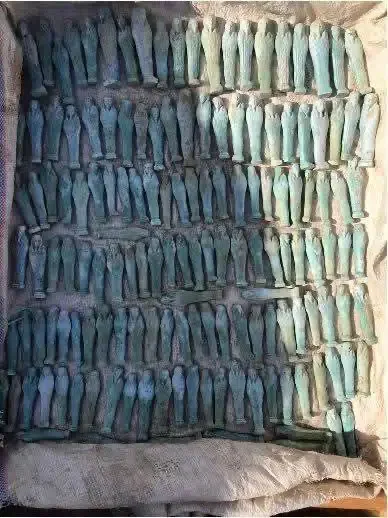
The discoveries included gold tongues and lamellae, earrings, a gold pendant, and amulets, along with a large number of statues. Some ceramic coffins featured human-like faces with a caricature style, while others took an explicit anthropomorphic form. However, some of the discovered burials suffered damage due to looting and quarrying activities that occurred in the area in previous periods. (End) A.F.F / A.M.S
