Minister of (Electricity) confirms importance of International Conference on (Energy Research) in developing systems, supply security and economic efficiency
Press coverage 2 newspapers covered this event: Al-Jarida · Kuwait News →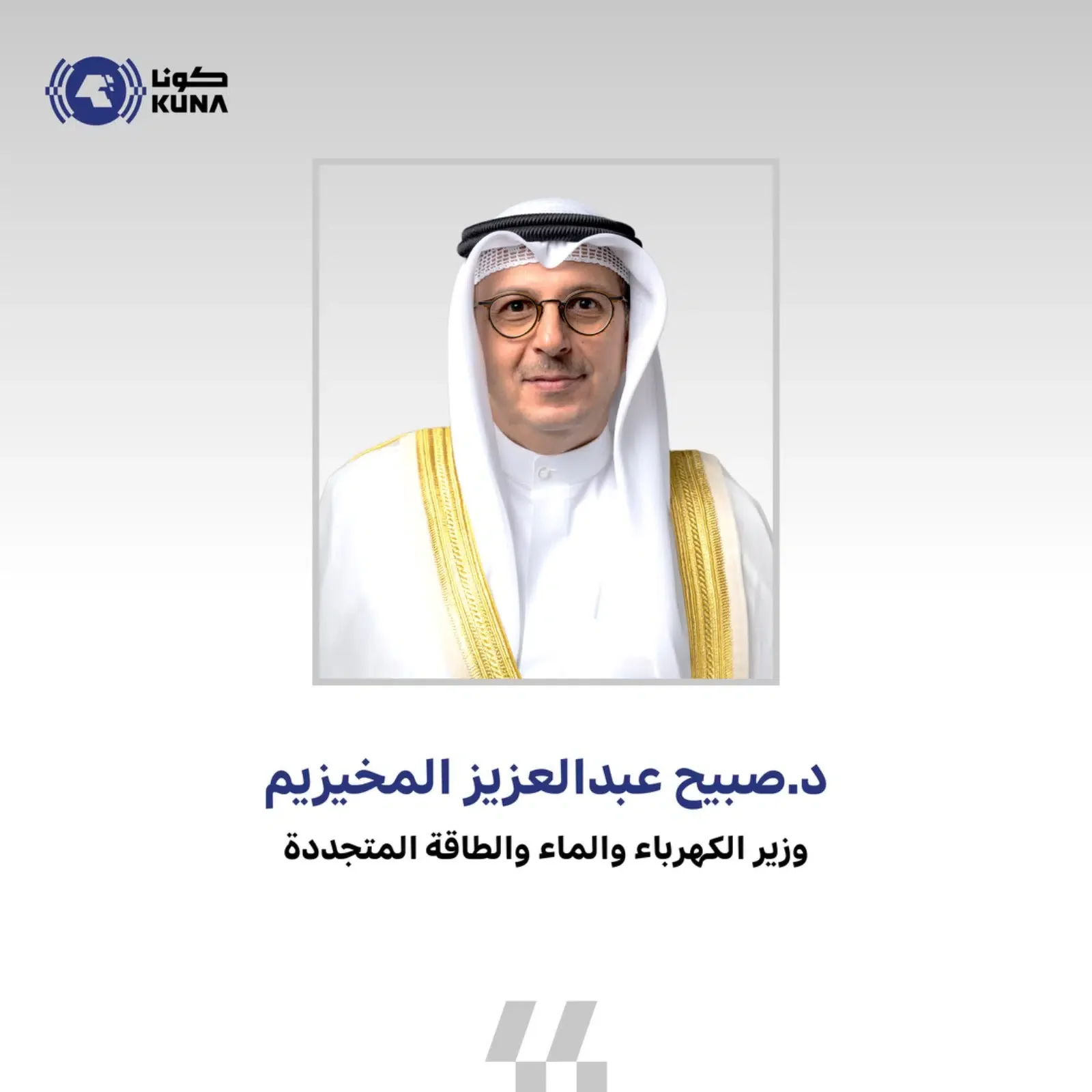
صورة: وكالة الأنباء الكويتية (كونا)
Minister of Electricity and President of Kuwait University participate in the 9th International Conference on Energy Research
Translated by Alqyas from KUNA — Original source
Kuwait – Dr. Subaih Al-Muhezeim, Minister of Electricity, Water and Renewable Energy, emphasized the importance of the Ninth International Conference on Research and Development in Energy, noting that it comes at a time when the need to develop energy systems and achieve a balance between supply security, economic efficiency, and environmental sustainability is growing.
Speaking on behalf of His Highness Sheikh Ahmad Abdullah Al-Ahmad Al-Sabah, the Prime Minister and patron of the conference, which launched today, Tuesday, at Sabah Al-Salem University City, Minister Al-Muhezeim stated that the Ministry of Electricity, Water and Renewable Energy is committed to developing the electricity and water systems, increasing their production capacities, and enhancing their reliability to meet the country’s needs and support its development projects. He described this responsibility as requiring long-term planning, investment in infrastructure, and the application of scientific research to find practical, implementable solutions.
He explained that the conference’s themes reflect this interconnectedness, ranging from energy conversion, management, and conservation, to fuels and their alternatives, energy storage, energy policies, and planning, extending to renewable energy technologies, emerging technologies, efficiency in generation, air conditioning, and cooling systems, as well as plant and facility safety.
He highlighted the Ministry’s particular interest in renewable energy projects, foremost among them the Shagaya project, which is considered a strategic initiative for diversifying electricity generation sources and enhancing sustainability. The combined production capacity of the first and second phases of the project amounts to 1.6 million megawatts, while the combined capacity of the third and fourth phases reaches 3 million megawatts. Additionally, efforts are underway to improve the operational efficiency of plants and networks, develop control systems and smart services, and enhance demand management and consumption conservation.
For her part, Sarah Maston, President of the American Society of Heating, Refrigerating and Air-Conditioning Engineers (ASHRAE), expressed her pleasure at participating in the conference on behalf of the society, adding that energy “touches almost every part of our lives and supports our economies, industries, and communities.” She noted that as energy demand continues to rise, there is an increasing need to rethink how we produce, use, and manage our resources, pointing out developments in air conditioning, renewable energy integration, and system improvements.
Maston stated that these technologies “create new opportunities but also challenge us to think differently, and we need new ideas and modern technologies. Working on how to implement them is what we hope to explore at the conference through research presentations, expert speakers, and discussions with policymakers.”
On her part, Dr. Dina Al-Milhim, President of Kuwait University, expressed appreciation and pride over the patronage of His Highness Sheikh Ahmad Abdullah Al-Ahmad Al-Sabah, Prime Minister, for the conference, noting that it reflects the political leadership’s interest in education and scientific research under the presence of His Highness the Amir of Kuwait, Sheikh Meshal Al-Ahmad Al-Jaber Al-Sabah, may God protect him, and His Highness the Crown Prince, Sheikh Sabah Khaled Al-Hamad Al-Sabah, may God protect him, as well as their commitment to enabling academic and research institutions to contribute to the progress of Kuwait and achieve its development aspirations.
Al-Milhim stated in her speech that energy constitutes the foundation of economic security, growth, and quality of life, which requires meeting its needs efficiently while preserving resources, the environment, and the future of coming generations.
She highlighted the significance of this for Kuwait, given that approximately 70 percent of its electricity consumption is linked to air conditioning systems. Accordingly, the conference will discuss diversifying energy sources, ensuring supply reliability, reducing consumption and emissions, while maintaining a comfortable living environment. She noted that the three-day conference, with broad international participation, “continues a scientific journey spanning 27 years, during which the conference is held every three years to exchange knowledge and expertise and to anticipate the future of energy.” She pointed out the collaboration with the American Society of Heating, Refrigerating and Air-Conditioning Engineers (ASHRAE), and the participation of academic and research institutions, government entities, and the private sector, welcoming participants and scholars from within Kuwait and abroad. She further noted that this year’s conference coincides with Kuwait University’s celebration of its 60th anniversary, “a journey during which the university has contributed to preparing generations of national cadres, advancing scientific research, and serving society.” Al-Milhem expressed optimism about embarking on a new phase, “in which we will continue our efforts to further develop education, direct scientific research toward national priorities, keep pace with global scientific and technological developments, and contribute to them.”
For his part, Dr. Osama Al-Yousef, chairman of the Supreme Organizing Committee of the conference, said the conference will cover a wide range of topics over three days, including energy conservation, conversion, and management, renewable energy technologies and storage, air conditioning and refrigeration systems, energy policies and planning, energy, environment, and sustainable development, as well as facility safety and emerging technologies. Al-Yousef added that the conference program combines peer-reviewed scientific papers, lectures by a select group of invited experts, a panel discussion to outline research priorities in the sustainable use of energy, and a panel on the future of engineering education in the Gulf Cooperation Council countries, in addition to an exhibition showcasing the latest innovations by energy companies in Kuwait and the Gulf. He emphasized that all of this aligns with the “New Kuwait 2035” vision.
He explained that “the goal of our conference is to improve the use of energy resources in the sectors that consume the most, in the arid regions of the Arabian Peninsula. We live in an environment where summer temperatures exceed 50 degrees Celsius, and air conditioning accounts for the largest share of electricity consumption. This makes relying solely on imported solutions insufficient, and local scientific research becomes an imperative, not an option.”
It is worth noting that the Sabah Al-Salem University City was designed according to sustainability and green architecture standards, including central cooling with nighttime thermal storage, solar water heaters, and the reuse of treated wastewater in irrigation systems, making the city itself a living laboratory that supports the conference’s themes. The conference is organized through the efforts of several entities, most notably the College of Engineering and Petroleum, the international partner ASHRAE, the Kuwait Institute for Scientific Research, the Public Authority for Applied Education and Training, Abdullah Al-Salem University, and supporting sponsors from the government and private sectors. (End) A.S.A./A.N.D.
