UN official: Developing state institutions in Syria requires strengthening political participation and accountability
صورة: وكالة الأنباء الكويتية (كونا)
UN officials focus on political participation and the humanitarian crisis in Syria
Translated by Alqyas from KUNA — Original source
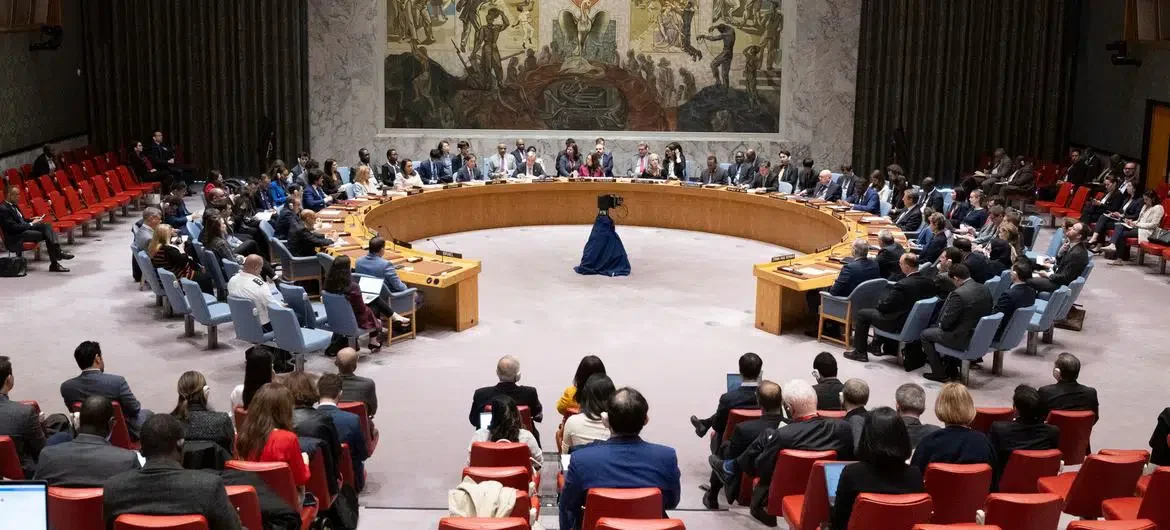
New York, November 16 (KUNA) -- Claudio Cordone, the Deputy Special Envoy of the UN Secretary-General to Syria, affirmed today that progress in building state institutions must be accompanied by concrete steps in political participation, accountability, economic recovery, and reconstruction, benefiting all Syrians. He made these remarks during a virtual briefing from Damascus before a session of the UN Security Council on the situation in Syria, stating, “As the country approaches the second anniversary of the fall of Bashar al-Assad’s regime, significant efforts are being made, but more work is needed to ensure the success of the transition process.”
He outlined three main priorities before the Council: (political transition and recovery), (economy and reconstruction), and (stability and security). Regarding political transition, Cordone considered the establishment of the interim People’s Council a key milestone in the transition phase, noting strong public expectations for the council to play an active role in developing legislative practices and enhancing public accountability. He stressed the necessity of preparing to draft a permanent constitution and holding credible, inclusive elections, which requires establishing clear mechanisms and specific timelines, while ensuring the full and equal participation of women and the involvement of civil society in the political process.
On the economic front, Cordone emphasized that accelerating economic recovery is crucial for the stability of the transition phase, warning that regional instability could negatively impact reconstruction efforts and improvements in living conditions. He welcomed new commitments made by regional partners this month and urged that aid and investments be directed in line with national priorities, contributing to improved services, job creation, and livelihoods, while ensuring the participation of women and affected communities in determining recovery priorities.
On security matters, the UN official referred to the continued implementation of the January 29 agreement in northeastern Syria, affirming that its sustainability requires progress in the integration process and addressing issues related to Kurdish representation, linguistic and educational rights, and participation in state institutions. He expressed concern over the ongoing stalemate and tense security and political situation in the southern province of Sweida.
In a related context, Cordone condemned the continued Israeli military activities that violate Syria’s sovereignty and territorial integrity, including incursions, the establishment of temporary checkpoints, arrests, airstrikes, land clearing, and damage to agricultural and water infrastructure. He reiterated the UN Secretary-General’s call to put an end to violations of the 1974 Disengagement Agreement, fully respect Syria’s sovereignty and territorial integrity, and work to address the issue of Syrians detained by the Israeli occupation.
For his part, Mohammed Yahya, UN Assistant Secretary-General for Humanitarian Affairs and Deputy Emergency Relief Coordinator, noted that Syria is showing tangible signs of progress despite the persistence of massive humanitarian needs, stressing the importance of seizing the opportunity to support recovery efforts and rebuild the country. In his briefing to the Council, Yahya explained that approximately 60,000 additional internally displaced persons have returned to their homes since last October, two-thirds of them from camps, alongside the return of about 18,000 other refugees.
He warned that a return does not mean the end of humanitarian needs, pointing out that explosive ordnance remains one of the most prominent obstacles to safe and sustainable return. Since the Council’s previous briefing last month, it has killed at least 30 people, including 19 children, and injured more than 80 others, including 35 children. He added that approximately 4.2 million people will require additional assistance as winter approaches, while around 200,000 displaced persons and returnees are living in damaged shelters that do not provide adequate protection from the cold. On the health front, Yahya warned of the challenges posed by the discovery of poliovirus, noting that the Syrian Ministry of Health, with support from the World Health Organization, the United Nations Children’s Fund (UNICEF), and other partners, has managed to vaccinate more than 34,000 children. He stressed that vaccination campaigns alone are insufficient to address health risks, given that routine immunization programs have been damaged by years of conflict. Yahya called on the international community to double its efforts to support the humanitarian response in Syria and to provide the necessary funding to protect millions of Syrians and help them rebuild their lives, despite the severe pressures facing humanitarian organizations due to funding shortages. (End) A.S.T./R.J.
