Yemeni House of Representatives unanimously approves designation of Houthis as a terrorist organization
Press coverage 1 newspapers covered this event: KUNA →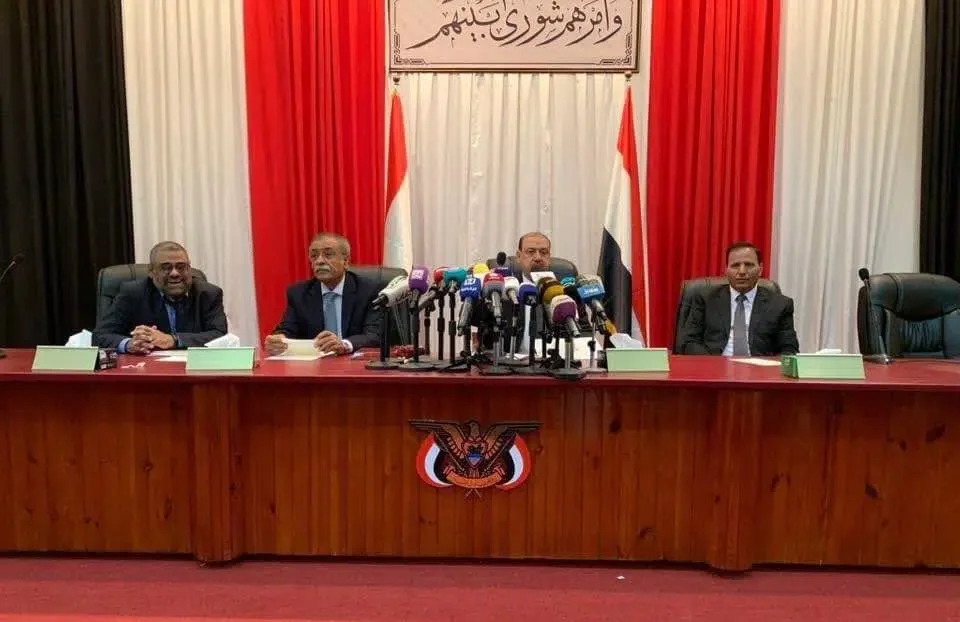
صورة: وكالة الأنباء الكويتية (كونا)
The Yemeni House of Representatives unanimously approved a bill to designate the Houthi militia as a terrorist organization and criminalize its activities and financing.
Translated by Alqyas from KUNA — Original source
Aden, Nov 16 (KUNA) -- The Yemeni House of Representatives unanimously approved on Monday the final version of a bill classifying the Houthi militia as a “terrorist organization,” criminalizing its activities and financing, paving the way for its submission to Rashad al-Alimi, Chairman of the Presidential Leadership Council, for issuance.
The state-owned Yemeni News Agency (Saba) reported that the approval came during a meeting of the House held via video conference, chaired by Speaker Sultan al-Barakani, and attended by Ministers of Legal Affairs Ishraq al-Maqatari and State Minister for the Affairs of the House of Representatives and Shura Council Abdullah Abu Hawriya, Chief of Staff of the General Staff and Member of the House of Representatives Brigadier General Siwar bin Aziz, and the Inspector General of the Ministry of Interior Dr. Faiz Ghallab.
The House affirmed that the approval of the bill comes after exhausting peace opportunities and political options, amid the continued escalation of the terrorist Houthi militia’s attacks and assaults on citizens in various areas, including the siege imposed on the city of Taiz and the shelling of its residential neighborhoods, as well as attacks on the governorates of Lahij and Marib, the city of Aden, the Western Coast, and Al-Jawf.
It noted that the Houthi militia has exceeded Yemen’s borders by targeting Saudi Arabia, its economic facilities, its safe cities, and Islamic holy sites in Makkah al-Mukarramah and Al-Madinah al-Munawwarah, while threatening navigation in the Red Sea, the Gulf of Aden, and the Bab al-Mandab Strait.
The bill consists of 55 articles distributed across nine chapters, stipulating the “classification of the group as a terrorist organization, a rebel faction, and those spreading corruption in the land, across all its political, military, and civil organizations and formations,” and specifying the legal consequences thereof, as well as the crimes, penalties, and necessary measures to prosecute those involved, cut off funding sources, and halt arms supplies.
The bill criminalizes coups against state institutions, sieges of cities, starvation of populations, targeting of civilians, public facilities, private property, roads, laying of landmines, recruitment of children, kidnapping, enforced disappearance, attacks on international navigation, and the financing and arming of the group.
It also prohibits incitement to and promotion of ideas of tribal supremacy, racism, and sectarianism, and imposes severe penalties, including the death penalty, for crimes and situations specified therein.
The bill regulates the establishment of a permanent technical unit within the Office of the Public Prosecutor to collect information and prepare files related to the group and its affiliated entities, track their funds and assets, and seize, freeze, confiscate, and recover them in accordance with the law.
The House emphasized that the approval of the bill represents a national and constitutional obligation to confront the group’s crimes and violations, uphold the rule of law, and secure justice for victims. It called on the international community to take practical measures to counter the group’s activities, cut off its funding and arms supplies, and protect regional security and international navigation. (End) S.N.S./H.S.S.
